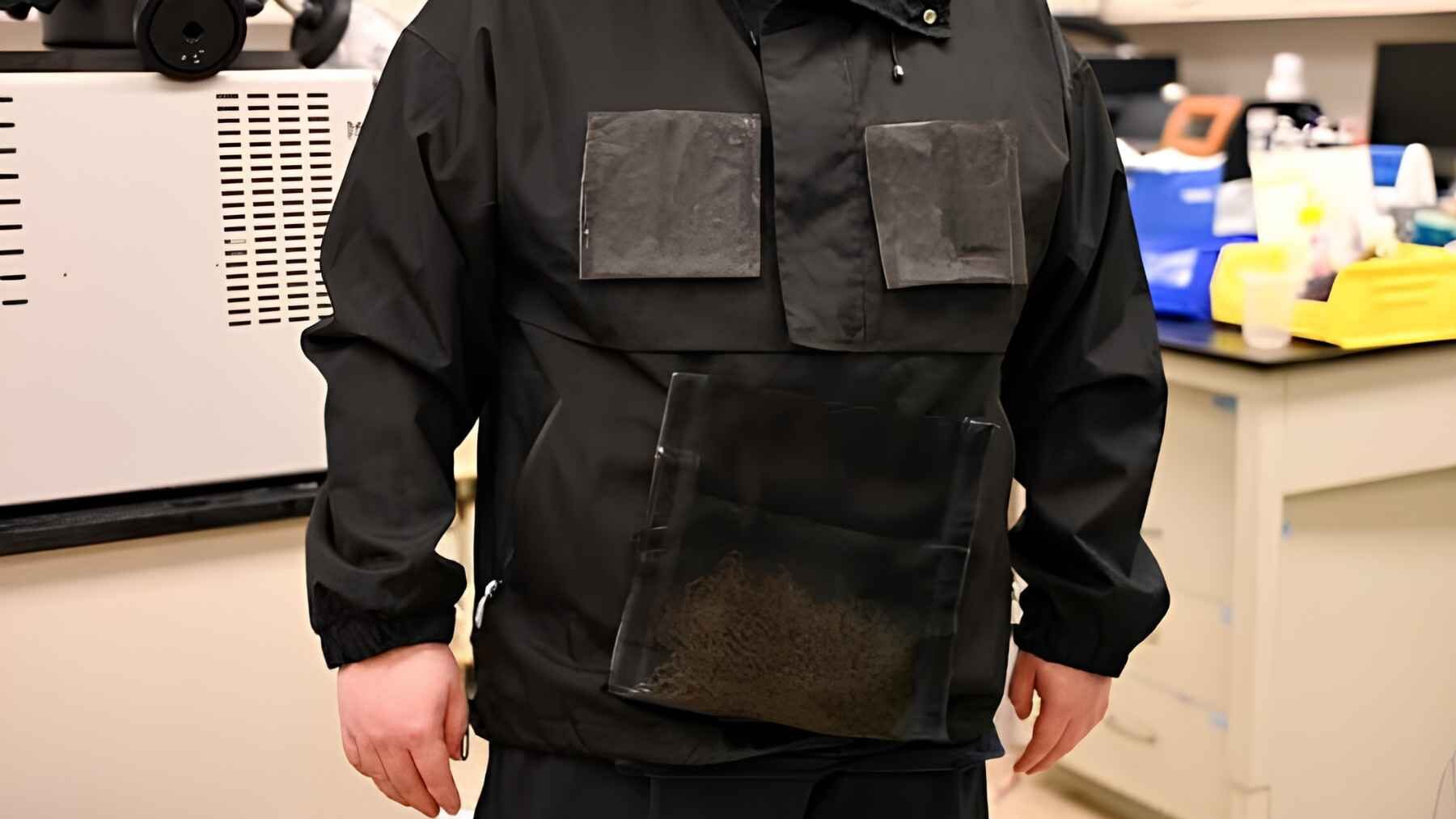
A jacket that helps fill a water bottle sounds like camping gear from a science-fiction movie. However, engineers at The University of Texas at Austin have built a working prototype that pulls moisture from the air and turns it into drinking water, producing about 14 to 30 fl oz. per day depending on humidity. This is not enough to replace a faucet, but it could become a useful backup for hikers, emergency crews, soldiers, and outdoor workers far from a reliable water source.
The idea lands at a serious moment. In 2024, 2.1 billion people still lacked safely managed drinking water, according to WHO and UNICEF. A wearable water harvester will not solve that crisis by itself, yet it points to a smaller, more personal kind of water technology.
Water from air
Air contains water vapor even when the sky looks dry. Atmospheric water harvesting is the process of capturing that vapor, concentrating it, and turning it into liquid water.
Anyone who has seen drops form on a cold glass has seen the basic idea. The difference here is that the Texas team is using engineered fabric, not a chilly cup on a kitchen table.
A jacket with working fibers
The prototype uses hydrogel textile fibers. A hydrogel is a water-loving material that can absorb moisture like a super sponge, then release it when heated.
The key is movement. The fabric does not just soak up humidity and sit there. It helps guide the captured moisture into small detachable units that can later be removed and processed.
Why the fabric matters
Many water-harvesting materials look promising in a lab, then struggle when they are scaled up. A tiny sample can behave beautifully, while a real jacket has to bend, breathe, and keep working outside.
Chuxin Lei and Guihua Yu helped develop a hierarchical fiber design, meaning the material has pathways at different scales to move water faster. That is why the jacket is not just a new fabric, but a new way to package water collection into something a person can wear.
Sunlight finishes the job
After the fabric captures moisture, the detachable units are placed inside a foldable collector and heated. That heat makes the hydrogel release the water, which can then condense into liquid form.
This matters significantly; if sunlight can do much of the work, users do not have to carry a heavy battery pack or add another device to the electric bill when the technology is used in larger gear.
What it can really deliver
In testing, the jacket made about 14 to 30 fl oz. of drinkable water per day. That is a helpful reserve, not an all-day supply.
For comparison, a 2021 Nature analysis of solar water harvesting used about 169 fl oz. per person per day as a drinking-water target, meaning the jacket is best understood as a backup canteen, not a replacement for wells, pipes, treatment plants, or bottled supplies.
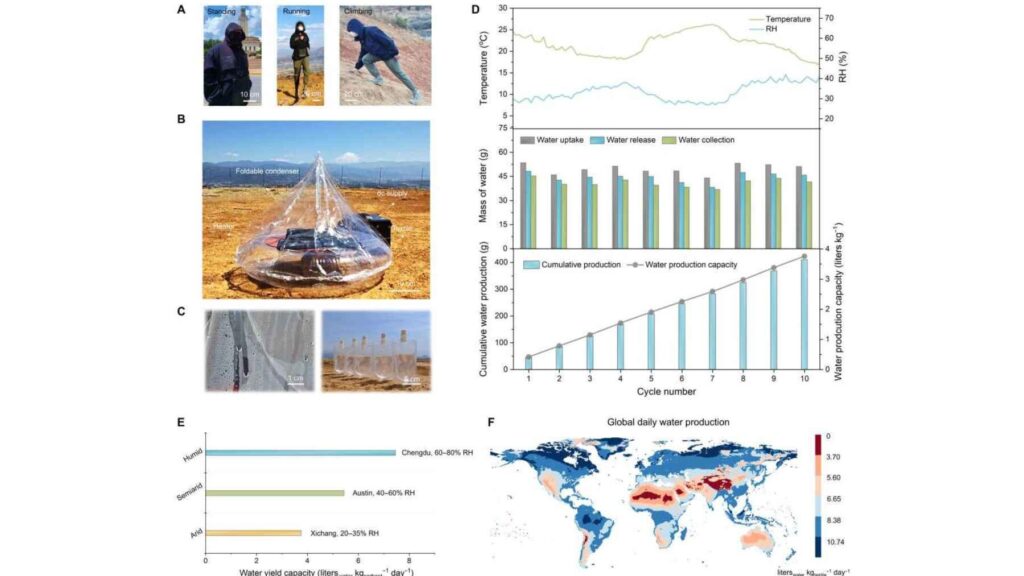
Research figures illustrate the hydrogel-based wearable water harvesting system, showing how the textile captures moisture from the air, releases drinking water through solar heating, and performs under different environmental conditions.
Small amounts still matter
Still, small amounts can make a difference. A camper who misjudges a trail, a field worker in that sticky summer heat we all know, or an emergency responder working after a storm may not need a full household water system in the moment.
They may need time. An extra 30 fl oz. could help bridge the gap until a safer source is reached.
Beyond one jacket
The same concept could move into backpacks, tents, emergency shelters, tarps, and other outdoor equipment. A tent that quietly gathers water while people sleep sounds unusual, but it follows the same logic.
That is where the story gets bigger. Clothing may simply be the easiest way to show how decentralized water collection could become part of everyday gear.
A broader research push
The jacket also fits into a larger research effort around hydrogels and solar water collection. In 2019, the same research community at UT Austin reported solar-powered hydrogel materials that could absorb moisture from air and release clean water when warmed.
A related Nature Water paper led by Weixin Guan described a field-portable, solar-powered device tested in Austin and the Chihuahuan Desert. It delivered about 44 fl oz. in Austin and continued working under cloudy conditions, which is important because real weather rarely behaves like a perfect lab test.
Where it could help
The best regions for this kind of technology are not necessarily the driest places on Earth. The system still needs enough moisture in the air, so semi-arid and humid water-stressed regions may be stronger candidates.
Parts of North Africa, the Middle East, South Asia, and sub-Saharan Africa are among the areas researchers see as promising. On the other hand, experts would likely treat this as a complement to water infrastructure, not a substitute for it.
What comes next
The university’s commercialization unit has filed a patent application, which suggests the team is looking beyond a one-off prototype. The road from the lab jacket to the store shelf can be long, however.
Cost, durability, cleaning, taste, safety testing, and performance in many climates will all matter. At the end of the day, what this jacket is trying to do is simple enough to understand, even if the materials are advanced.
The official study has been published in Science Advances.