What if one of our most unusual prehistoric relatives survived not by hunting giants, but by waiting for giant lizards to finish eating? A new analysis suggests Homo floresiensis, the small human relative nicknamed the “hobbit,” probably scavenged meat from Stegodon carcasses first opened by Komodo dragons. The findings also weaken the case that these islanders regularly used fire.
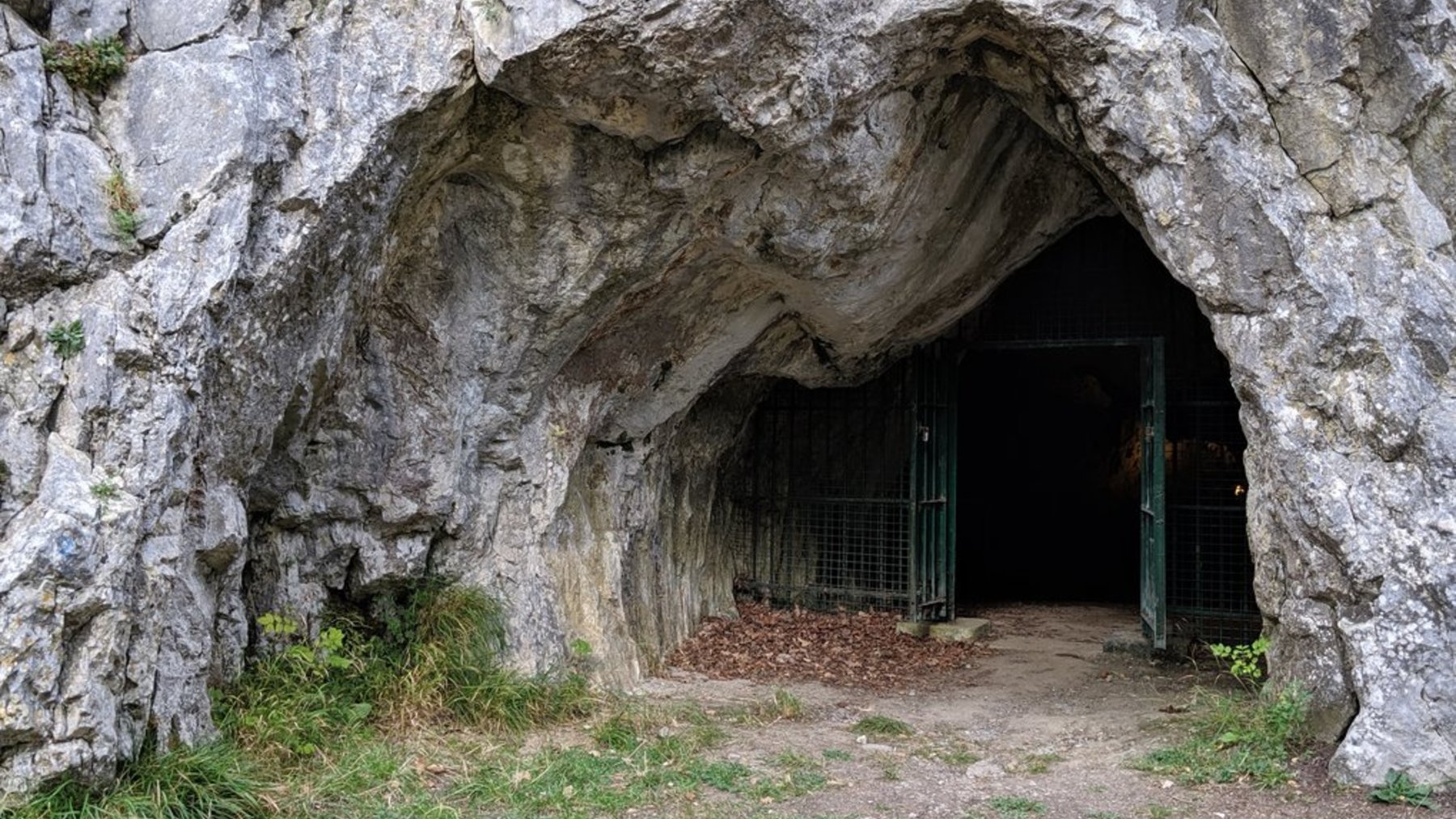
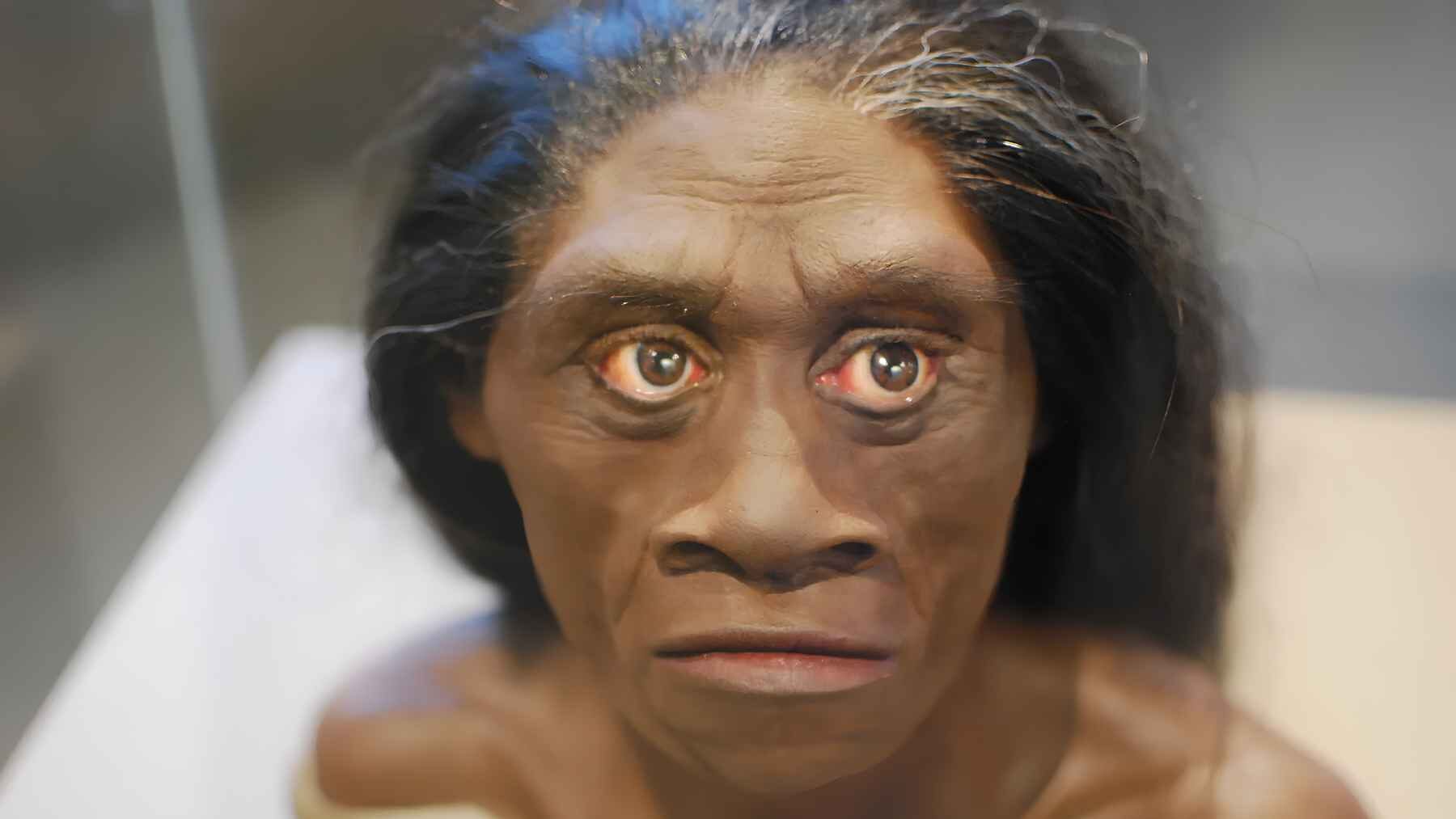
That is a major change from the story told after the species was discovered in 2003 at Liang Bua cave on the Indonesian island of Flores. Homo floresiensis stood about 3.5 ft. tall, with a skull roughly the size of a grapefruit and a brain only slightly larger than a chimpanzee’s. Yet stone tools and animal bones nearby made the hobbits look like surprisingly capable big-game hunters.
The hunter story unravels
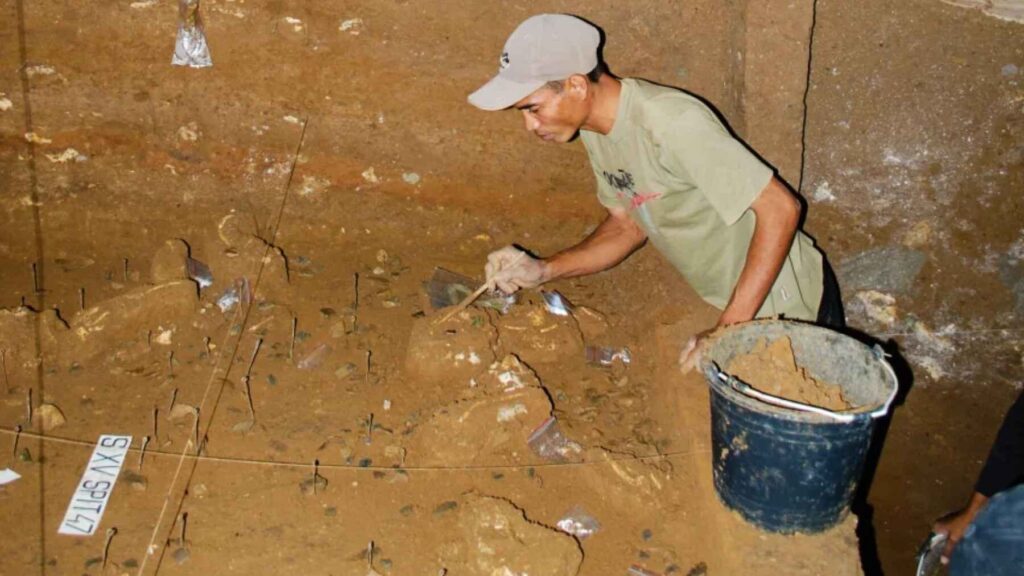
Archaeologists found thousands of stone artifacts beside bones from Stegodon florensis insularis, an extinct elephant relative that weighed about 1,260 lbs. and stood roughly 5 ft. at the shoulder, and some bones appeared to carry cut marks. At the time, the simplest explanation seemed obvious: the hobbits had killed and butchered the island’s largest plant-eater.
A few smaller animal bones also looked burned, raising the possibility that Homo floresiensis controlled fire and cooked food. Those abilities are often associated with larger-brained hominins such as Homo erectus, Neanderthals, and Homo sapiens; but bones, tools, and fossils lying in the same cave layer do not automatically prove they were part of the same meal.
A Komodo dragon provides the clue
Paleoanthropologist Elizabeth Grace Veatch, affiliated with the University of Tübingen and the Smithsonian’s National Museum of Natural History, wanted to test the hunting claim directly. Her team used taphonomy, the study of what happens to a body after death, to reconstruct who reached the Stegodon carcasses and in what order. “I wanted to see if we really could show that H. floresiensis was the hunter that it had been portrayed as for decades,” she said.
The investigation took the researchers to Zoo Atlanta, where a Komodo dragon named Rinca fed on a goat carcass. They collected the remaining bones, examined the tooth damage, and made three-dimensional scans. Those marks were then compared with more than 3,100 Stegodon fragments from Liang Bua and with cuts made experimentally by stone tools.
The dragons appear to have eaten first
The pattern was hard to ignore. Komodo tooth marks appeared most often on meat-rich areas around the shoulders and hips, while stone-tool cuts clustered on poorer sections such as the skull, spine, ribs, and feet. The ancient bones also lacked impact damage expected from spears or other projectile weapons.
That suggests the dragons had first access and the hobbits arrived later to remove whatever tissue remained. This was still purposeful behavior. Homo floresiensis made tools and knew how to use them, but the evidence points to scavenging rather than routine big-game hunting.
Would venom in the carcass have made that meal dangerous? The researchers argue that venom proteins would likely have been broken down by digestive enzymes. Still, because the dragons took the richest portions first, exactly how much food remained for the hobbits is uncertain.
The missing campfires
The fire evidence also faded under closer inspection. The team examined nearly 7,000 rodent remains, including more than 4,200 from sediment linked to Homo floresiensis, and found no signs of heating in those older layers. Burned rodent bones appeared only in younger layers associated with Homo sapiens.
Only one Stegodon rib fragment among more than 3,000 pieces appeared burned, and the researchers think it was heated much later. Most likely, the meat was eaten raw. The study does not prove that no hobbit ever used fire anywhere on Flores, but it finds no convincing evidence for controlled fire at Liang Bua during their occupation.
A different kind of survival
Coauthor Briana Pobiner argues that the hobbits may have combined scavenged meat with plants, insects, and smaller animals. Living in groups and keeping a wary distance from Komodo dragons may have been enough to avoid becoming prey themselves. It sounds precarious, but the strategy appears to have worked for tens of thousands of years.
Earlier research on thousands of rat bones found that the area around Liang Bua was largely open grassland more than 100,000 years ago, then became more forested around 60,000 years ago. The hobbits, Stegodon, giant birds, and Komodo dragons all disappear from the cave record around that transition. The changing landscape may have disrupted the food web that made scavenging possible.
A new question for the human family tree
A simpler survival toolkit could support the idea that Homo floresiensis came from an early branch that split before hunting large animals and controlling fire became common in later humans. Chris Stringer of London’s Natural History Museum, who was not involved in the study, said the results strengthen the possibility that the species was closer to Homo habilis or Australopithecus than to Homo erectus. The findings add behavioral evidence to that minority view, but they do not settle the ancestry debate.
In fact, a 2024 study of roughly 700,000-year-old arm and tooth fossils from Mata Menge on Flores reached a different conclusion. Their anatomy appeared closer to early Asian Homo erectus and suggested that extreme body shrinkage happened after hominins became isolated on the island. Behavior and ancestry can point in different directions, which is why one new bone analysis cannot redraw the family tree by itself.
For the most part, the study replaces a dramatic big-game hunting scene with a more grounded picture of adaptation. The next step is to test bones from other animals and learn how much of the island’s menu Homo floresiensis actually used.
The full study was published in Science Advances.