
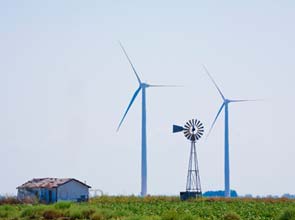
The United States’ installed wind capacity recently hit 40,180 megawatts or over 40 gigawatts, representing 15 percent increase from 35,600 MW at the start of 2010 according to the quarterly report of the American Wind Energy Association.
About 5,115 MW of new wind capacity was installed in 2010. Texas retained its position as the country’s leading wind energy state with a cumulative capacity of 10,085 MW by the end of the year. Texas makes up about 25 percent of all wind capacity in the country.
Iowa follows with 3,675 MW while California is third with 3,177 MW. Minnesota and Washington completed the top five roster with 2,192 MW and 2,105 MW, respectively.
Other states that actively pursued wind power development were Illinois with 498 MW capacity added and South Dakota with 396 MW.
Delaware and Maryland installed their first utility-scale wind turbines, bringing the number of states with utility-scale wind projects to 38, 14 of which have installed over 1,000 MW of wind power.
This year, the wind association said the United States expects slight growth, at 5,600 MW of new capacity, primarily driven by a one-year extension of the 1603 Investment Tax Credit for renewable energy.
The support corresponds to $3 billion from the federal budget being earmarked for clean energy development.
More projects to break ground
The association said more projects will start building to meet the new construction deadline for the tax credit scheduled to expire by yearend.
Elizabeth Salerno, director of the association’s industry data and analysis, cited wind’s long-term price stability against natural gas as another driver for further growth in the coming years.
“Wind’s costs have dropped over the past two years with power purchase agreements being signed in the range of 5 cents to 6 cents per kilowatt-hour recently. We expect that utilities will move to lock in more wind contracts, given the cost-competitive nature of wind in today’s market,” said Ms. Salerno.
The association recommends the creation of more long-term, predictable federal policies to address the boom-bust cycle the industry is currently experiencing.
“Now that we’re competing with natural gas on cost, we need consistent federal policies to ensure we have a diverse portfolio of energy sources in this country and do not become over-reliant on one source or another,” said Denise Bode, AWEA chief executive.
United States wind trails China, which has 41,800 MW of wind capacity – a 62 percent improvement from its 25,800 MW capacity in 2009 – according to a January 13 report from the Chinese Renewable Energy Industries Association.
United States, formerly the world’s largest wind power producer, only had 2,578 MW capacity in 2000 but steadily grew to 6,725 MW by 2004, data from the Global Wind Energy Council show. In 2007, the United States had 16,824 MW of wind capacity that escalated to 25,237 MW by 2008.