
Solar cells of the future could use graphene as a transparent contact layer.
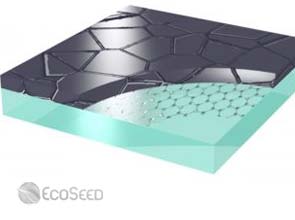
Researchers at the Helmholtz-Zentrum Berlin fur Materialien und Energie have found that grapheme retains certain properties valuable to solar cells even when coated with silicon. They remain extremely conductive and completely transparent while being inexpensive and nontoxic.
“We examined how graphene’s conductive properties change if it is incorporated into a stack of layers similar to a silicon based thin film solar cell and were surprise to find these properties actually change very little,” explained Marc Gluba.
Mr. Gluba and his research partners described their work with graphene sheets in solar cells in the recently published Applied Physics Letters Vol. 103, 073102 (2013).
They grew graphene on a thin copper sheet which they then transferred onto a glass substrate. The entire thing was then coated with a thin film of silicon. They then used this as a contact layer in two conventional versions of thin-film silicon solar cells.
One sample contained an amorphous silicon layer, while the other contained poly-crystalline silicon. Even though the morphology of the top contact layer changed as a result of being heated by the sun hitting it, the graphene remained detectible.
The devices with the graphene layer also showed a high mobility of charge carriers conducting electrons through the solar cell. Charge carrier mobility within the embedded graphene layer is roughly 30 times greater than the conventionally used zinc oxide based contact layers.
«That’s something we didn’t expect to find, but our results demonstrate that graphene remains graphene even if it is coated with silicon,» says Norbert Nickel who also worked on the study.
While there still remain some challenges in manufacturing the thin contact layers of graphene, the researchers believe that it will have tremendous benefits in developing the thin-film solar cells of the future. – EcoSeed Staff