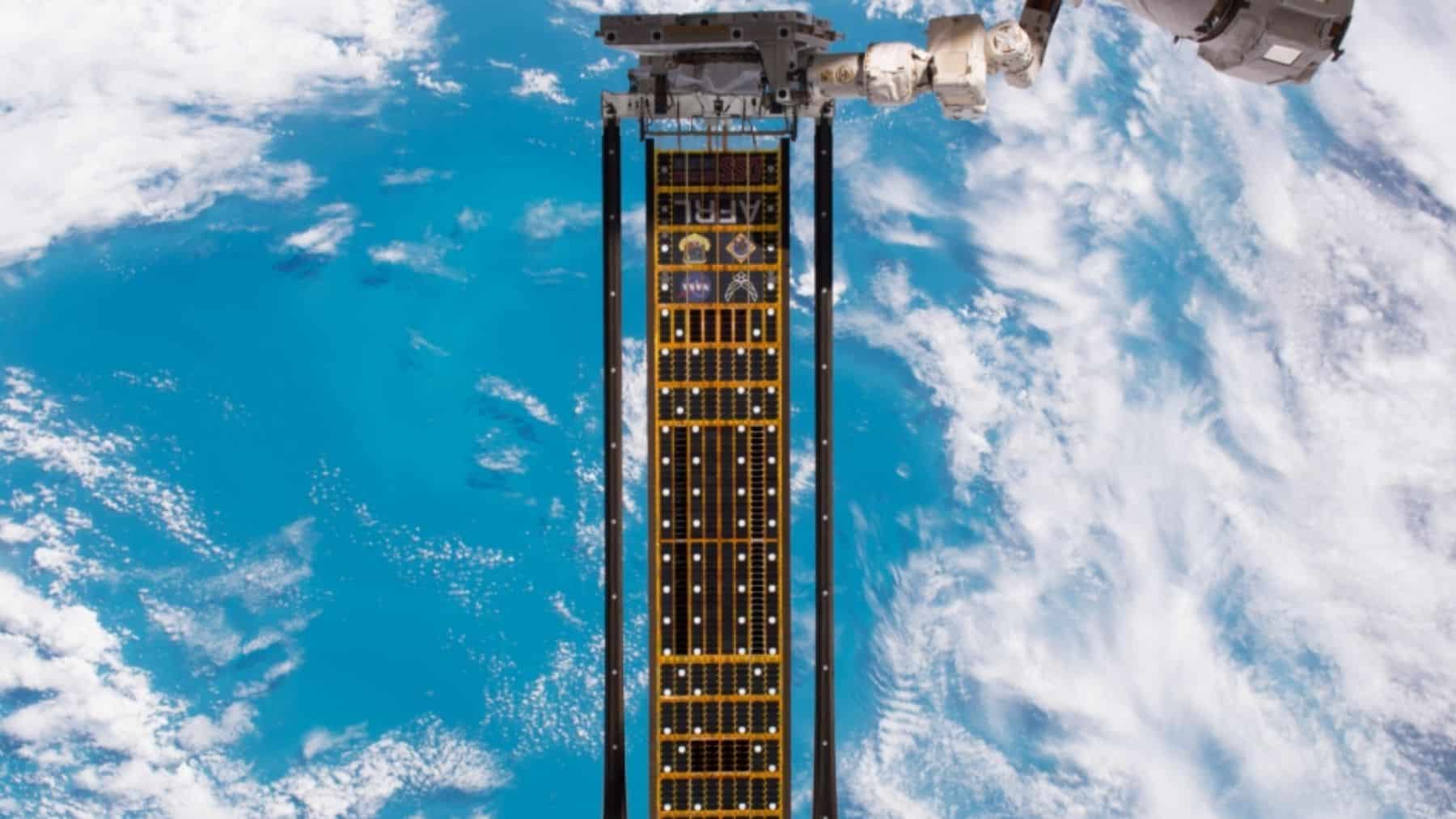
A “super solar panel” is said to be 400km above the Earth’s surface and is transforming how we choose to generate power for all future space missions. While generating power for missions that extend beyond Earth has always been a focal point, the solution may finally be in the pipeline. Currently being tested in space, this novel innovation is offering the promise of being able to generate about 120 kilowatts of electrical power for the International Space Station (ISS). This incredible super solar panel is also known as IROSA (ISS Roll-Out Solar Array) and is perhaps one of the most powerful solar systems up in space.
Looking at the solar wings that are said to be superior
It must be mentioned that Redwire Corporation, in partnership with Boeing’s Spectrolab, has recently offered the fourth pair of solar wings that is, at present, already undergoing testing in space. ROSA (Roll-Out Solar Array) technology, developed by Redwire, is central to the IROSA system. Redwire’s ROSA technology was already successful in powering NASA’s DART spacecraft. Offering the promise to power NASA’s Gateway Program, too, the eight solar wings must be given full credit.
Every one of the eight wings, including the latest fourth pair, promises to generate over 20 kW of power, offering a combined power output of 120 kW. The solar panels are said to be superior compared to the more aged and archaic panels that have experienced years of wear and tear. Aside from being promising, ROSA is a lightweight solar panel that offers incredible performance at a lower launch mass. Posing less of a chance for failure and an attractive weight, what could possibly go wrong?
CEO of Redwire, Peter Cannito, is convinced that the ROSA-powered IROSA system will ensure sustained human activities in space. His affirmation makes it clear that these are surely superior solar panels.
What happens after the testing period?
At present, the fourth pair of IROSA wings that was delivered early in January 2025 is being tested under extreme conditions, including being exposed to hot and cold temperatures. The next step will see the launch of a resupply mission, more or less in late 2025 or early 2026. The initial three IROSA pairs were launched and installed between 2021 and 2023. The third pair, initially believed to be the final pair, was installed in June 2023.
The need for more power led to the fourth pair being launched and installed earlier this year. These arrays will offer power and ensure that the ISS continues to operate at full capacity. This building is said to be the highway to Mars and, as such, offers much promise for the future, while perhaps revolutionizing future space missions in its entirety.
The technology is forward-thinking
The success of ROSA will be effective for the next-generation space habitats, lunar bases, and missions between planets.
Both Boeing and Redwire note that IROSA will ensure power infrastructure in space, with more and more commercial space stations taking shape. About $35 million has already been invested in the latest pair of wings, making ROSA the core platform, ensuring high-output solar energy in orbit at the moment.
The time has come when powering space habitats has become as essential as launching them. ROSA is taking the lead in terms of ensuring that space habitats are powered. A space-powered future is now somewhat imaginable, and it is all thanks to the super solar that is 400km above the Earth, offering 120 kW of clean energy. While ROSA technology seems to be reigning supreme, the focus cannot fall too far away from Musk and Trump’s Mars revolution. Whether NASA’s priorities will change is yet to be seen; however, our attention has surely drifted beyond Earth and towards Mars.