Modular construction is attracting more and more people (even young people, as we saw this week). However, some still reject it as unstable, a myth that we will demolish with this concrete prefab house that can be yours for only $160k. Imagine living among seven modules and with a swimming pool… floating (yes, as you read it).
This prefab house arrives from the other side of the Atlantic and is ready in 7 days.
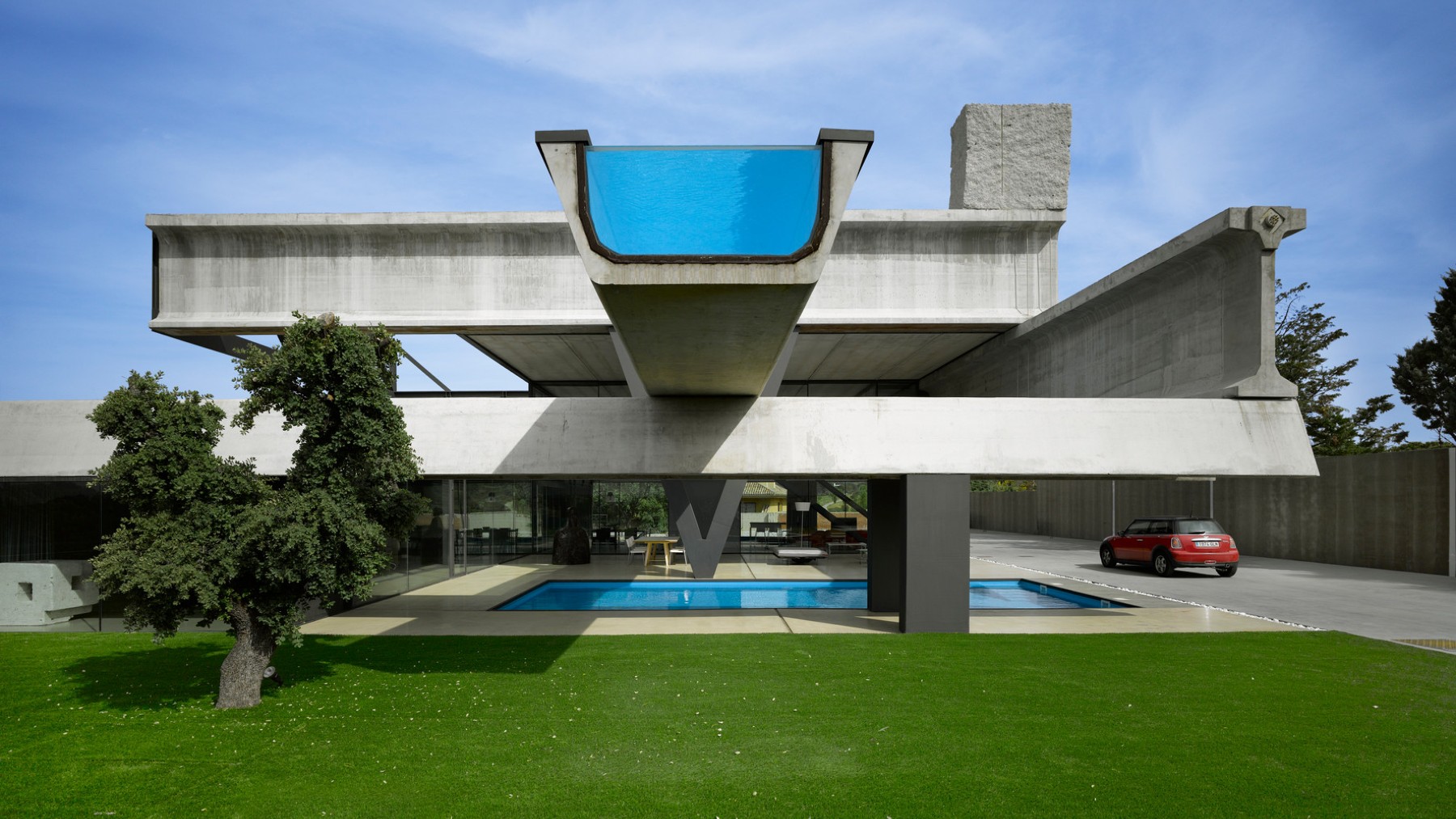
The Hemeroscopium House is named as a recent concrete prefab house in Madrid, Spain. The architecture firm Ensamble Studio created this intriguing and fascinating 4000 sq ft dwelling with modular concrete boxes.
The house so built has been conceptualized around seven prefab sections, which have been hoisted to create the entire architecture of the building. Measuring up to 27m long, 9m wide, and 10m tall, these solid concrete blocks can be connected to form a structural design with a modern look.
The modules define interconnected and highly luminous living spaces in the house, with few interior partitions, grandiose heights, and rich natural lighting. Some of the main characteristics of the Hemeroscopium House are scale, the orthogonal plan and geometry, white facades, and large windows defining the interior.
Modular construction, almost invisible in the Hemeroscopium House
The Hemeroscopium House was built using precast concrete elements; many of these elements can be seen in the design. The seven elements designed by the Ensemble Studio were manufactured as seven individual pre-fabricated modules and then delivered to the construction location.
They are planned to be approximately 13 feet wide, 39 feet long, and 10 feet high for each module. They were cast from reinforced concrete and provoked the possibility of being placed one on the other. As for the above details, using concrete ensured that it acted as a source of thermal mass.
This was done intentionally regarding the nature of the modules to achieve the contained open spaces upon assembly. For instance, the staircase is designed with a middle opening that allows light to reach the ground floor once the modules are stacked.
Some concrete modules were cast at the prefab facility and then transported to the site, where they were craned into position. The interconnectedness of the modules was established during the face-to-face meetings.
A unique, innovative floating pool you will love: how can it be there?
Of special note is the outdoor swimming pool, which has been constructed with a floating concept over the terrace area. There is an integrated swimming pool located on the terrace level that seems to be floating in the air, and the pool’s glass bottom adds to its beauty.
Their exterior features, including a floating pool and a wood deck patio made of ipé wood that extends around the pool and the main living area, establish an open-plan connection from the interior to the exterior. Translucent façade panels that act as full-height sliders give direct access to a covered patio area.
Behind the patio is a lawn and garden hill that descends to the large backyard. The landscape of the exterior environment does not intrude much into the courtyard but blends in well with the contemporary design and flair that characterizes the entire building.
Designed for exterior and interior use, the building is a work of art, specifically the floating pool. Personalizing the design and blending it with the existing wooden deck of the patio gives a touch of a modern-day paradise-like feeling.
We particularly love this concrete prefab house for two reasons (beyond its floating pool, which we can’t stop looking at the company’s images). One is its price, which is quite affordable for a 4000 ft² home with top qualities. The other is its composition, with seven distinct modules that avoid imitating conventional houses, something ubiquitous in modular construction.