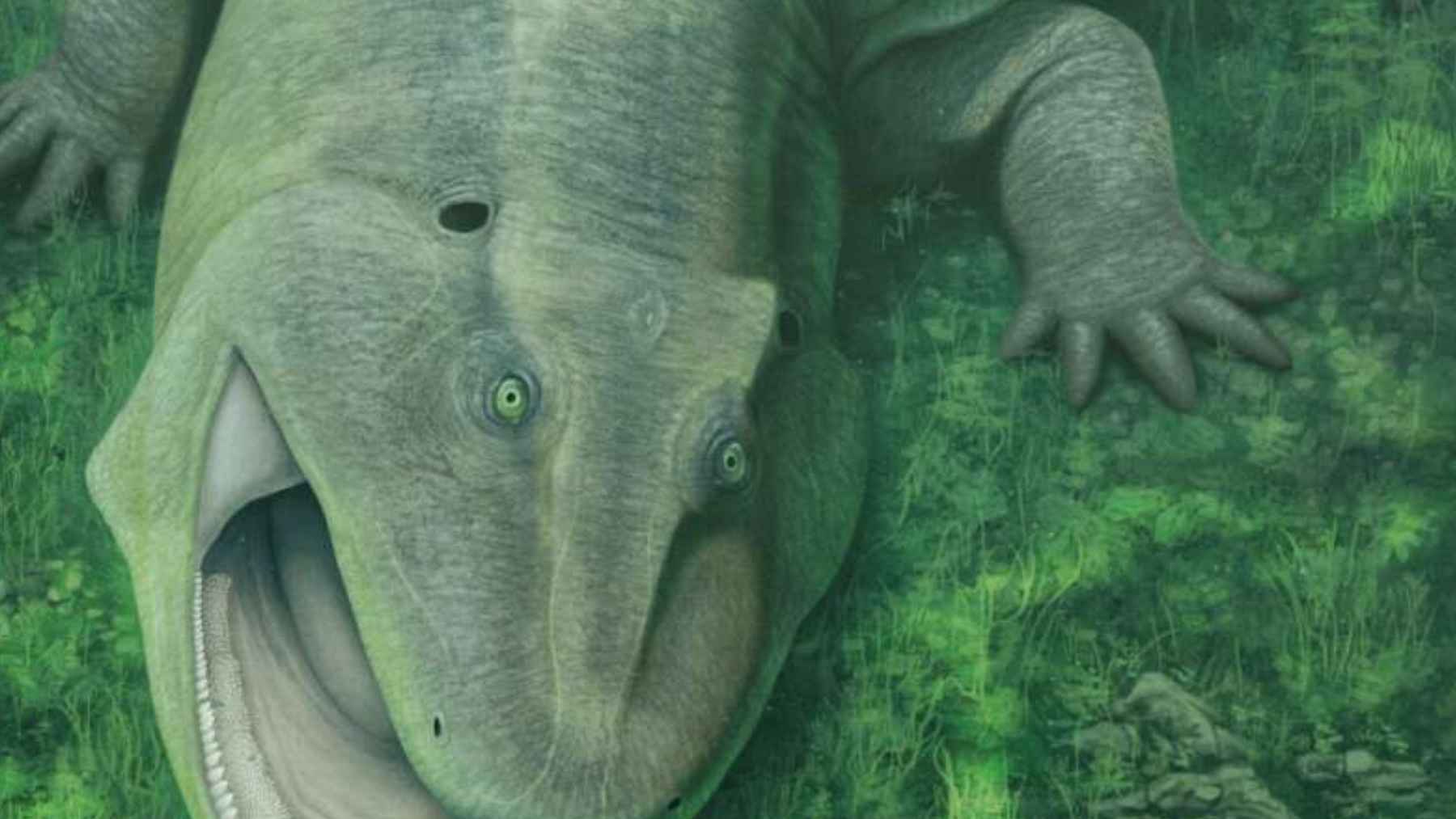
What can a handful of fossil jaws really tell us? In this case, quite a lot. A newly described animal from Brazil called Tanyka amnicola had a lower jaw so unusual that some of its teeth pointed sideways, not upward.
More important, the find suggests that very ancient tetrapod lineages in Gondwana were still alive and still evolving in surprising ways about 275 million years ago.
The paper, published on March 4, 2026, describes nine jaw specimens from the Pedra de Fogo Formation in northeastern Brazil.
Researchers say the animal likely lived in lakes or wetland settings, may have grown to around three feet long, and is still known mostly from those distinctive jaws.
That may sound frustrating, but the jaws alone were enough to make scientists stop and look twice.
A living fossil with a very odd bite
The team places Tanyka on the stem of the tetrapod family tree, meaning it belonged to an older branch that sits outside the later groups that gave rise to reptiles, birds, mammals, and modern amphibians.
In practical terms, that means this was an archaic survivor in a world that already included more familiar-looking tetrapods. Lead author Jason Pardo even described it as “a living fossil in its time.”
And then there is that jaw. At first, researchers wondered whether the strange twist was simply damage or deformation. But after finding nine jaws with the same pattern, they concluded it was real anatomy.
Instead of the tooth row facing upward, the jaw was rotated so the teeth angled outward, while the inner side carried a broad patch of denticles that likely formed a rough grinding surface. The twist was real. And very weird.
That feeding system may be the most intriguing part of all. The authors say the rasping surfaces could have helped process small invertebrates or some plant material. The Field Museum release goes a bit further and says the teeth suggest Tanyka ate plants at least some of the time.
So no, this is not fully settled. But for the most part, the message is clear. This animal was not using a simple grab-and-swallow bite. It had a specialized mouth built for processing food.
Why Gondwana suddenly looks more interesting
Here is the bigger story. The Pedra de Fogo Formation is one of the few places that gives scientists a real window into early Permian animals from Gondwana, the southern supercontinent that once included South America, Africa, Australia, and Antarctica.
Compared with Europe and North America, that fossil record is still relatively sparse. That is why a find like Tanyka matters well beyond its strange appearance.
For years, the broad picture of early tetrapod evolution has often looked a little too neat. After the Carboniferous Rainforest Collapse, older stem tetrapod groups were thought to fade while newer groups expanded. But the new paper argues that this turnover was more complicated than that, at least in Gondwana.
In other words, some ancient lineages did not just linger on. They kept exploring new ecological roles, even in environments that may have been hotter and more seasonal than expected.
That is what gives this fossil its real bite. Tanyka amnicola is not just another prehistoric oddball. It is a reminder that evolution rarely moves in a straight line, and that some of the most revealing chapters are preserved in places scientists are only beginning to understand.
The study was published in Proceedings of the Royal Society B.