If you’ve ever felt like spring is arriving earlier, you’re not imagining things. A new study suggests Earth’s seasonal “green wave” is also shifting its path, with the planet’s overall greenness drifting toward the northeast over time.
The headline result is simple, but the idea behind it is surprisingly direct. Instead of staring at thousands of maps, the researchers tracked one moving “green center” that summarizes where leaves and plant growth are most concentrated across land.
How scientists measure a planet’s “green center”
In late February 2026, a team led by the German Centre for Integrative Biodiversity Research Halle-Jena-Leipzig (iDiv), the Helmholtz Centre for Environmental Research, and Leipzig University treated vegetation like weights on a globe to build that global tracker. Lead author Miguel Mahecha put it this way, “Imagine holding a perfectly round globe,” then adding tiny weights wherever leaves are denser until the planet has a single balance point.
Scientists can estimate that kind of balance point using satellite greenness data and computer models that simulate climate and ecosystems. The goal is not to replace local fieldwork, but to create a stable global signal that can be compared year to year without getting lost in the noise.
Gustau Camps-Valls at the University of Valencia said the approach “compressed the biosphere’s complexity into a single, moving heartbeat,” meaning the living part of Earth can be tracked with one shifting coordinate. He also argued the same framework could be adapted to follow an ocean “blue wave” or a heat “red wave,” turning it into a broader monitor for the whole Earth system.
A yearly loop between Iceland and Liberia
The green center still follows the seasons. It reaches its northernmost point in mid-July in the North Atlantic near Iceland, and it drops to its southernmost point off the coast of Liberia in March.
That may sound distant, but the rhythm is familiar. It is the same story you see in your neighborhood when lawns need mowing, trees burst into leaf, and then the growing season fades back in fall, just on a planetary scale.
Scientists often call this timing “phenology,” basically nature’s calendar. When that calendar shifts, it can affect crops, wildfire risk, water use, and the timing of food for insects and migrating animals.
The drift is northward and eastward, and it may speed up
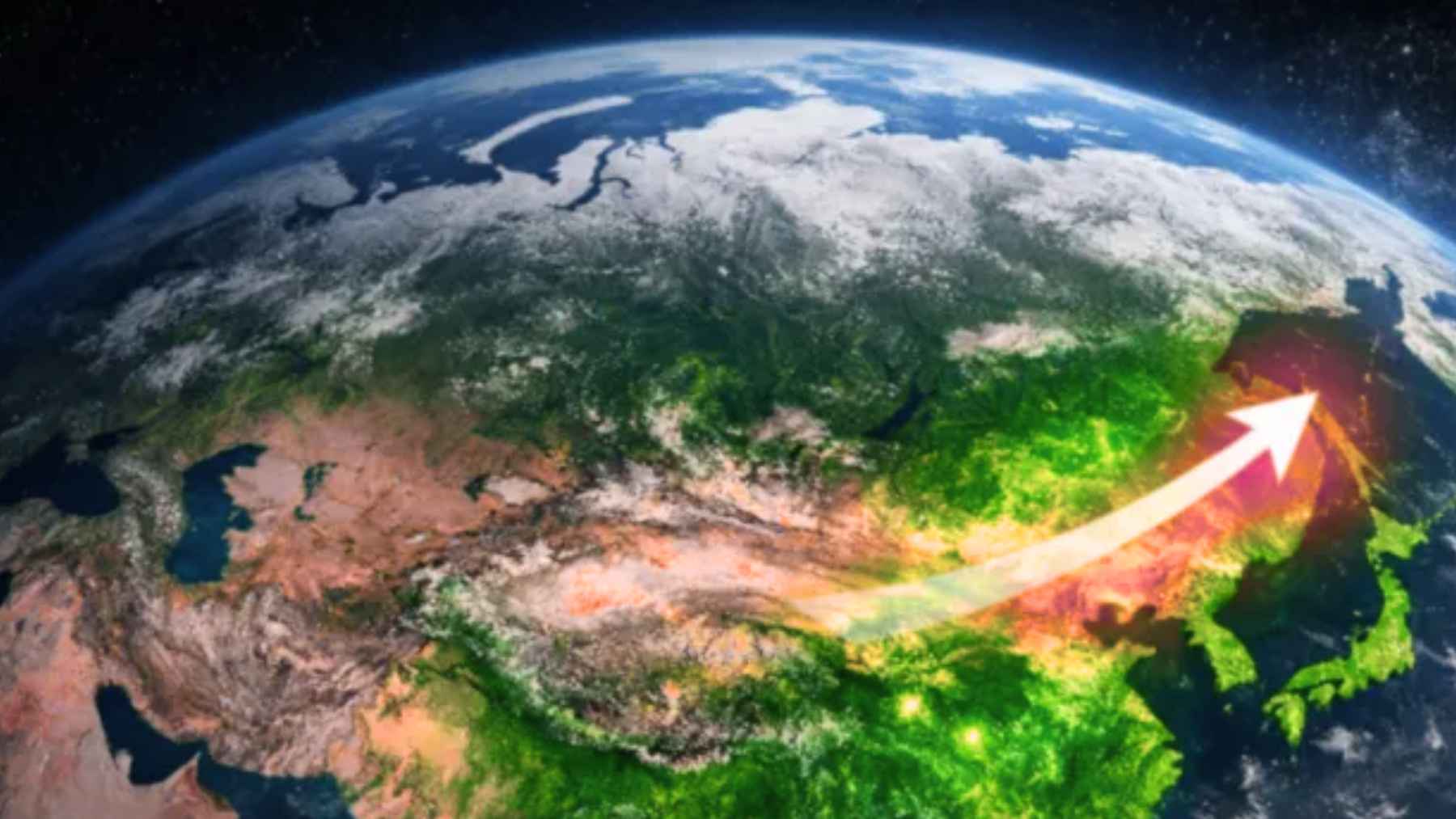
Using this green-wave “centroid,” the study found the center is moving northward during both Northern and Southern Hemisphere summer peaks, rather than swinging back south as much as expected. It also detected an accelerating eastward drift, and it projects the overall swing could keep shrinking later this century.
In plain terms, the loop is getting lopsided. The green wave still “breathes” with the seasons, but the average position is leaning toward northern land areas more of the year.
One likely piece of the puzzle is longer growing seasons and milder winters in parts of the Northern Hemisphere. If plants stay active later into the year, the planet can look a bit greener for longer, even when the southern growing season is in full swing.
Why more greening can pull the center east
A shift in longitude is a clue about where new leaf growth is piling up. If certain regions add more leaves through farming, reforestation, or ecosystem recovery, the green center gets tugged toward them, even if other places are drying or burning.
A NASA satellite analysis has highlighted how much land management can matter here. In 2019, the agency reported that China and India were leading the increase in leaf area on land, linked largely to tree planting, forest work, and intensive agriculture.
There is an important caveat, though. A “greener” signal can reflect healthy forests, but it can also reflect high-input croplands, plantations, or short-lived surges after wet years, and satellites cannot always separate those stories by themselves.
CO2 fertilizes plants, but climate sets hard limits
CO2 is the same heat-trapping gas driving much of global warming, but plants also use it to grow. In photosynthesis, plants turn sunlight, water, and CO2 into sugars, so more CO2 can boost growth in some conditions, at least for a while.
A 2016 Nature Climate Change study found that roughly a quarter to half of Earth’s vegetated land showed significant greening over previous decades, while less than four percent showed widespread browning. In model experiments, the authors estimated CO2 fertilization explained about 70 percent of the observed greening trend.
But the boost is not unlimited, and it can come with tradeoffs. The Intergovernmental Panel on Climate Change has warned that in many dry regions, reduced water availability can outweigh the benefits of added CO2, meaning “greener” does not automatically mean safer or more stable ecosystems.
What this “green heartbeat” could be used for next
The researchers have also shared an interactive explainer called “The Green Wave,” which lets readers explore the global path of the green center over time. For a topic that can feel abstract, seeing the loop move can make the trend much easier to grasp.
For science, the promise is speed and comparability. A single global metric can make it easier to spot unusual years, test climate models, and connect changes in vegetation timing with droughts, fires, and land-use shifts that people actually experience.
It is not a magic shortcut, and it will not tell you what is happening in one specific forest. But it may become a useful dashboard light for the planet’s living surface, and it raises a simple question that is hard to ignore, where is the world turning green next?
The main study has been published in Proceedings of the National Academy of Sciences.