When Stephen Hawking warned that humanity might not survive the next 1,000 years without leaving Earth, the line landed like pure science fiction. But was he really predicting an exact doomsday? Not quite. He was making a broader argument that a species living on one “fragile planet” cannot afford to think only in the short term.
That is a big reason his words still echo far beyond physics labs. Hawking reshaped modern cosmology by showing that black holes can emit radiation, and he reshaped public culture by turning difficult ideas about time, the Big Bang, and the universe into language millions of people could actually follow.
In a subject that can feel impossibly far away, he made the cosmos feel close enough to think about over morning coffee.
Why his 1,000-year warning still resonates
The famous line came from Hawking’s 2016 Oxford Union speech. There, he said, “I don’t think we will survive another thousand years without escaping beyond our fragile planet,” and he followed that with a clear call to keep exploring space for the future of humanity. Read carefully, and the point is less about panic than about survival.
In practical terms, Hawking was saying that humanity should not place all of its hopes on a single world forever. That is what gives the quote its staying power.
It sounds dramatic, yes, but underneath it sits a simple idea that even younger readers can grasp. One home can be wondrous and still be vulnerable.
The breakthrough that changed black holes forever
Hawking’s greatest scientific contribution came in the 1970s, when he showed that black holes are not completely black after all. By combining ideas from general relativity and quantum theory, he found that black holes can emit radiation, a result later known as Hawking radiation.
That was huge, because it linked two pillars of physics that had long seemed painfully hard to reconcile.
His work also stretched far beyond black holes. Hawking helped show that the universe had a beginning in the Big Bang, and later developed the “no boundary” proposal as part of an effort to explain the universe’s origin through the laws of physics.
For scientists, these were foundational advances. For everyone else, they changed the way we talk about the beginning of time itself.
How he made cosmology part of everyday culture
Plenty of scientists make historic discoveries. Very few also become trusted guides for the general public. Hawking did both, most famously with A Brief History of Time, which his official biography says stayed on the UK best-seller list for 4.5 years, was translated into more than 40 languages, and sold more than 20 million copies.
That success mattered because it proved something important about readers. People were willing to wrestle with black holes, spacetime, and the fate of the universe if someone respected their curiosity and explained the ideas clearly.

Books such as The Universe in a Nutshell and Black Holes and Baby Universesand Other Essays helped keep that bridge open between specialist science and everyday life. Simple idea. Huge effect.
The illness that never stopped the science
Hawking’s public impact cannot be separated from the life he lived. Soon after his 21st birthday, tests showed he had a progressive and incurable motor neuron disease, and he was given only two years to live. He outlived that prognosis by decades, continuing to research, write, and teach until his death in March 2018.
After a tracheostomy took away his natural speaking voice, communication became another scientific and human challenge.
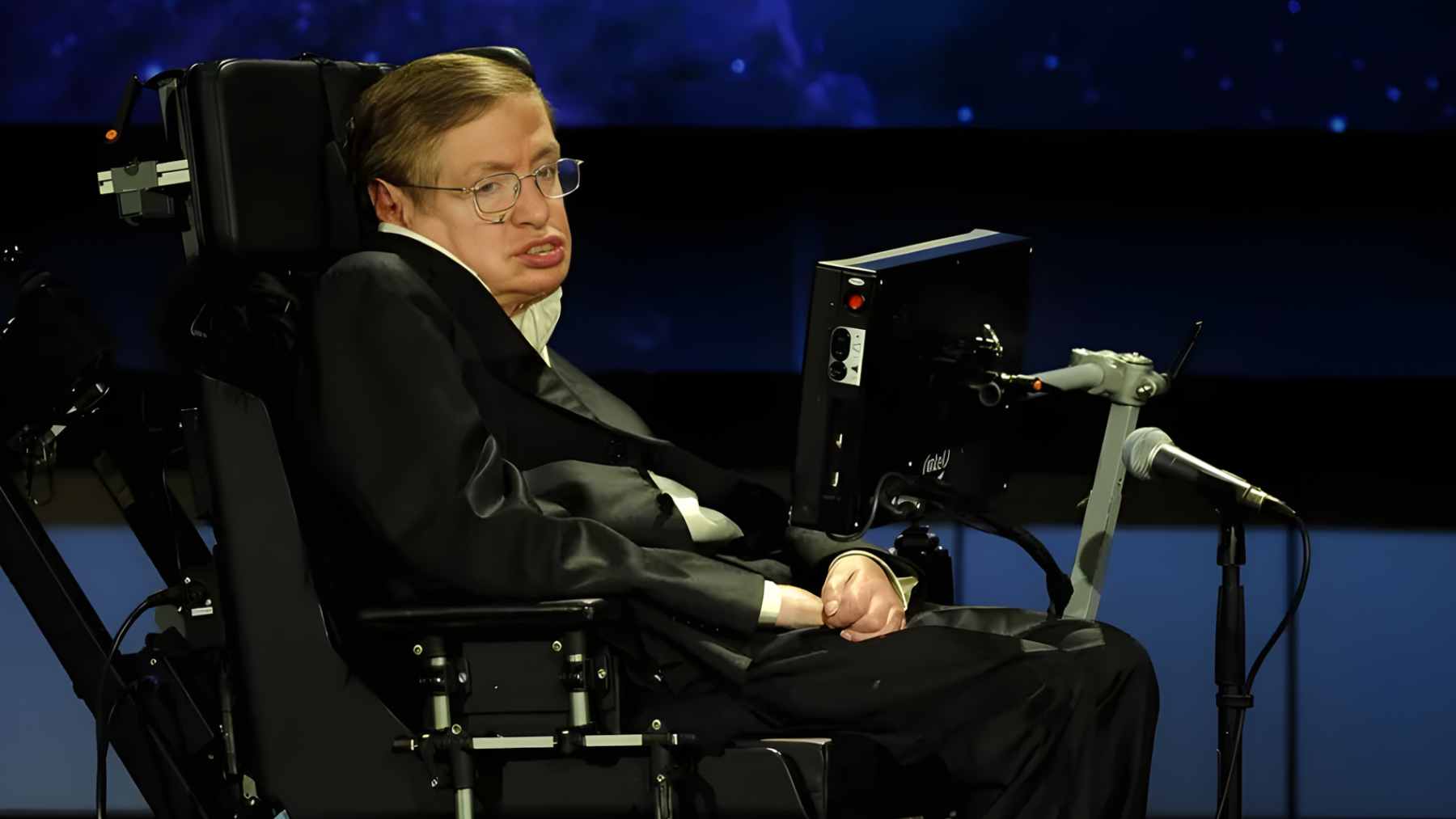
He first relied on a spelling card and eyebrow movements, then later worked with computer developers, including Intel, on a computerized system and voice synthesizer whose flat American accent became part of his identity. That voice was synthetic, but the determination behind it was unmistakably human.
Maybe that is why Hawking’s warning still hits so hard. He spoke about survival as someone who understood limits better than most people ever will, yet refused to let those limits define the size of his questions.
Look up at the stars, he urged, but do not miss the urgency beneath the wonder. Our world is extraordinary, and it is not something any civilization should take for granted.
The official speech was published on the Stephen Hawking Estate’s website.