Empty space looks calm, even boring. Quantum physics has long claimed it is anything but empty, filled with flickers that appear and vanish too fast to catch.
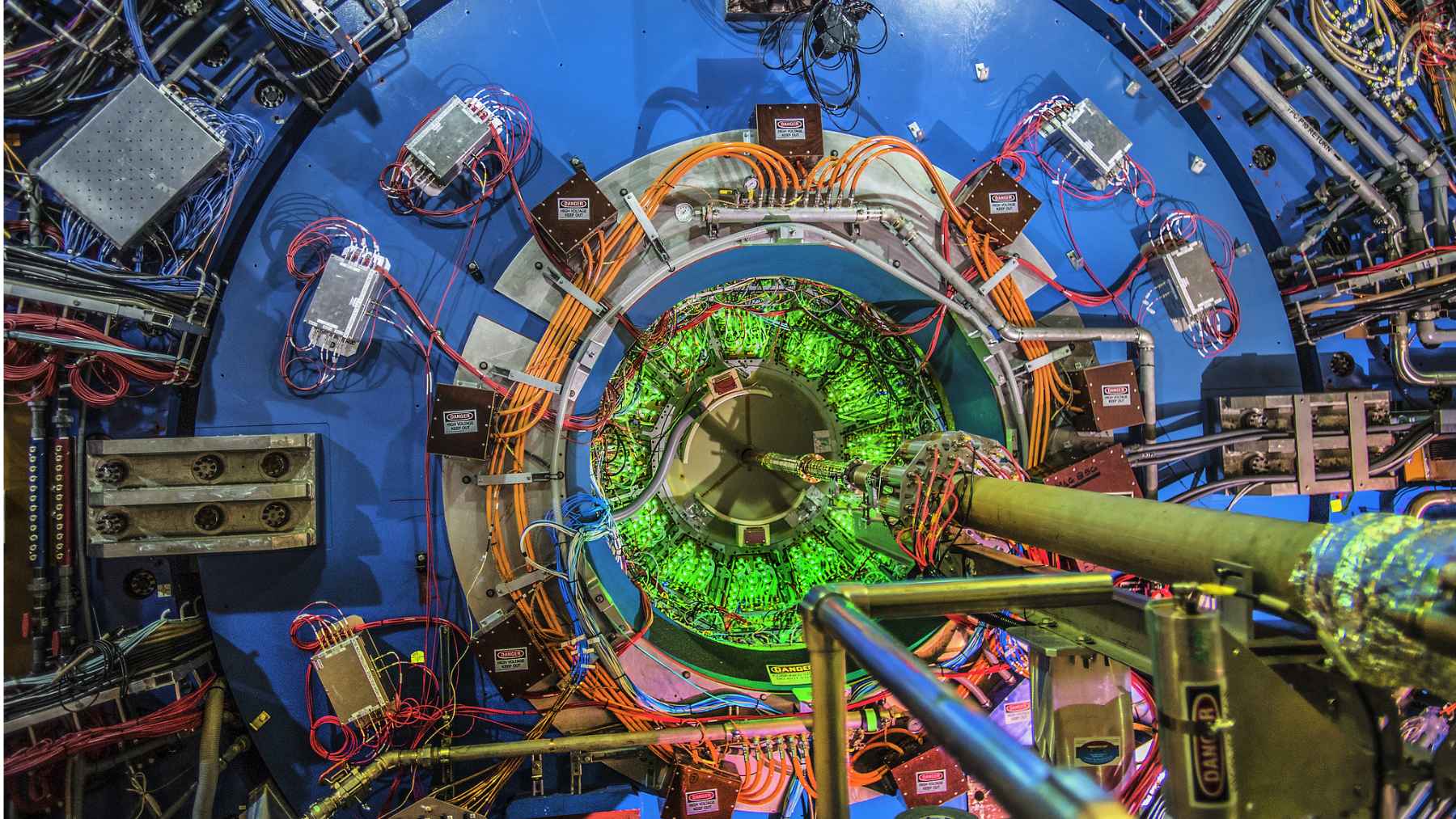
Now an experiment is reporting evidence that some of those flickers can leave a measurable mark on real particles. In high-energy proton collisions at the Relativistic Heavy Ion Collider (RHIC), the STAR Collaboration at the U.S. Department of Energy’s Brookhaven National Laboratory in New York tracked paired particles whose spins lined up in a way the team links to the vacuum itself, a connection the researchers describe as the first direct experimental evidence of its kind. Zhoudunming (Kong) Tu, a co-leader of the analysis, said, “This work gives us a unique window into the quantum vacuum that may open a new era in our understanding of how visible matter forms and how its fundamental properties emerge.”
The quantum vacuum in plain English
When most of us hear “vacuum,” we picture nothing at all, like the emptiness between planets. In quantum theory, even “empty” space still has energy fields that can jitter, and that jitter can briefly act like pairs of particles.
Physicists call those short-lived blips “virtual particles.” They are not free, long-lasting objects you could bottle, but they can still influence what happens nearby, a bit like wind you only notice because it moves the leaves.
This result is also not magic. The energy that makes virtual pairs “real” comes from the collision itself, and the vacuum is the stage where that energy can turn a fluctuation into a detectable ingredient of matter.
A quick guide to quarks and confinement
Quarks are among the most basic components of matter. Protons and neutrons are built from them, and colliders can create many other quark-based particles for a split second.
There is a catch that makes quarks hard to isolate. The strong force, described by a theory called quantum chromodynamics (QCD), keeps quarks trapped inside larger particles, so a single quark does not show up by itself in nature.
In practical terms, pulling quarks apart is like stretching a rubber band that keeps fighting back. Add enough energy, and you tend to make new particles instead of a free quark, which is one reason confinement is still a major puzzle.
Why lambda particles were the perfect target
So how do you spot a particle that should never exist for long? You pick one that decays in a “talkative” way, leaving clues behind. That is the clue.
The researchers focused on lambda hyperons and anti-lambdas, a matter and antimatter pair that includes a strange quark or a strange antiquark. In common models of these particles, almost all of the lambda’s spin comes from that strange quark, which makes spin a useful tracer.
These particles last only about one ten-billionth of a second. But their decay products leave clear tracks that let scientists reconstruct the spin direction and match one particle to its partner.
Spin alignment as a fingerprint of the vacuum
Here is the basic test the team used. Strange quark pairs that pop out of the quantum vacuum are expected to be spin aligned, so if a lambda and an anti-lambda inherit those quarks and keep that alignment, their spins should point in a correlated way.
Jan Vanek of the University of New Hampshire, who led the data analysis, described the pattern in an everyday image, saying, “It’s as if these particle pairs start out as quantum twins. When they’re generated close together, the lambdas retain the spin alignment of the virtual strange quarks from which they were born.” It is the kind of signal you only see after a lot of careful sorting.
The analysis drew on millions of collisions and looked for pairs produced close together in the spray of particles. In the published paper, the researchers report a spin-correlation signal of about 18 percent with an uncertainty of about 4 percentage points, and they found it at a level of 4.4 standard deviations, which scientists usually treat as strong evidence.
When the two particles emerged farther apart, the correlation dropped sharply, which fits the idea of quantum decoherence, meaning extra interactions can scramble the original “twin” connection until it looks like ordinary randomness.
A new route into the mystery of mass
Why does any of this matter beyond a physics lab? Because the strong force and the quantum vacuum are tied to a question that shows up in everyday life, including the number you see on a bathroom scale.
The quarks inside a proton account for only a small share of the proton’s mass. Most of the mass of ordinary matter is thought to come from the energy of the strong force and the seething activity of the QCD vacuum around confined quarks.
By measuring how vacuum-style correlations survive or disappear, scientists gain a new way to test models of confinement and the quantum-to-classical transition. In the long run, that kind of knowledge could also inform quantum information research, although the practical path is still uncertain.
What comes next for this line of research
The authors describe the result as evidence, not the final word. Particle collisions are messy, and other processes can also create quark pairs, so the method will need cross-checks in other collision settings and with other particle types.
One future target is the Electron-Ion Collider, a facility planned at the same site that is expected to reuse much of today’s accelerator infrastructure. The goal is to send these vacuum-linked quark pairs through different atomic nuclei and see how the surrounding matter changes the correlations that survive.
For readers who want the source material, the team’s official press release summarizes the result in plain language.
The main study has been published in the journal Nature.