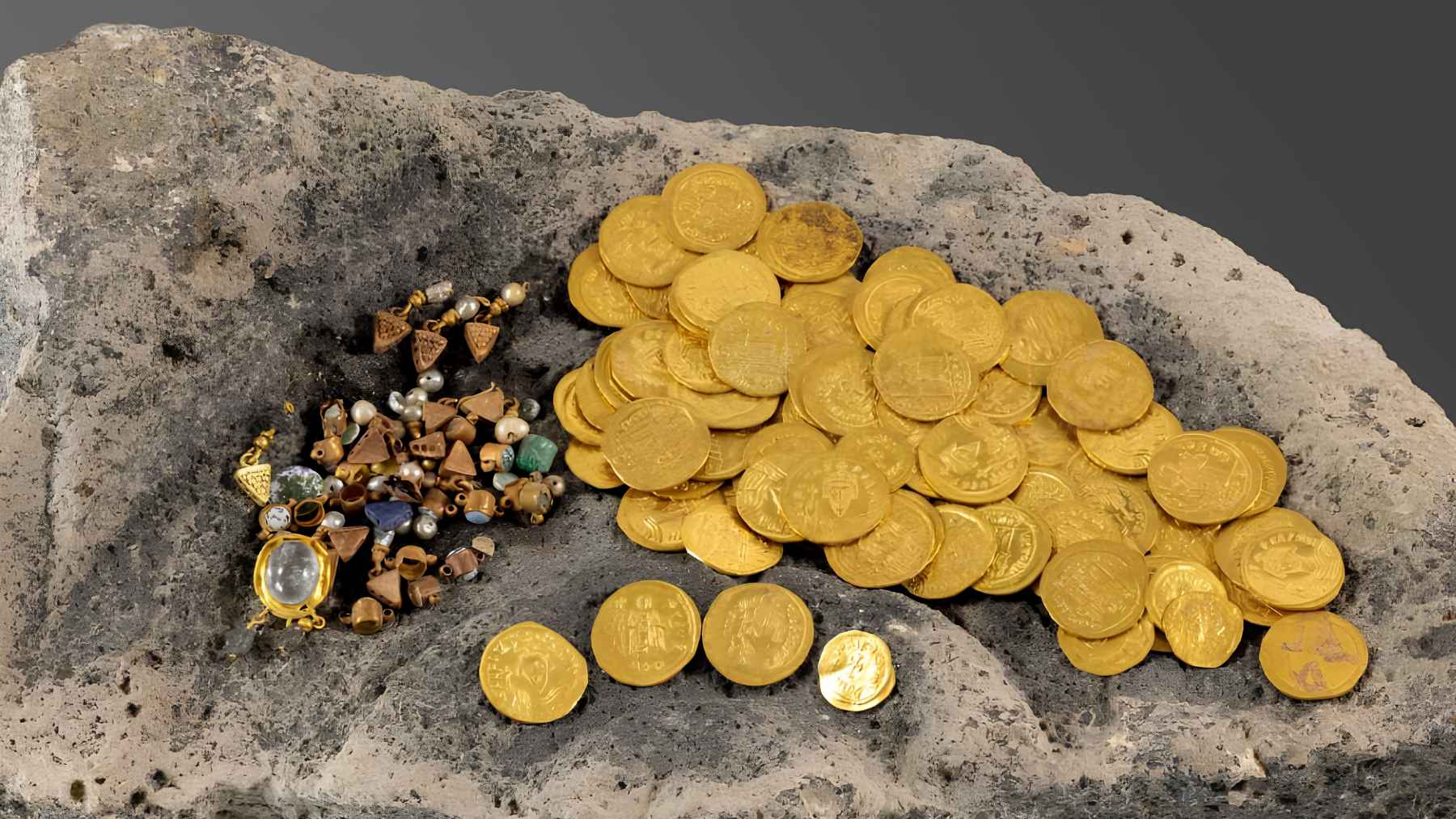
A signal from a metal detector on a hillside above the Sea of Galilee led archaeologists to something far bigger than a stray coin. In the ancient city of Hippos, also known as Sussita, the team uncovered 97 pure gold coins and dozens of pieces of fine jewelry from the late Byzantine period.
The discovery is not just a shiny surprise. It looks like an emergency stash, hidden when war and political upheaval were closing in on one of the region’s Christian cities. Why would someone bury that much wealth and never come back? That is where the real story begins.
Gold in the dirt
The find began at the end of July 2025 when Edie Lipsman, a metal detector operator working with the excavation, picked up a signal near a large stone between two walls. When the stone shifted, the signal grew stronger and gold coins began to appear.
“The device went crazy. I couldn’t believe it, gold coins started appearing one after another,” Lipsman said. Dr. Michael Eisenberg, who co-directs the excavation with Dr. Arleta Kowalewska, called the cache one of the largest Byzantine gold hoards found on dry land in Israel.
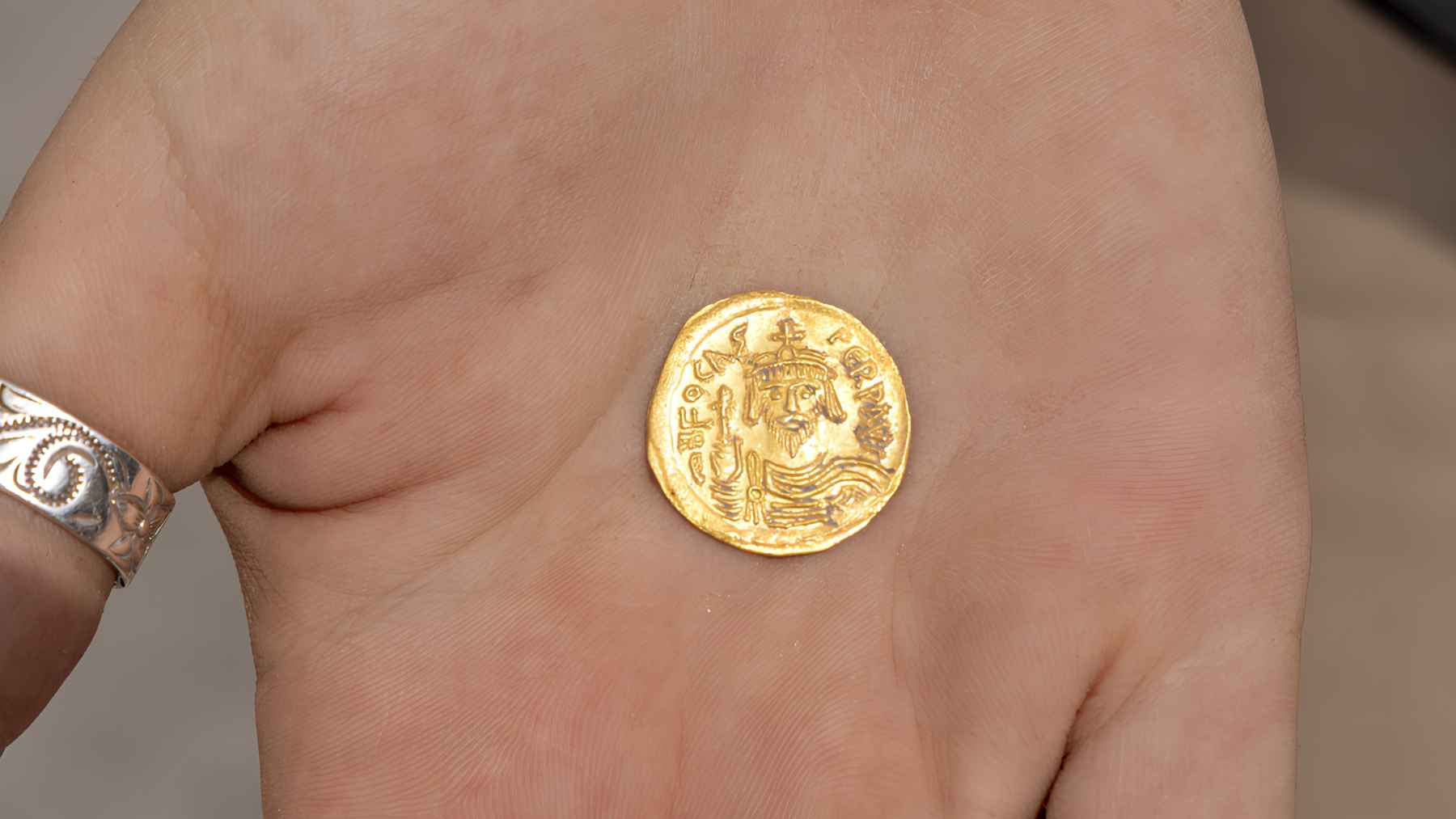
What the coins reveal
The coins span nearly a century, from the reign of Emperor Justin I in the early 500s to the first years of Emperor Heraclius in the early 600s. That tight timeline gives archaeologists a strong clue about when the hoard was buried.
The set includes solidi, semisses, and tremisses. In plain English, those were full, half, and one-third gold coins, the kind of money used for serious payments rather than buying a loaf of bread in the market.
One small tremissis appears to have been minted in Cyprus around A.D. 610, during the revolt that helped bring Heraclius to power. A single coin can do a lot of talking when it carries the mark of a political crisis.
Jewelry with a human touch
The coins were found with fragments of gold earrings inlaid with pearls, semiprecious stones, and glass. These were not rough objects tossed into a hole in a hurry, but carefully made pieces that likely mattered to their owners.
Some coins also preserved traces of fabric, which suggests the gold had been kept inside a cloth pouch. That tiny detail matters because it turns a pile of treasure into something more familiar, almost like finding an ancient wallet.
A city above the lake
Hippos sat on a hill about 1.2 miles east of the Sea of Galilee, high enough to watch the lake and the routes around it. The excavation project describes the site as one of Israel’s long-running classical archaeology digs, with work continuing there since 2000.
The Israel Nature and Parks Authority says the city reached its height in the Roman and Byzantine periods and later survived into the early Muslim era. It was finally destroyed by a major earthquake in A.D. 749 and abandoned afterward.
Before that collapse, the city was alive with churches, homes, workshops, and trade. This was not some quiet ruin waiting for tourists, it was a working community with bills to pay, goods to move, and valuables to protect.
Why someone hid it
By A.D. 614, Sasanian armies were advancing through Byzantine Palestine. For people in threatened towns, burying gold could be a desperate way to keep family wealth safe until danger passed.
It sounds dramatic, but the logic is simple. You hide what you cannot carry, mark the place in your memory, and hope the fighting moves on before your life falls apart.
The trouble is, some people never returned. That is why emergency hoards often feel so personal. They are not just records of empire, but records of interrupted lives.
Why archaeologists care
Ancient coins are like time stamps. Their portraits, mint marks, and inscriptions help researchers narrow down dates, trade routes, and changes in political power.
Jewelry adds another layer. It shows taste, status, craft, and possibly faith, especially in a city where Christian churches formed an important part of daily life.
Put together, the coins and earrings point to a place that was wealthy enough to own luxury goods, but vulnerable enough to hide them underground. That tension is what makes the discovery useful, not just beautiful.
What happens next
Researchers now plan to read each coin, document each jewelry fragment, and compare the hoard with other finds from Galilee and nearby regions. The goal is to understand where the coins came from, how they moved, and what they could buy.
Museums may be interested, but the slower work comes first. Archaeology is often less like a treasure hunt and more like carefully reading a story written in dirt, metal, and time.
At the end of the day, this hoard does not simply prove that Hippos had gold. It shows how quickly a prosperous city could become unsafe, and how ordinary human decisions can survive for 1,400 years.
The official statement on the discovery was published by the Israel Nature and Parks Authority.