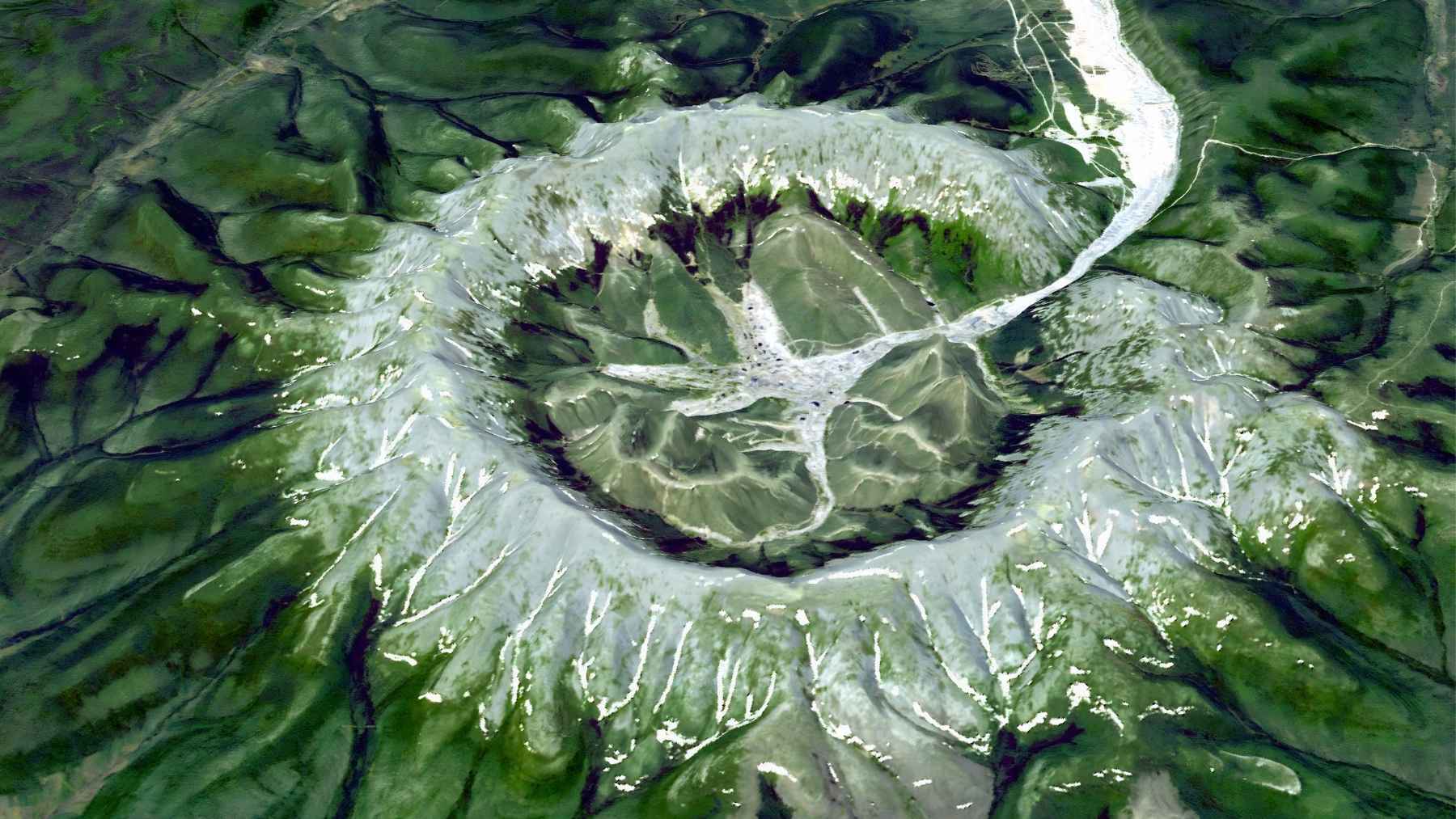
At first glance, the Kondyor Massif looks like something that slammed into Earth. A near-perfect ring rises from remote Khabarovsk Krai in Russia’s Far East, forming a circle about 3.7 miles across that stands out sharply in satellite images. NASA Earth Observatory says the feature resembles a meteor crater or the caldera of an extinct volcano, but it is neither.
The real story is slower, deeper, and in some ways stranger. Kondyor appears to have formed when molten rock pushed upward from below, lifting older layers without breaking through the surface in a classic eruption. In other words, the “crater” was built from below, not carved from above.
A ring that fools the eye
Seen from space, Kondyor looks almost too neat to be natural. Its bare circular ridge contrasts with the green vegetation inside and outside the ring, while water collects near the center and drains outward through a river channel.
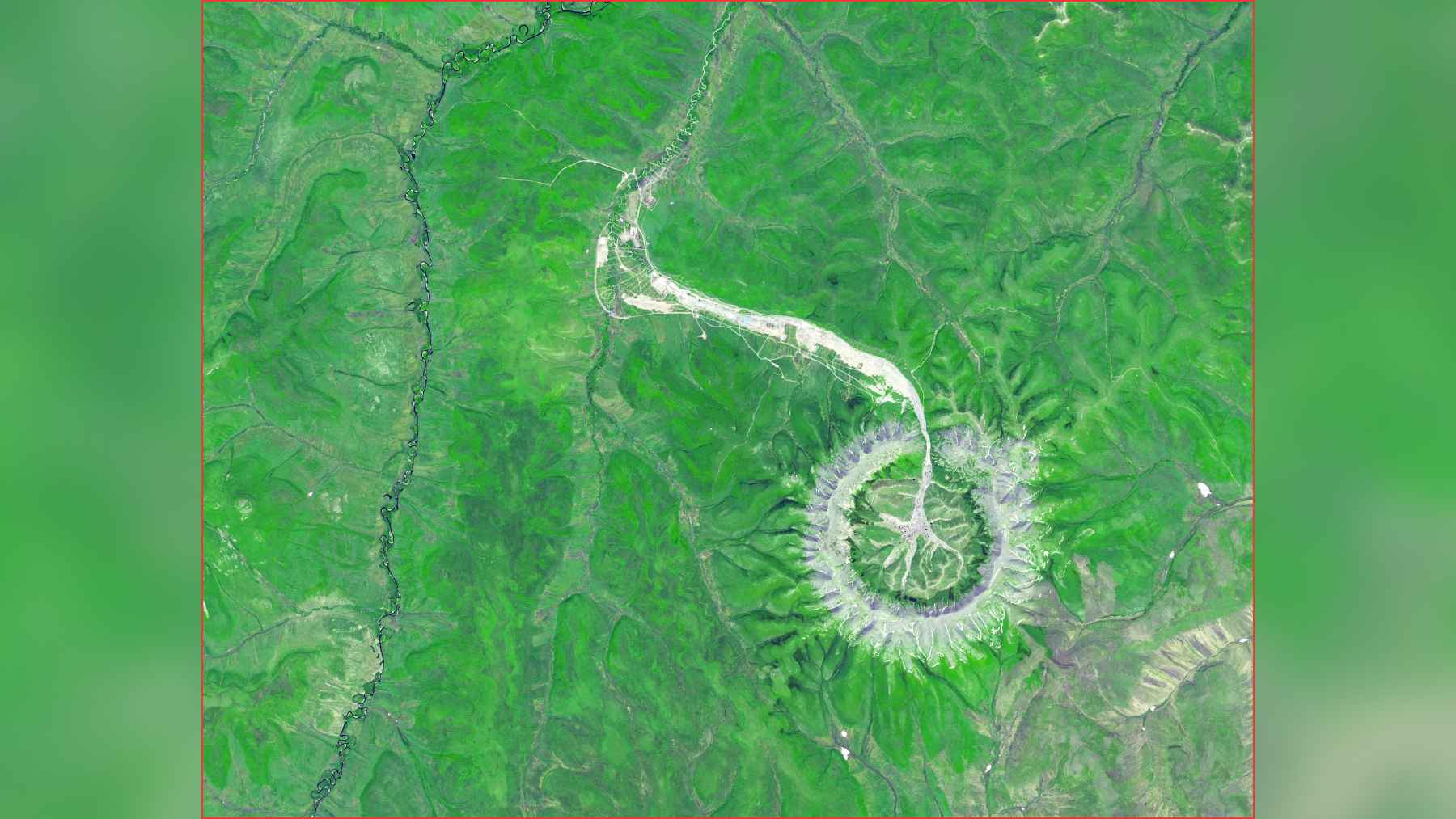
NASA’s Terra satellite captured the formation with the Advanced Spaceborne Thermal Emission and Reflection Radiometer (ASTER) instrument, which can map both surface color and height. NASA’s Jet Propulsion Laboratory describes the broader circular intrusion as about 6.2 miles across, with a ridge rising up to roughly 1,970 feet.
Not a crater
So why is it not a meteor crater? Impact craters usually show signs of violent collision, such as shattered rocks, thrown-out debris, and shock damage from an object hitting at high speed. Kondyor does not fit that pattern.
It is also not a normal volcano. A volcano usually forms when magma reaches the surface and erupts as lava, ash, or gas. Here, the magma pushed into existing rock and cooled underground, like bread dough swelling under a crust that never fully cracks.
Built from below
Geologists call this kind of feature an igneous intrusion. “Igneous” simply means rock that formed from cooled molten material, and an intrusion happens when that material squeezes into older rock instead of erupting above ground.
Kondyor is also described as ultramafic, a term for deep, dark rocks rich in minerals like iron and magnesium. Those rocks often come from far below the surface, which is why this strange ring matters to scientists studying Earth’s interior.
What the rocks reveal
A Journal of Petrology study led by Jean-Pierre Burg, with researchers from ETH Zürich, Université de Montpellier, the French National Centre for Scientific Research (CNRS), and the Russian Academy of Sciences, described Kondyor as a zoned ultramafic complex in Russia’s Far East. The team argued that its structure began at mantle depths, meaning much deeper than the crust we walk on.
That does not mean every detail is settled. In geology, even a formation this visible can hide a complicated history. The big picture is clear, though. Kondyor is the surface expression of a powerful underground process, not the scar of a space rock.
A hard place to reach
Part of Kondyor’s mystery comes from its isolation. The massif sits in a remote part of eastern Russia, far from large cities and easy roads. For most people, satellite images are the only realistic way to see its full shape.
That matters because a circle this large is hard to appreciate from the ground. Up close, it is a rugged mountain landscape. From orbit, the whole design snaps into focus, and suddenly the land looks like a giant natural target.
Platinum in the circle
Kondyor is not only visually unusual. It is also mineral-rich, especially in platinum, gold, and silver. NASA notes that platinum-iron crystals from the site can reach about 0.6 inches, which is large for this kind of mineral grain.
A 2020 study in the journal Lithos, led by Kreshimir N. Malitch, reported that the Kondyor area has attracted researchers for decades because of its associated platinum placer deposit. The paper also said that about 110 U.S. tons of platinum had been mined there over 36 years, based on figures from Amur Mining Company.
Why Kondyor matters
Kondyor is a reminder that Earth can make shapes that look almost artificial without any help from people, aliens, or meteor strikes. Time, pressure, magma, and erosion can do plenty of surprising work on their own.
It also shows why satellites have changed geology. Some structures are too large, too remote, or too subtle to understand from ground level alone. From space, Kondyor becomes a readable story, one written in a nearly perfect ring.
The official NASA feature has been published on the NASA Earth Observatory’s website.