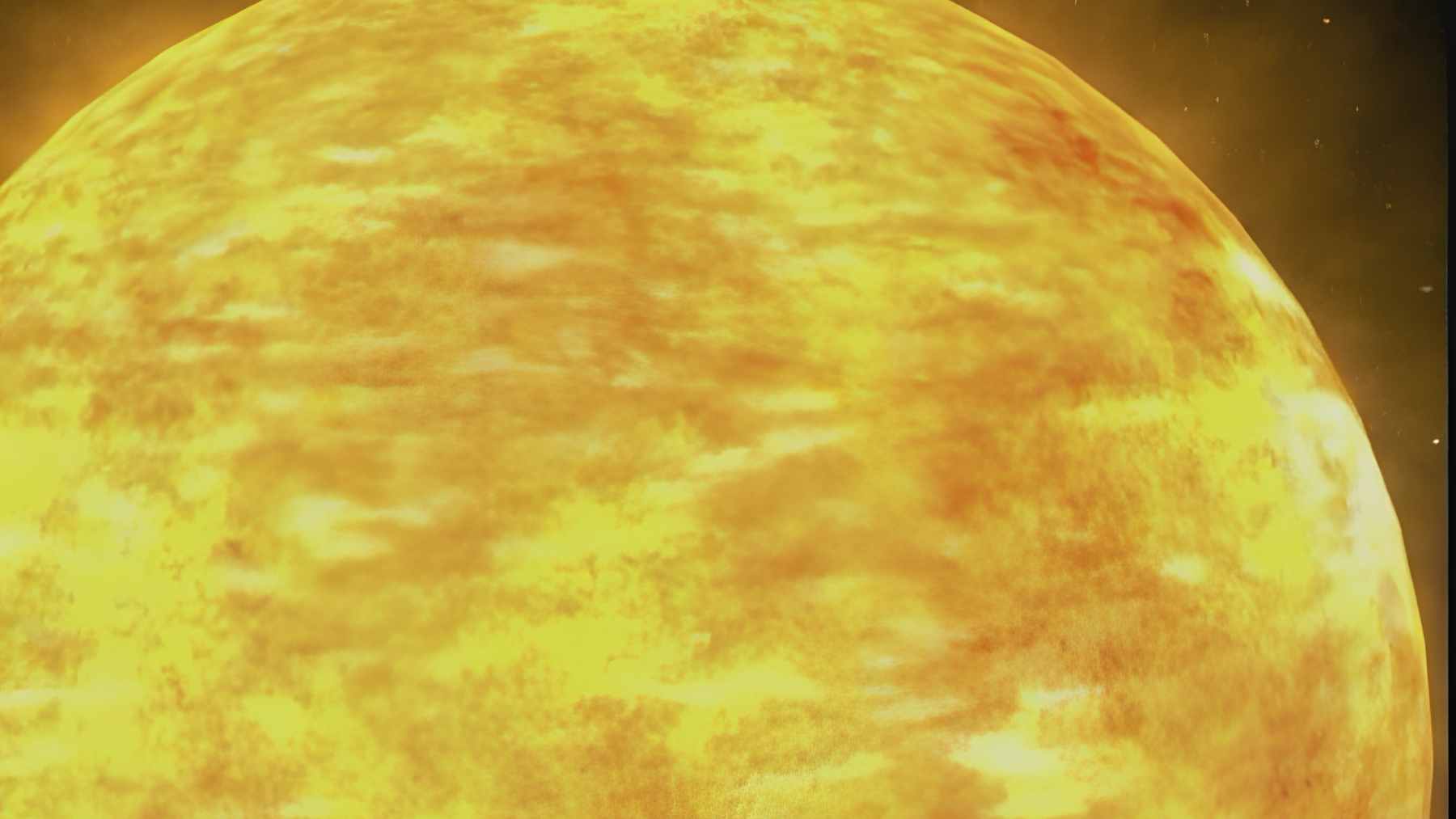
Most of us grew up drawing the Sun as a yellow circle with lines shooting out from the sides. Weather apps do the same. Flags, classroom posters, cartoons, and even basic astronomy labels have helped lock in the idea that our star is naturally yellow.
However, that familiar color is not the whole story. Seen from space, above the air that surrounds Earth, the Sun appears white because its light contains all the visible colors mixed together. The yellow tint we see from the ground is mostly a trick of the atmosphere.
The color we learned
The yellow Sun is everywhere because it is simple and easy to recognize. It stands out on a blue background, and it matches what many people see when the Sun is low in the sky.
Astronomers also use the phrase “yellow dwarf” for stars like the Sun, which can make the idea feel official. Effectively, that label describes the Sun’s place among stars, not the color an astronaut would see from space.
That difference matters. The Sun is classified as a G2 V main-sequence star, and its visible surface is about 10,000 degrees Fahrenheit, according to NASA Science. That is real science, but the “yellow” part is more of a comparison with hotter bluish stars and cooler orange-red stars.
Why space changes the view
So what would the Sun look like without Earth’s air in the way? White. Not paper-white in the soft indoor-light sense, but a brilliant white glare that carries all the visible colors at once.
NASA’s Scientific Visualization Studio explains that the Sun appears white in ordinary photos because it emits all the colors our eyes can see together. Space observatories may show the Sun in gold, red, blue, or green, but those colors often come from filters used to highlight different kinds of solar activity.
That is why so many solar images can be confusing. A fiery orange Sun on a science page may be useful, beautiful, and accurate for a specific wavelength, but it is not always showing what human eyes would see.
The atmosphere gets involved
The twist begins when sunlight enters Earth’s atmosphere. Air is not empty. It is filled with tiny molecules, mostly nitrogen and oxygen, and they interfere with sunlight in a very specific way.
Shorter blue and violet waves of light get scattered more easily than longer red and orange waves. That scattered blue light spreads across the sky, which is why a clear day looks blue instead of dark. NASA Space Place describes this as sunlight being scattered in all directions by gases and particles in the air.
And what happens to the direct beam from the Sun? Some of its blue has been pulled away and sent across the sky. What reaches your eyes from the Sun itself is left looking a little warmer, more yellow than it really is.
One effect, two colors
This process has a name. It is called Rayleigh scattering, after British physicist John William Strutt, third Baron Rayleigh, whose broader work included light scattering and who received the 1904 Nobel Prize in Physics for investigations involving gases and argon.
The key point is simple. The blue sky and the yellow-looking Sun are not two separate mysteries. They are the same atmospheric effect seen from two directions.
Look away from the Sun, and you see the blue light that was scattered sideways. Look toward the Sun, safely and indirectly, and the remaining light seems slightly yellow because some blue has been removed from the direct path.
Noon is different
The Sun does not always look equally yellow. At noon on a clear day, when it is high overhead, its light takes the shortest route through the atmosphere. Less air means less scattering.
That is why the Sun can look nearly white in the middle of the day, even from the ground. The Royal Observatory Greenwich notes that white light scatters in the atmosphere and that shorter wavelengths scatter more, which also helps explain why sunset colors deepen when sunlight travels through more air.
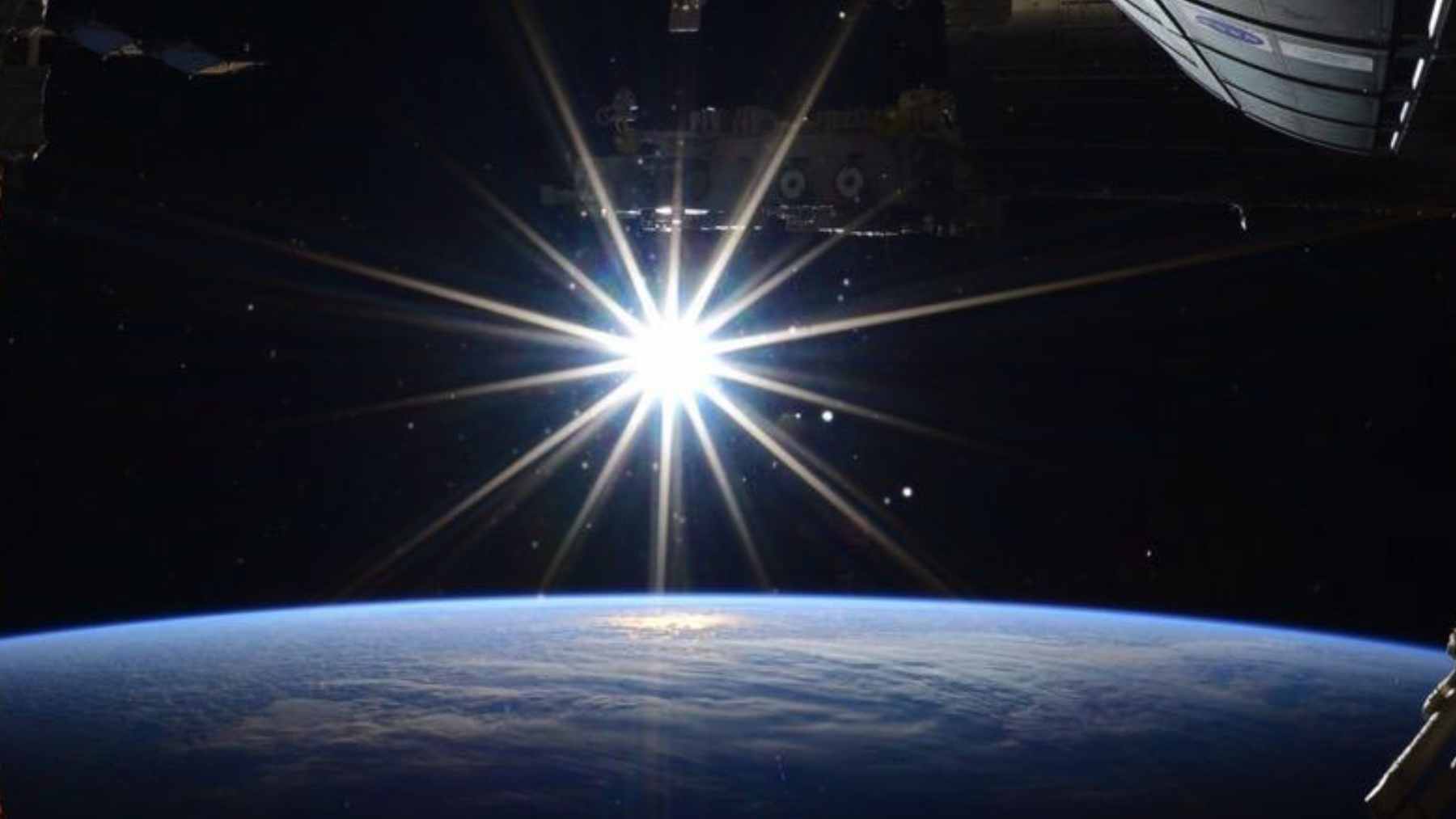
This is also why looking at the Sun is dangerous no matter what color it appears to be. White, yellow, orange, or red, it is still our nearest star, not a lamp.
Sunset tells the story
At sunrise and sunset, sunlight takes a much longer slanted path through the atmosphere. By then, far more of the blue and even some greenish light has been scattered out of the direct beam.
What is left reaches us as orange, red, and sometimes deep crimson. It is the same everyday physics, just turned up because the light has more air to cross.
It is a little like watching the atmosphere filter the Sun in real time. Morning and evening do not change the Sun itself. They change the path its light has to survive before reaching your eyes.
A familiar mistake
The idea of a yellow Sun is not silly. From Earth, especially near the horizon, yellow is often what people actually see. Children draw what culture teaches them, and culture often simplifies nature.
The correction, however, is more interesting than the mistake. The Sun is white, the sky is blue, and the sunset is red because Earth’s atmosphere sorts sunlight by wavelength before it reaches us.
At the end of the day, our planet is not just a place where we see the Sun. It is part of the viewing equipment. The air above us edits the light, and most of the time, we do not even notice.
The official explanations used for this article were published by NASA Space Place’s website.