If you ride a train through Switzerland, there is a moment when daylight disappears, your ears pop, and your reflection floats in the window. It feels routine. For many commuters, it is just the quiet part of the journey when you check messages or think about dinner.
Outside that glass, something much bigger is going on. You are inside a country‑wide climate and environmental project that has been carved into rock for nearly three decades.
A second country under the mountains
Switzerland has more than 1,400 tunnels, with total tunnel and gallery length already above 2,000 kilometers. That includes rail tunnels under the Alps, road tunnels on national highways, and hidden galleries for water and power. In length alone, the underground network rivals major urban transport systems.
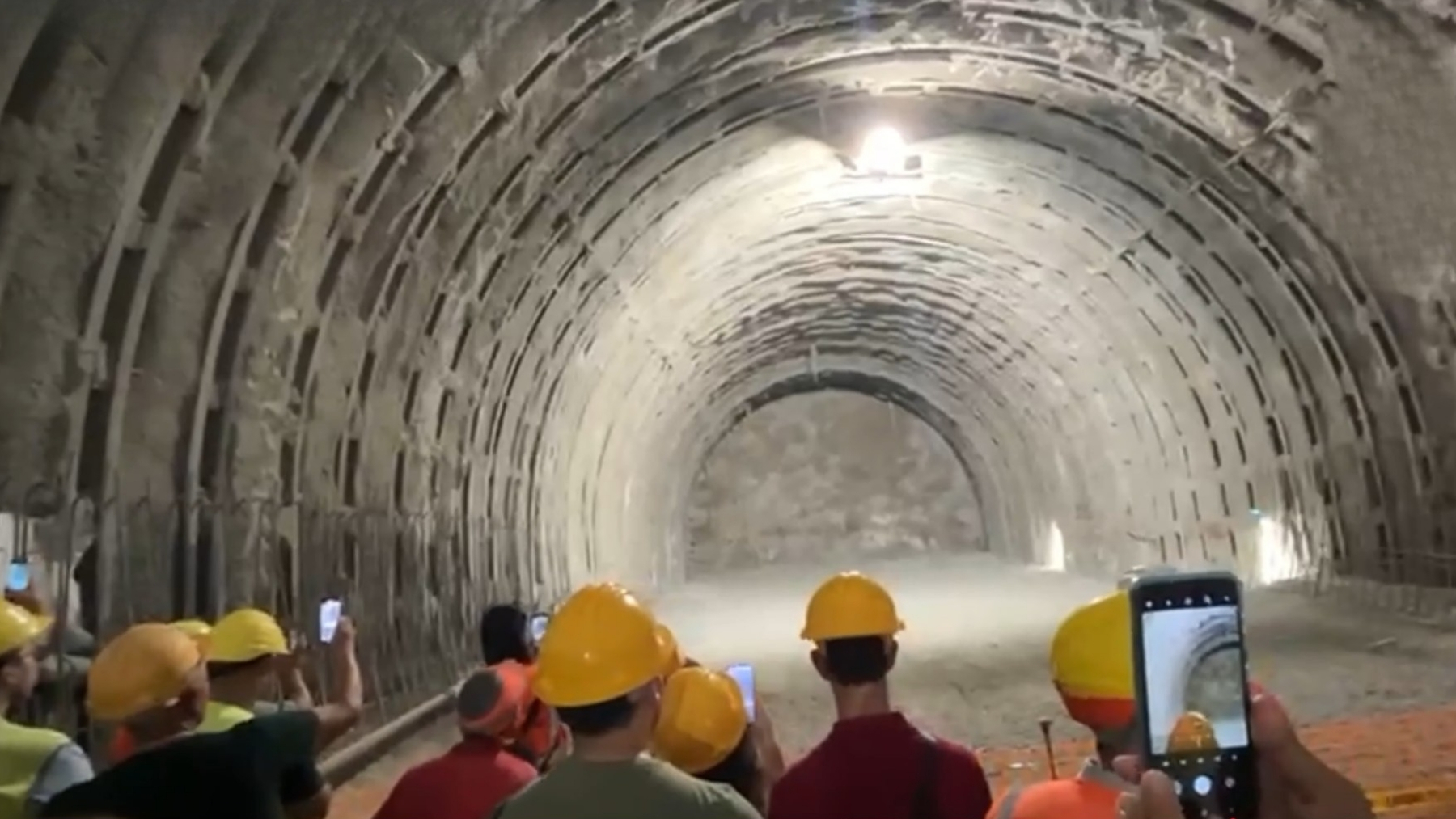
The most famous piece of this hidden world is the New Rail Link through the Alps (NRLA). This mega project combines three base tunnels, Lötschberg, Gotthard and Ceneri, into a flat rail corridor beneath the mountains. The Gotthard Base Tunnel alone runs about 57 kilometers under the Alps and is the longest railway tunnel in the world. A passenger train crosses it in roughly 20 minutes.
From a distance, this looks like pure convenience. Shorter trips, fewer hairpin curves, less time stuck behind trucks in mountain traffic. At the end of the day, though, the key goal is environmental. The Swiss government describes the NRLA as a way to “shift freight traffic from road to rail in order to protect the Alps.”
Trains instead of trucks in fragile valleys
Heavy trucks used to thunder through Alpine valleys in ever-growing numbers. That meant diesel fumes in narrow villages, summer smog trapped between steep slopes, and more accident risk on winding passes. The Alpine Initiative, approved by Swiss voters in the 1990s, pushed the country to move long-distance freight onto trains instead.
The tunnels are the hardware that makes that promise real. A flat route under the mountains allows longer and heavier freight trains with lower energy use, since locomotives no longer need to climb steep gradients. Studies of Eurozone freight show that trains typically require about one-fifth of the energy and emit roughly one-quarter of the greenhouse gases per tonne‑kilometer compared with heavy trucks.
Combined with a distance-based heavy-vehicle fee, this has changed the balance on Alpine transit routes. Today more than 72 percent of cross-Alpine freight in Switzerland travels by rail. In 2018, around 941,000 trucks crossed the Swiss Alps, about one-third fewer than in 2000.
Without the Swiss modal shift policy, analysts estimate that 651,000 additional trucks would have passed the Alps in 2016 and that at least 0.7 million tons of CO2 were avoided in 2017 compared with a business‑as‑usual scenario.
Even so, the job is not done. In 2019, a specialist from the Swiss Federal Office of Transport noted that “we are now shortly under a million trucks on the road per year” through the Alps and that this was still about 300,000 more than the political target.
In 2022, official figures still counted around 880,000 lorry journeys across the Alps, with rail holding a high share of about 74 percent of goods transport. For the most part, Switzerland has bent the curve, but it has not completely solved it.
For people living in those valleys, every freight train that replaces a convoy of trucks means quieter nights, fewer exhaust fumes in summer heat, and less risk when you pull onto the highway.
Building deep tunnels without trashing nature
Digging a tunnel through a mountain is never impact free. The Gotthard Base Tunnel alone involved excavating about 28 million tons of rock and pouring huge volumes of concrete. That embodied carbon footprint is real.
Swiss planners tried to minimise local damage during construction. An official environment report on the Gotthard project describes how 152 kilometers of shafts and passages were excavated “with minimal environmental damage”.
Construction materials were moved by rail or ship where possible, site machinery was fitted with particle filters, and dirty wastewater was treated and cooled before it reached rivers. Nearby communities got noise and dust barriers built from stockpiled topsoil, and vehicles were washed often to keep streets clean.
Wildlife was part of the plan as well. Once work finished, riverbanks were restored, streams were put back into more natural channels, and dry-stone walls were rebuilt to give reptiles and small animals places to live. The idea was simple: if you dig deep, you have to give something back on the surface.
Deep infrastructure also brings safety gains in a warming climate. Avalanche galleries and tunnels already protect roads and railways from snow and rockfalls in Alpine regions. As heavy rain and extreme events increase, buried routes and flood relief tunnels can keep key lines open when surface roads are blocked.
What other countries can learn
Switzerland’s underground world did not appear overnight. Voters backed the Alpine Initiative and NRLA decades ago. Engineers then spent years refining routes and safety systems. A separate federal rail fund now guarantees long-term financing for upgrades and new links instead of short political cycles.
For other countries wrestling with highway congestion, air pollution and rising logistics emissions, the Swiss example offers a few practical lessons. Tunnels on their own are not a magic climate fix.
They only deliver real benefits when they are part of a wider package that includes strong rail investment, pricing that reflects environmental costs, and rules that actually push freight operators onto cleaner modes.
Back on the train, that can sound very abstract. You stand in a quiet underground platform, maybe clutching a coffee and checking the weather for the weekend, and all you notice is that the service left on time. Yet that ordinary feeling of reliability is exactly what gives people the confidence to leave the car at home and let the underground country carry them.