Long before roads, maps, or metal blades, hominins living beside an ancient lake in northern Israel seem to have known where to find the right stone. A new study of basalt tools from Gesher Benot Ya’aqov suggests they were not grabbing random rocks from the ground, but choosing volcanic material for specific jobs.
That is a big deal for a simple reason. Stone tools are one of the clearest records we have of early human thinking, and this work points to planning, landscape knowledge, and a tool-making tradition that may have lasted for many generations. Dr. Tzahi Golan and Dr. Yoav Ben Dor of the Geological Survey of Israel led the research, with Prof. Naama Goren-Inbar of the Hebrew University of Jerusalem.
A lakeside workshop
Gesher Benot Ya’aqov sits in the Jordan Valley, in northern Israel, where an ancient lake once shaped daily life. The site is about 780,000 years old and has preserved repeated visits by Acheulian hominins, meaning early humans and close relatives known for making large stone cutting tools.
Excavations there have uncovered stone tools made from flint, limestone, and basalt, along with animal remains, plant evidence, signs of fish consumption, and old traces of controlled fire. This was not just a random stop by the water. It looks more like a place people returned to again and again because it had food, raw material, and know-how in one landscape.
Why basalt mattered
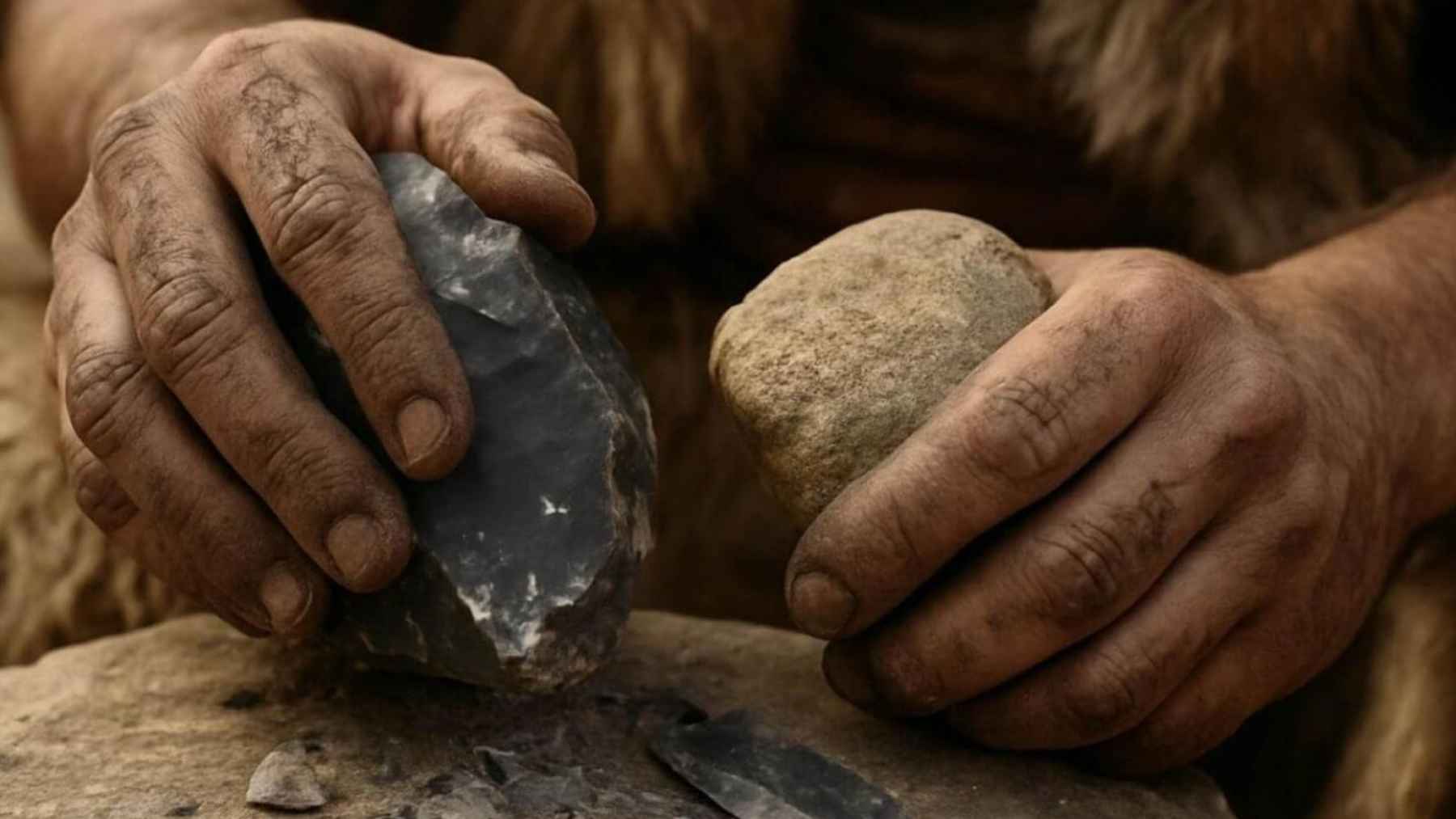
Basalt is a dark volcanic rock. It can be tough, heavy, and useful for making large cutting tools, including hand axes and cleavers. A hand axe could help with cutting and scraping, while a cleaver had a broad working edge that may have worked a little like a heavy kitchen knife.
Making these tools was not as simple as picking up a stone and chipping away. Earlier work at the site showed that toolmakers selected large slabs, shaped them into giant cores, struck off big flakes, and then turned those flakes into finished tools. One 2017 study on cleavers argued that this process required a planned sequence of decisions, with the choice to make a cleaver happening early in the work.
Reading a rock fingerprint
So where did the basalt come from? That question drove the new study.
The team compared the chemical makeup of ancient artifacts with basalt samples collected near the site. They also studied rock pulled from deep drilling beneath the archaeological area, which gave them a look at buried lava flows no longer visible at the surface. Think of it like matching a fingerprint, but with the natural mix of ingredients inside each rock.
The analysis looked at major elements, tiny trace elements, and rare earth elements. Those terms sound technical, but the idea is straightforward. Different lava flows cool with slightly different chemical signatures, and those signatures can help researchers trace a tool back to its likely source.
The nearest stone was often chosen
The results showed that many artifacts were made from basalt found very close to the camp, in some cases within about 0.6 miles. Several tools also matched basalt flows buried under Gesher Benot Ya’aqov itself, meaning the ancient landscape once exposed stone sources that have since disappeared from view.
That matters because the region sits in the Dead Sea Transform, a major fault zone where land has shifted over time. Tectonic movement, erosion, and sediment buildup changed the ground across hundreds of thousands of years. What we see today is not exactly what those toolmakers saw.
Not just any rock
Here is the most interesting part. The match was not the same for every kind of tool.
Giant cores were strongly linked to nearby and buried local basalt sources. Some cleavers, on the other hand, appear to have been made from basalt flows not found among the sampled outcrops. That does not prove the toolmakers thought like modern engineers, but it strongly suggests they noticed which rocks worked best for different tasks.
Size likely mattered. Shape mattered too. So did the internal structure of the stone, the hidden grain that decides whether a slab breaks cleanly or ruins the job. Anyone who has ever picked the wrong piece of wood, fabric, or even kitchen knife understands the basic idea.
Knowledge that stayed alive
The same selection patterns appeared in several archaeological layers. That points to continuity over a long stretch of time, not just one clever group making one lucky choice. The lesson may have been passed along by watching, copying, and correcting mistakes.
No written instructions. No formal classroom. Just hands, memory, and practice, repeated long enough to become a technological tradition. For the most part, the evidence makes these early communities look less like passive survivors and more like careful planners working inside a changing world.
A wider picture of early life
This new basalt study fits with a growing body of research from the same site. A Nature Ecology & Evolution paper reported evidence that fish were cooked and eaten at Gesher Benot Ya’aqov, making the site important for the history of food preparation.
Another study published in the Proceedings of the National Academy of Sciences found ancient starch grains on basalt tools, suggesting that plant foods such as acorns, grass grains, yellow water lily, legumes, and water chestnuts were processed there. That adds a more familiar human detail.
These people were not just making sharp edges. They were organizing food, tools, fire, and movement around a lakeside home range.
Why this discovery matters
At first glance, basalt sourcing can sound like a small technical point. However, it opens a window into behavior that bones alone cannot show. Where people got their stone can tell us how well they knew the land, how far they moved, and whether they planned ahead before the cutting even began.
The takeaway is not that these hominins were modern people in every way. The safer conclusion is more precise and, in some ways, more fascinating. Nearly 800,000 years ago, they could read their landscape well enough to choose the right volcanic rock for the right tool.
The main study has been published in Scientific Reports.