For 9 days in September 2023, seismic instruments around the world picked up something strange. Not the chaotic signature of a normal earthquake, but a slow, steady pulse that returned about every 92 seconds.
Scientists eventually traced the signal to Dickson Fjord in East Greenland, where a massive rock and ice avalanche crashed into the water and generated a megatsunami roughly 650 feet high. New satellite analysis has now helped confirm that the wave became trapped in the narrow fjord, sloshing back and forth like water in a giant bathtub while sending vibrations through Earth’s crust.
A mountain fell into the fjord
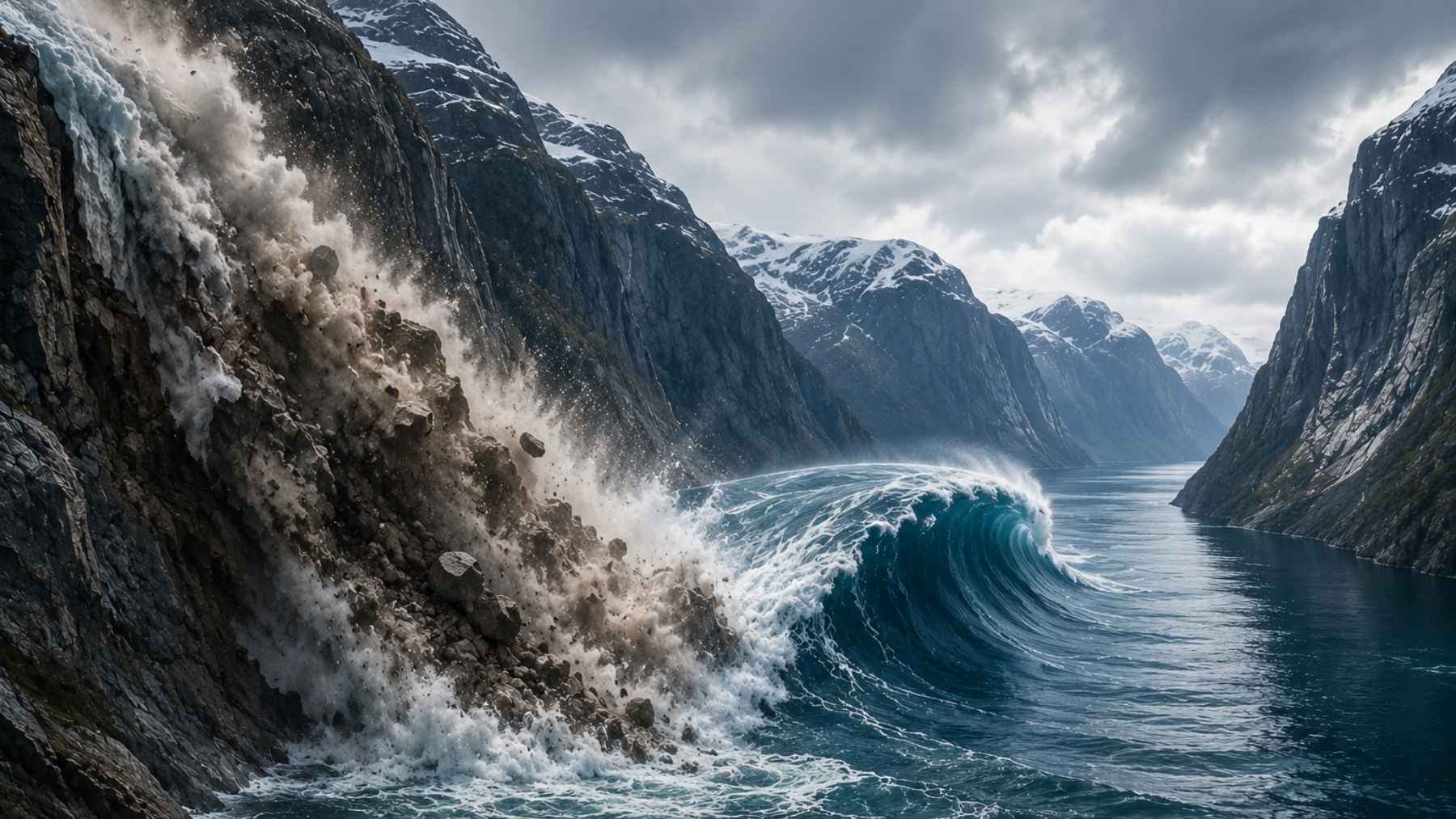
On September 16, 2023, more than 880 million cubic feet of rock and ice broke loose and plunged into Dickson Fjord. That is about 33 million cubic yards of material, enough to fill around 10,000 Olympic-size swimming pools.
The impact sent a huge wave racing through the fjord, where steep walls and tight turns gave the water almost nowhere to release its energy. Far from the open ocean, the wave rebounded again and again, turning the fjord into a natural echo chamber.
The fjord itself is no small crack in the landscape. NASA’s Jet Propulsion Laboratory describes it as about 1,772 feet deep and 1.7 miles wide, with walls rising higher than 6,000 feet in some places.
The signal that puzzled scientists
At first, the seismic record made little sense. Earthquakes usually create busy, messy signals with many frequencies, but this one was oddly clean and persistent.
The rhythm came in at 10.88 millihertz, or one pulse about every 92 seconds. It lasted for 9 days, then a similar signal appeared 1 month later after another event in the same fjord.
“When we set out on this scientific adventure, everybody was puzzled,” said Kristian Svennevig of the Geological Survey of Denmark and Greenland. According to GEUS, solving the mystery took a collaboration of 68 scientists from 40 institutions in 15 countries.
Why the water kept moving
The key word is “seiche.” It means a standing wave that rocks inside an enclosed or partly enclosed body of water, a bit like the slosh you see after bumping a full bathtub.
In Dickson Fjord, the tsunami did not simply surge once and fade away. Models and satellite observations show the water rocked from side to side for days, pressing on the seafloor with enough regular force to register on seismic stations thousands of miles away.
That is the eerie part. Nobody standing on land felt a global disaster in the usual sense, but sensitive instruments heard the planet ringing.
Satellites finally saw it
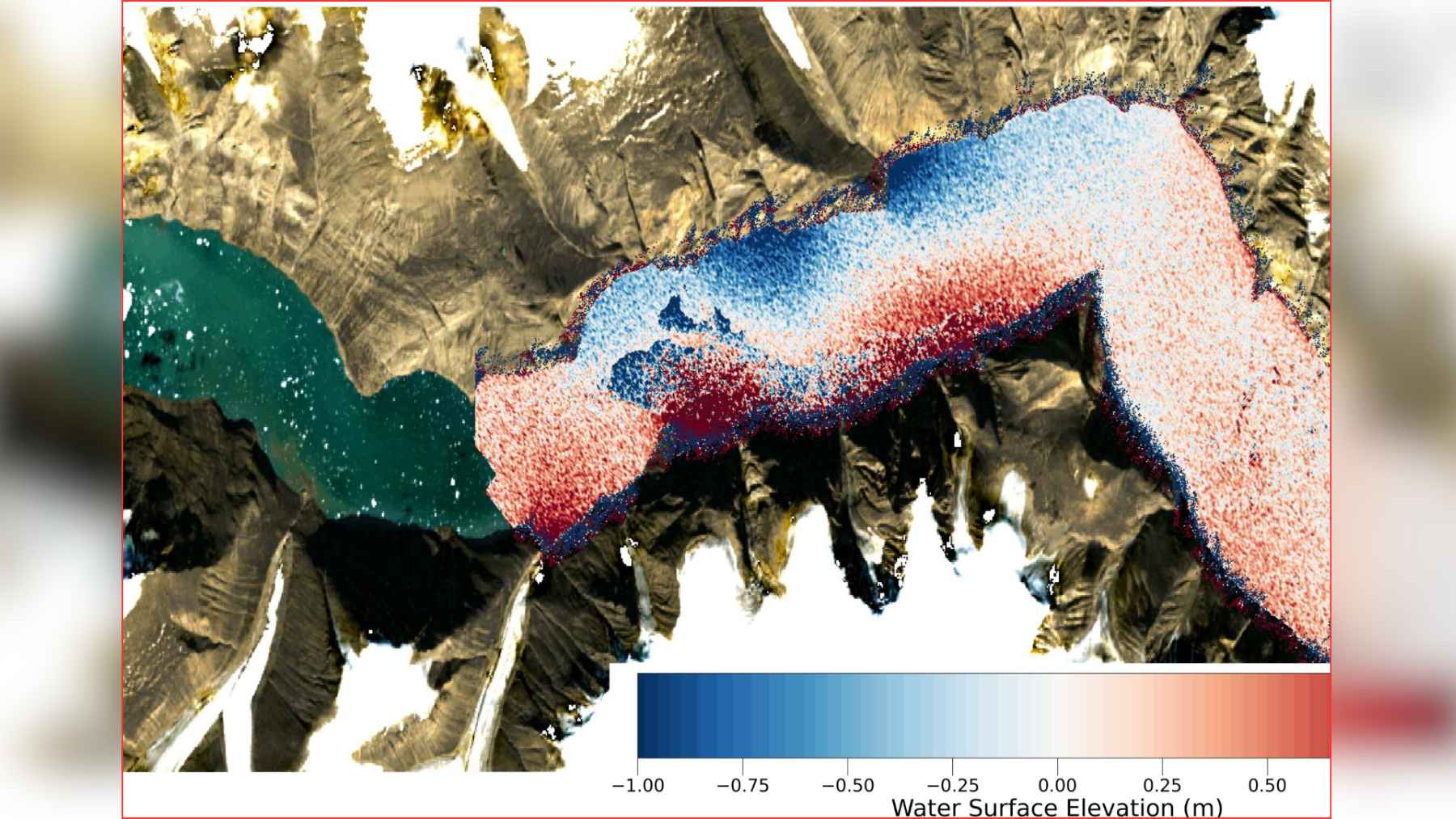
The newest breakthrough came from the Surface Water and Ocean Topography satellite, known as SWOT. The mission is a collaboration between NASA and France’s Centre National d’Études Spatiales (CNES), with contributions from other space agencies.
Unlike older altimeters that measure a thin line beneath the spacecraft, SWOT can map a broad swath of water roughly 30 miles wide. Its KaRIn radar instrument allowed researchers to see changes in water height inside the fjord, where older satellites struggled.
On September 17, 2023, 1 day after the collapse, SWOT data showed water on the north side of Dickson Fjord sitting as much as 4 feet higher than on the south side. Later analysis in Nature Communications estimated the initial trapped wave amplitude at about 26 feet.
Climate change is part of the story
The disaster did not happen in isolation. GEUS reported that glacial thinning at the base of the mountain over recent decades helped set up the collapse, and linked that thinning to climate change.
Ice that once helped brace the mountain slope had weakened. Once that natural support faded enough, gravity did the rest.
“Climate change is giving rise to new, unseen extremes,” said Thomas Monahan of the University of Oxford. That warning matters because Arctic regions are warming fast, and many of the most dangerous slopes sit far from roads, towns, and ordinary monitoring equipment.
A warning for Arctic travel
No cruise ship was near Dickson Fjord when the 2023 tsunami hit. That was luck, not planning.
The area sits along routes used by tourist vessels exploring Greenland’s fjords, and GEUS noted that a tsunami of this scale could have had devastating consequences if a ship had been nearby. In a place where help is far away and weather can turn quickly, even a few minutes of warning could matter.
There is also cultural damage to consider. GEUS reported that tsunami waves damaged a research base at Ella Island and destroyed cultural and archaeological heritage sites across the fjord system.
What scientists do next
Researchers are now looking back through seismic archives for similar slow pulses that may have gone unnoticed. Some may point to past landslides in remote places where nobody was watching.
Better monitoring could combine satellite passes, seismic networks, fjord maps, and machine learning. It sounds technical, but the goal is simple enough. Spot the danger earlier.
At the end of the day, Dickson Fjord shows that the Arctic can still surprise the world. A mountainside can fall in a place few people ever see, and the whole planet can hear it.
The study was published in Nature Communications.