Norway’s shrinking mountain ice has revealed a remarkably complete pair of wooden skis, including twisted birch and leather bindings, from about 1,300 years ago. One important correction is needed before the story travels any further. Archaeologists found the first ski in 2014 and recovered its match in September 2021.
The skis still deserve attention because they offer rare physical evidence that people moved through Norway’s high mountains in winter, most likely for hunting, transport, or both. They also expose a harsher modern reality. The same warming that releases this frozen history can quickly destroy it once wood and leather meet open air.
A pair reunited after seven years
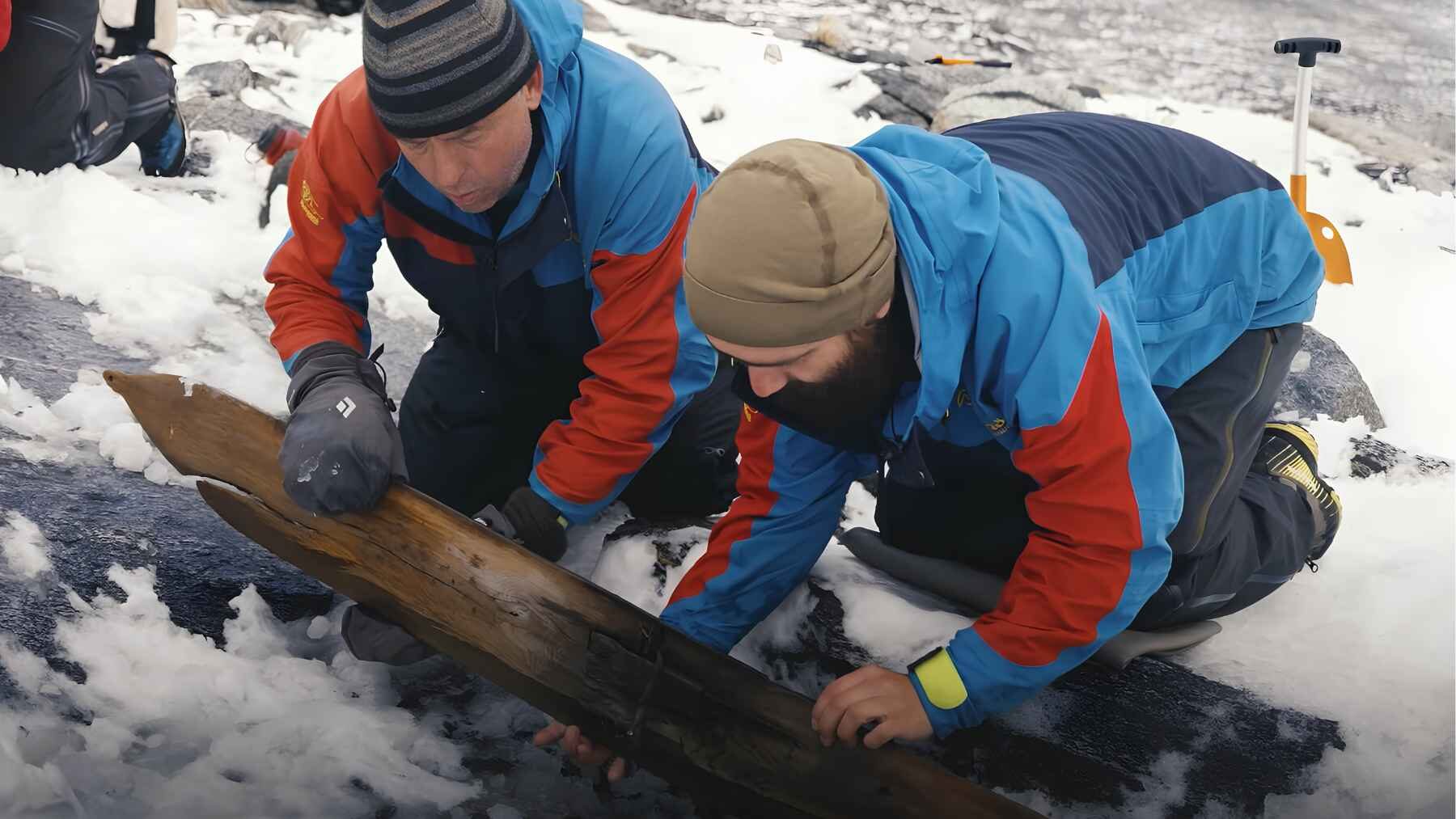
Archaeologist Runar Hole and companion Bjørn Hessen spotted the second ski on September 20, 2021, about 16 ft. from the first find. Satellite images had shown that the Digervarden ice patch had retreated, but the ski remained locked in ice. A rescue team returned six days later and cleared roughly 12 in. of fresh snow before carefully freeing it with an ice axe and lukewarm water.
The second ski measures about 6 ft. 2 in. long and 6.7 in. wide. It is approximately 6.7 in. longer and 0.8 in, wider than the 2014 ski, differences that may reflect handcrafting, wear, and the fact that one had remained farther inside the ice patch.
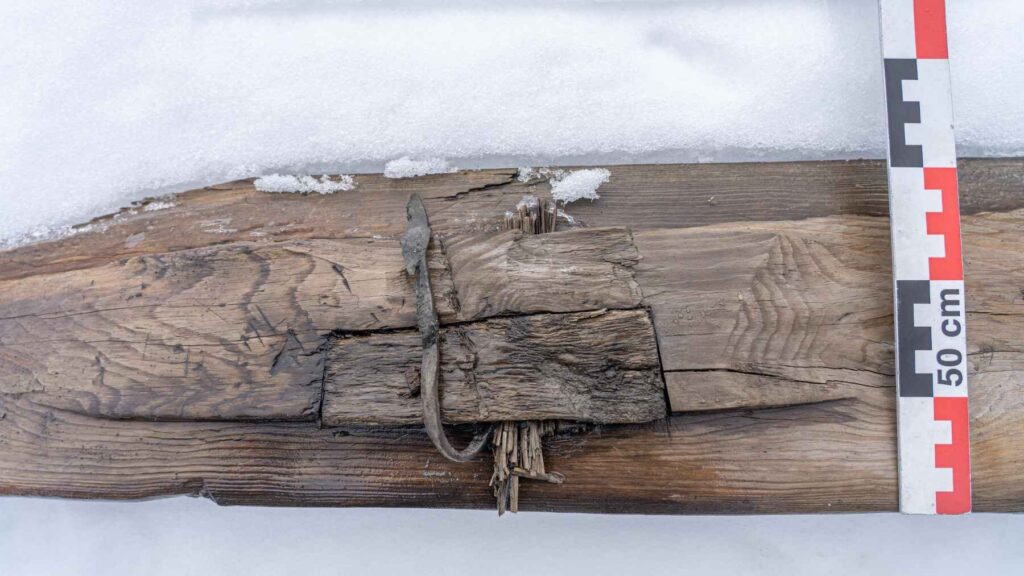
This was not unused equipment. The raised foothold had been repaired, while the binding retained twisted birch, a leather strap, and a wooden plug. Small variations between the skis make sense because they were handmade and had separate histories before one person used them as a pair.
Why the bindings matter
Ancient wooden skis are known from northern Europe, but their bindings almost never survive. The Digervarden skis preserve enough of that system for researchers to understand how the wearer’s feet were secured, which is why the team called them the “best-preserved pair of skis from prehistory.”
The binding combined a toe loop made from twisted birch with a leather component around the heel. That arrangement would have offered more stability and helped the skier push uphill, a practical advantage when every step had to carry a person across deep snow rather than a groomed trail.
The better-preserved ski also has a lengthwise groove on its underside. Researchers say that feature makes a fur lining unlikely, since a groove would serve little purpose beneath a layer of hide. Experiments with replicas showed that the broad Iron Age design was fully functional, although it did not turn like modern skis with rigid bindings.
Who crossed Digervarden
Digervarden has produced arrows, hunting structures, and other evidence linked to reindeer hunting. Yet cairns near the ski find may mark an old mountain route, and archaeologists recovered the remains of an 18th-century sled in roughly the same area.
That leaves a compelling possibility. The owner may have been a hunter, a traveler, or both. A 2026 scientific overview notes that skis and sleds provide clear evidence of winter movement and that human use of high mountains was more extensive than researchers once assumed.
Why were valuable, repaired skis left behind? A broken binding, a small avalanche, or a serious accident are possible explanations, though the evidence cannot tell us which one is right. The mystery remains.
Why an ice patch matters
Digervarden is an ice patch, not a fast-moving glacier. Bed-frozen ice patches can remain largely fixed to the ground and preserve wood, leather, textiles, and other organic materials for thousands of years, while flowing ice is more likely to bend, crush, or scatter them.
That distinction also changes how archaeologists work. Teams use satellite images, aerial photographs, terrain data, and local ground observations to identify stable ice and track retreat. Once an object emerges, meltwater can move it downslope and exposure restarts decay, turning each discovery into a race against weather.
The Digervarden rescue showed that urgency in real time. Archaeologists had to wait out a storm, hike for three hours, locate the find beneath new snow, and remove the ski without splintering the ancient wood. Not exactly a routine dig.
A climate archive at risk
A major melt season in 2006 exposed hundreds of objects in southern Norway and helped drive the creation of a permanent glacier archaeology program in Innlandet. By 2026, that work had increased the regional total to about 4,500 artifacts from 70 sites.
There is a painful contradiction here. Human-caused warming is opening an archive that was inaccessible for centuries, but it is also dismantling the cold storage that protected it. According to the latest review, Innlandet and Yukon are the only regions with permanently funded programs dedicated to recovering and documenting these finds.
The ice has acted a little like a freezer. Once the door opens, the clock starts. Wood and leather begin to deteriorate, while meltwater can carry away the surrounding context before a team arrives.
What the skis can prove
It is tempting to connect the skis directly to the Late Antique Little Ice Age, a cold period generally dated from 536 to about 660 CE. That claim goes beyond the available evidence, since the first Digervarden ski has a calibrated radiocarbon range of about 663 to 859 CE. The pair may reflect long-term adaptation to mountain conditions, but it cannot by itself document a response to that specific climate event.
What is solid is simpler and more revealing. An Iron Age traveler used repaired, technically capable skis in a mountain landscape once thought to see less winter activity, and modern warming is exposing that evidence at a cost.
The latest scientific overview was published in Annals of Glaciology.