A small piece of woven material has surfaced from the submerged Gran Carro settlement in Italy’s Lake Bolsena, filling a gap that archaeologists had faced for more than six decades. Researchers had already found spindles, loom weights, wooden tools, and other signs of cloth production, but never the cloth itself.
The fragment was recovered beside the remains of a domestic loom and among charred debris from an ancient dwelling. Though tiny and fragile, its tightly worked weave points to a level of skill that challenges the idea that everyday Iron Age crafts were simple or rough. It is a modest object with a surprisingly large story to tell.
A missing piece finally appears
The latest work was coordinated by the Underwater Archaeology Service of Italy’s Superintendency for Archaeology, Fine Arts and Landscape for Southern Etruria. L’Anfora SRL Archeologia Mare Ambiente and CSR Restauro Beni Culturali also took part in the excavation.
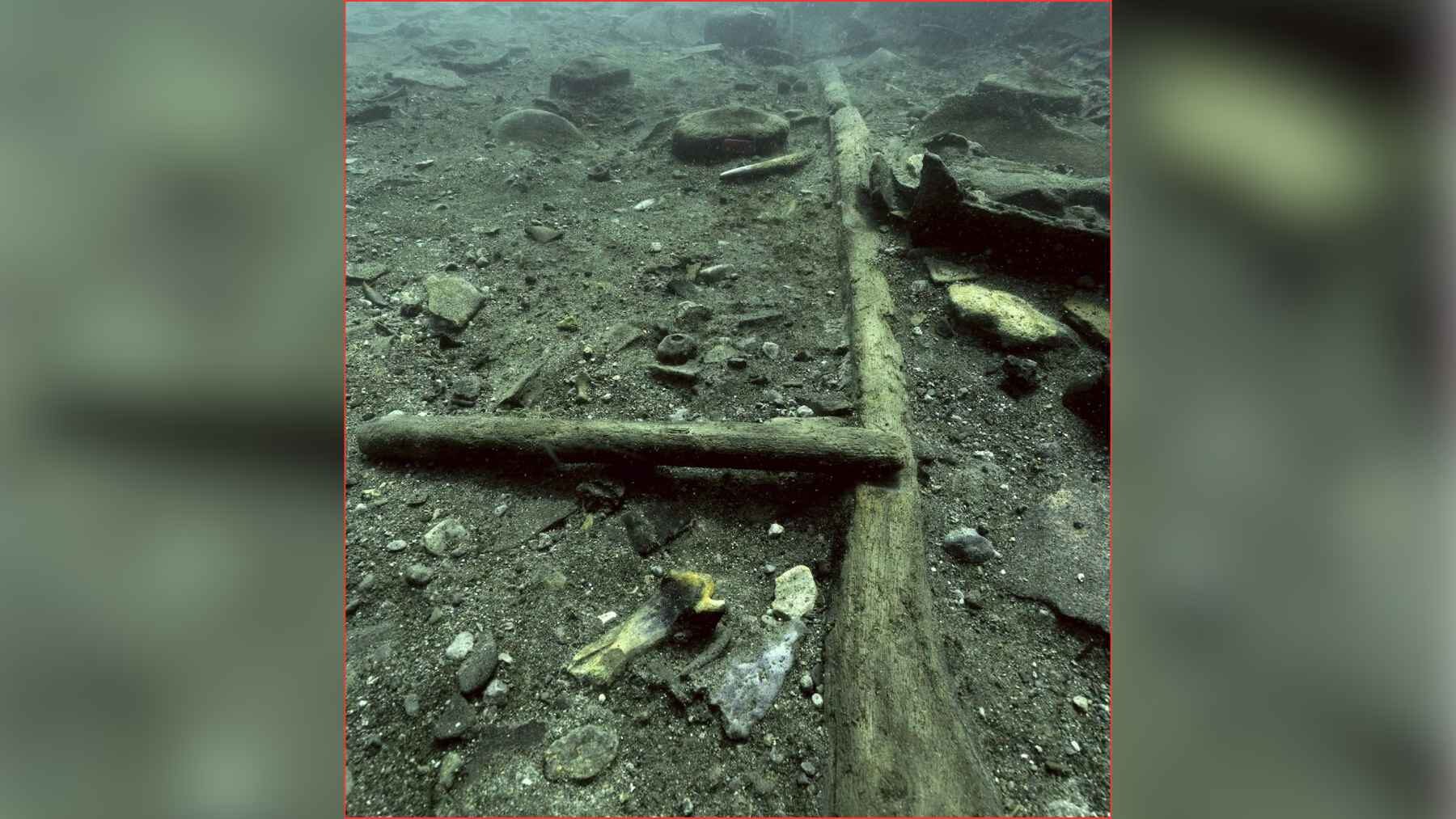
Archaeologists found the textile in an area next to a loom structure first identified during the 2025 campaign. Further excavation has now defined that loom more clearly and strengthened the conclusion that weaving took place inside the settlement’s wooden homes, not only in shared outdoor work areas.
That matters because textiles rarely survive for thousands of years. Pottery, stone, and metal can remain in the ground long after clothing, cord, baskets, and other organic materials have vanished, leaving an incomplete picture of daily life.
Weaving was household technology
A loom was not simply a piece of furniture. It turned prepared fibers into clothing, belts, bindings, bags, and other useful goods that people needed every day, much as a kitchen or workshop supports daily life now.
The arrangement of wooden remains and loom weights is helping researchers reconstruct the vertical frame used by the household. Earlier finds of wooden spindles, spindle whorls, and possible weaving combs had already pointed toward textile production. The newly recovered fabric connects those tools to a finished product for the first time.
Does one tiny scrap prove that every home had a loom? Not by itself, but together with the structure and the concentration of tools, it provides unusually direct evidence that textile work was woven into domestic routines across at least part of the village.
A bone tablet adds another clue
The team also recovered a perforated bone tablet in Area 1, the first object of its kind documented there. It is evidence for “tablet weaving”, a method in which warp threads pass through holes in small cards or tablets that are turned to create strong, patterned bands.
These narrow strips could have reinforced clothing, served as belts or straps, or supported hanging objects. The technique required careful coordination and planning, so the find broadens the picture of what Gran Carro’s craftspeople could produce. They were not relying on a single way of weaving.
Still, archaeologists are being cautious. The bone object and textile must be studied in detail before researchers can say exactly how they were used, what fibers were selected, or whether the materials came from the surrounding region.
Why the lake kept it hidden
Gran Carro lies near the eastern shore of Lake Bolsena, where much of the settlement is now about 4 to 5 meters underwater and roughly 100 meters from land. The site was discovered in 1959, and research has linked its occupation to a long period stretching from the Middle Bronze Age into the Early Iron Age.
Water can destroy organic material, but a lakebed with little oxygen can also slow the microbes that normally break it down. In this case, the fragment was found among burned structural remains, where charring and waterlogged conditions may both have contributed to its survival. That combination effectively turned the sediment into a sealed archive.
The same environment has preserved wooden building elements and household objects that would usually disappear on a dry archaeological site. That is why underwater excavation can reveal the quieter parts of the past, including work, storage, repairs, and meals rather than only monuments and graves.
Fire reshaped the village
The settlement’s archaeological layers show repeated episodes of burning, collapse, filling, and rebuilding. Researchers believe residents leveled the remains of damaged wooden structures and then constructed new homes above them, creating a complicated stack of occupation layers.
For divers, that means working through floors, walls, ash, sand, and objects in careful sequence. One careless movement can stir the lakebed and erase visibility, while fragile wood or fiber can be damaged by pressure that would barely affect a stone artifact.
That patience is paying off. Rather than treating the settlement as one frozen moment, archaeologists can begin to trace how homes, production, and daily habits changed through successive generations.
What researchers hope to learn
The textile fragment will undergo specialist examination at Italy’s Central Institute for Restoration. Researchers plan to study the fibers, thread twist, weave structure, and condition of the material, although no final identification of wool, flax, or another fiber has yet been announced.
Those results could show whether the cloth was locally produced, how much labor its manufacture required, and whether its raw materials point to wider exchange networks. They may also reveal whether the fabric was part of clothing, a practical household item, or something with a ceremonial role.
For now, its greatest value is simpler. Gran Carro had already preserved the tools of textile work. After more than 60 years, archaeologists finally have a surviving thread from the work itself.
The official statement was published on the Soprintendenza Archeologia Belle Arti e Paesaggio per l’Etruria Meridionale Facebook page.