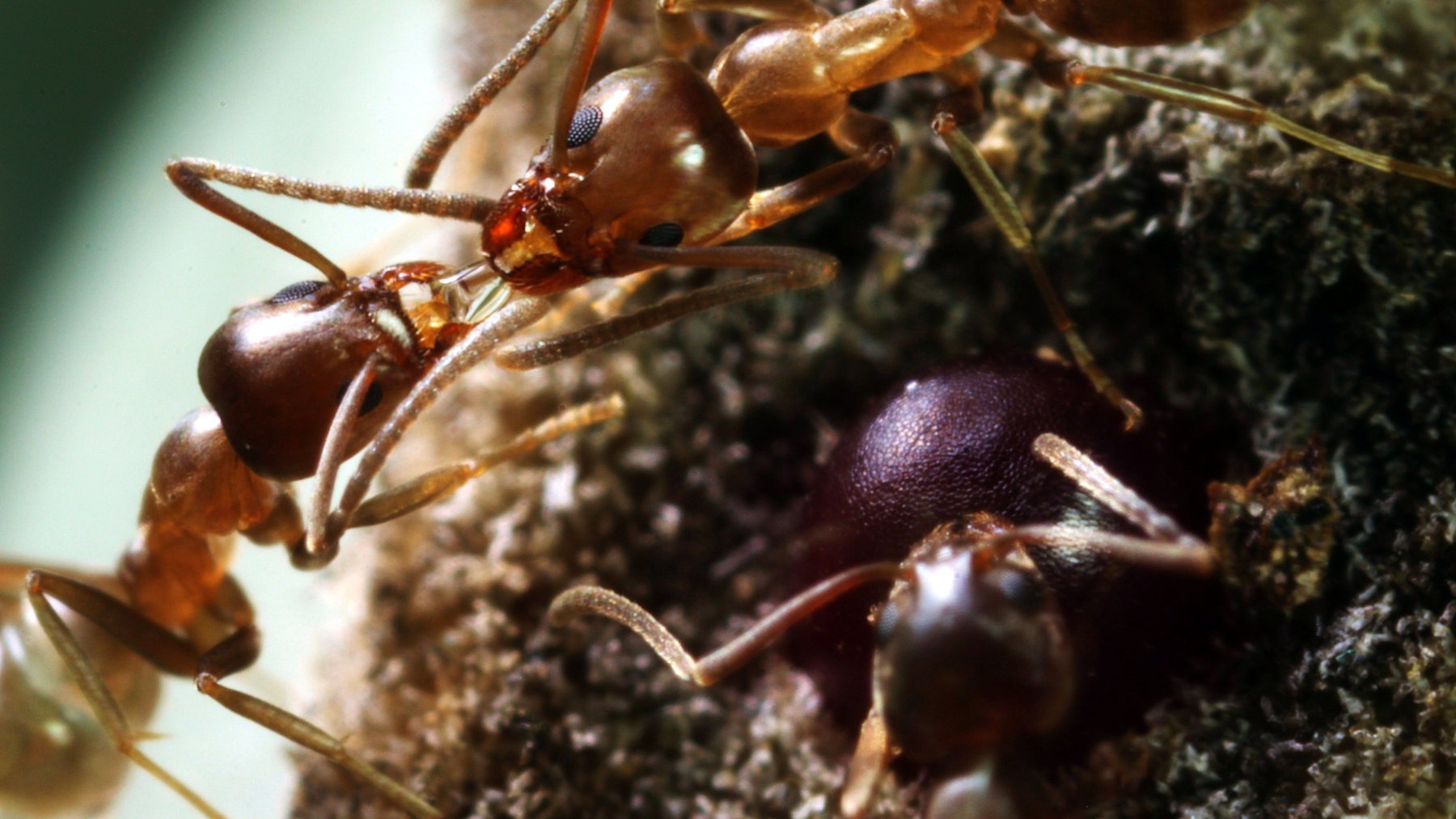
An ant trail passing under a flowerpot may look small enough to be brushed aside. But, the Argentine ant (Linepithema humile) created a social network registered in southern Europe, connecting sites in Italy, France, Spain and Portugal, spanning across around 6,000 kilometers (3,700 miles) of coastline. Although it is not a precise census, but rather an estimate, scientists calculated this system in millions of nests, containing billions of workers.
This discovery is not only a continental tunnel passing under cities, roads and beaches. It comprises a common social identity, which enables worker ants from separated nests to cross paths without the territorial confrontations observed in most ant species. Rather than behaving as a singular anthill, these innumerable local nests act more like cities within a federation.
A single society spanning 4 countries discovered by scientists
Across 6,004 kilometers of Atlantic and Mediterranean coastline, investigators sampled 33 Argentine ant populations in 2002. The results given by different aggression tests divided those sites between a huge main supercolony and a way smaller Catalonian colony. The main group was “largest cooperative unit ever recorded” according to the investigation team.
Although genetically different and geographically apart, ant workers from distant areas of the supercolony did not fight one another. But, on the other hand, workers from the Main group became highly aggressive when encountering those of the Catalonian group. The Main society extended between Italy, southern France, Spain and Portugal, according to latest investigations.
It is not a unique interconnected tunnel
Although the term “supercolony” may lead to assume that this is a singular nest spanning from the Italian coast to Portugal, this is not what researchers concluded. Rather than an uninterrupted underground structure, there is a common conductual limit observed within this 6,000 kilometer delimitation.
The way this arrangement works can be evidenced by research made on a California population. While local nest networks may contain up to 5 million ants and occupy up to 650 square meters, ants only shared labeled food along trails up to 50 meters. Instead of every worker feeding each other across a whole continent, the result showed something more alike a tapestry of laboring neighborhoods.
Keeping the peace with a chemical passport
What is the reason behind ants behaving like nestmates when they are collected from thousands of miles apart? Detecting chemical compounds present on each others bodies, particularly cuticular hydrocarbons, workers use those scent profiles as colony labels. While incompatible odors can help recognize an outsider, aggression is reduced by similar profiles.
Instead of losing all genetic diversity, the initial team suggested recognition cues suffered a “genetic cleansing” after introduction. But, the ants are not genetically indistinguishable, and further research continued to investigate how genes and chemical labels modify the tolerance between introduced populations. The main issue is tolerance, rather than a flawless relatedness.
The invasive species’ ecological advantage: cooperation
Transported across oceans and between far away areas by human activity, the Argentine ants are originally native to South America.Developing colonies can propagate an estimate of roughly 150 meters every year, according to one PNAS reconstruction. On the other hand, they can jump up to three orders of magnitude farther when human transport is involved. Once they settle in, decreased aggression inside a supercolony assists the ants in reaching a higher population, allowing workers to find more food, increasing their expansion.
This can mean grave consequences for native insects. At a sampling point investigated in one southern California study, the presence of Argentine ants, the average number of different local ground-foraging ant species fell from more than 7 to less than 2. Although the consequence differs by habitat, this is why ecologists treat this ant as much more than a domestic nuisance.
The impact is also felt by farmers. Sugary honeydew is collected by Argentine ants from various insects including mealybugs, scales and aphids, protecting those sap feeders from predators and parasitoids that would usually keep their numbers under control. Mainly in vineyards and citrus orchards, crop protection can be entangled by this partnership.
The biggest challenge? Controlling a network
The ants you may see walking across a counter or sidewalk represent just a very small visible part of a much bigger colony, spread across several nests. Killing those workers does not really impact the others nearby. For this reason, this species is so hard to eliminate. Researchers are now working on more accurate methods that could have better results, rather than repeatedly treating one entire area.
In 2025, researchers carried out a lab study, which exposed Argentine ants from four native supercolonies to six different insect-killing fungi. One of these strains, Beauveria bassiana Li053, killed more than 80 percent of the ants. Half of them died after just two to five days. The results seem promising, but further tests need to be carried out before it can be considered an efficient way to control the giant ant populations of Europe.
This huge “ant city” is not just one physical nest, but millions of colonies that are part of the same group. Their ability to cooperate is impressive, but at the same time, it also demonstrates how a species moved by humans can slowly transform entire ecosystems, even though one individual ant is very easily unnoticed.