In the midst of the energy transition, wind turbines have been installed underwater. The motive that has moved a Brazilian company to do this leaves experts in shock. The depths of the ocean hold great mysteries and one of them is intimately linked to energy extraction. We have previously seen such ambitious projects as unimagined energy in America, so it is not surprising to see these wind turbines.
Even with challenges to enjoy the energy located in the sea, significant progress is being made in the development of efficient and cost-effective technologies. In fact, there are already several projects in various parts of the world, and it is expected that in the coming decades ocean energy will have a privileged place. The sea, with its vast energy potential, is a valuable resource for achieving the renewable future sought by humanity.
After years of being governed by fossil fuels, the global objective is to bet on renewables in order to minimize the environmental impact caused. Global warming and climate change continue to advance while experts continue to perfect their technologies to exploit energy located or generated in the sea.
Underwater wind turbines: the installation that no one understands
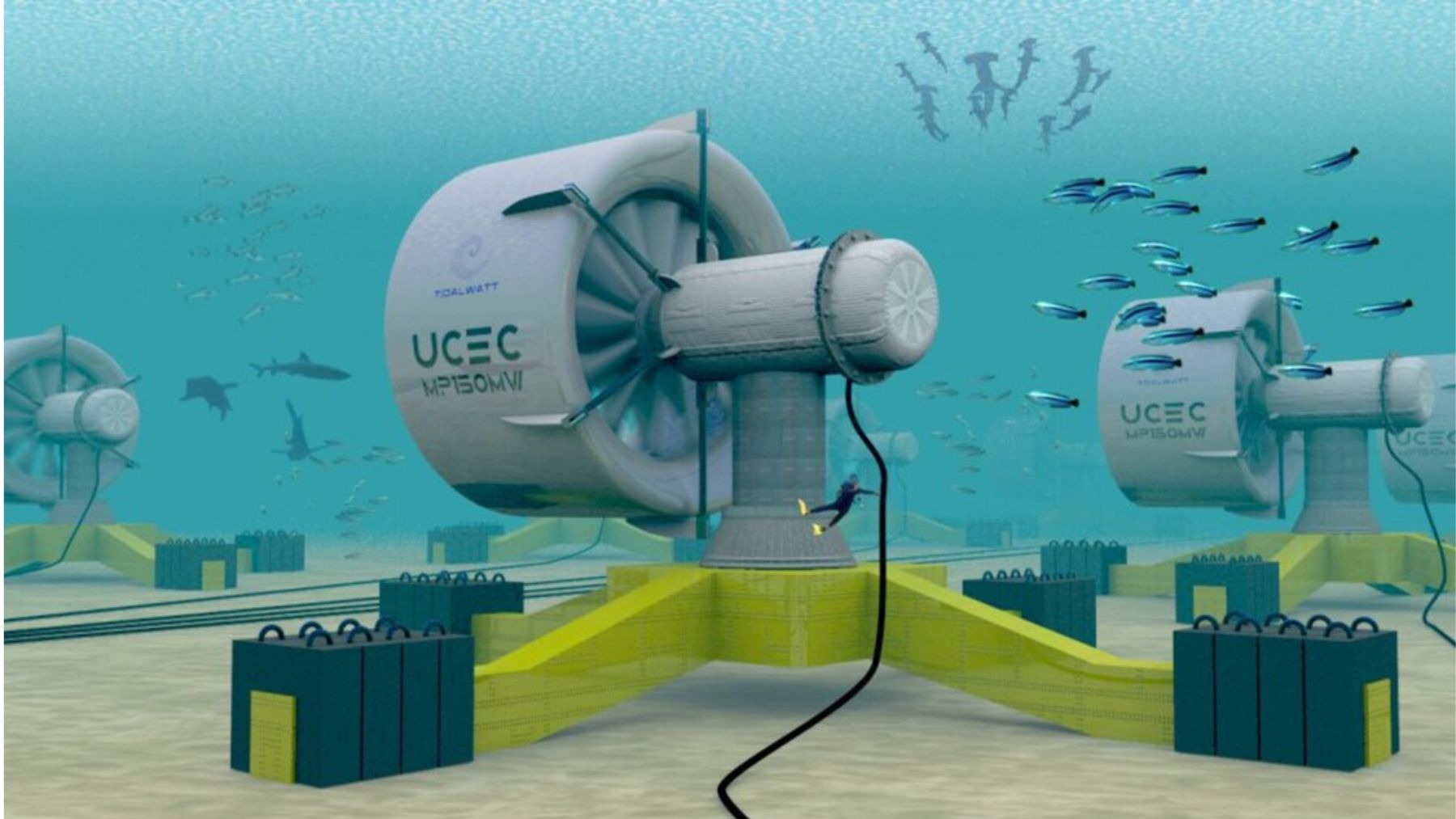
Brazilian company TidalWatt has developed its own underwater turbine: a Current Energy Collector unit (UCEC). Its purpose is to make the most of the energy located in the sea to gradually move away from fossil fuels and lower polluting gas emissions.
“If the source is predictable and constant, we say that it offers energy security. In that sense, the ocean is the only secure renewable energy source,” Mauricio Queiroz, CEO and founder of Tilda Watt, told Sustainable Brands.
“Ocean currents are already extensively mapped, so we already know numerous positions that are ideal for the installation of our subsea plants,” he added.
These turbines were also created to capture hydrokinetic energy from seabed currents and start from two premises. On the one hand, the reliability of ocean energy and, on the other, that these wind turbines are harmless to marine life.
The company’s approach is to use underwater turbines designed to capture the ocean’s energy. According to Mauricio Queiroz’s calculations, one of the company’s three-meter diameter devices could harness a current of 1.87 knots to generate 5 MW. “Practically the same power as a wind turbine with a diameter of 180 meters,” he pointed out to the aforementioned media outlet.
These underwater wind turbines change everything we knew about the ocean
In this way, his device could achieve similar power using a generator 60 times smaller in diameter.
A distinctive aspect of these wind turbines is their predictability, which is added to their many other benefits, such as the surface area they occupy, their impact or their technological details. “Because of source availability, a wind turbine on average produces energy 30% of the time; our technology does so 90% of the time. Being 3,600 times smaller, in coverage area, our turbines can produce three times more energy,” says the CEO of the firm.
Its devices are designed to work in areas with currents that exceed an average speed of one knot. With current data and taking Brazil’s consumption as a reference point, Queiroz estimates that a single underwater turbine could supply energy to around 22,800 families.
In short, these underwater wind turbines represent a before and after for those who believe in the ocean’s energy potential.