More than 120 years after Marie Curie’s pioneering experiments, some of her laboratory papers still contain radioactive contamination. France’s national library says a recently completed review has led to stronger measures to protect people and the environment while preserving these extraordinary scientific records.
But does that make the notebooks too dangerous even to view? The library’s measurements show that controlled displays can be safe, although handling the originals is another matter. The difference comes down to how people encounter the contamination, not how alarming the word “radioactive” sounds.
What the library’s radiation checks found
The Bibliothèque nationale de France (BnF) described its latest conservation review in the April to July 2026 issue of its magazine, Chroniques. Checks launched in 1996 and again from 2020 reassessed how the Curie collection should be stored and consulted, with the latest campaign resulting in stronger protections.
A separate BnF explanation reports a radiation dose of about 2 nanosieverts for someone spending 10 minutes in front of the museum case containing two notebooks. The library says the display adds no radiation above natural background levels, an important distinction from directly handling contaminated originals.
Access to original volumes remains restricted and closely supervised. Documented precautions include encapsulating the most contaminated sheets, covering some bindings with plastic, and providing microfilms so researchers do not always need the originals.
A discovery made in a leaking shed
The trail begins with Henri Becquerel, who reported in 1896 that uranium compounds emitted rays capable of fogging photographic plates. Marie chose to investigate those rays, using an electrical measuring instrument developed by Pierre Curie and his brother Jacques.
Her measurements showed that pitchblende, a uranium-bearing mineral, was more radioactive than its uranium content could explain. Something else had to be contributing, and the couple’s work led to the identification of polonium and radium in 1898. Radiation readings guided their search through the substances they separated from the mineral.
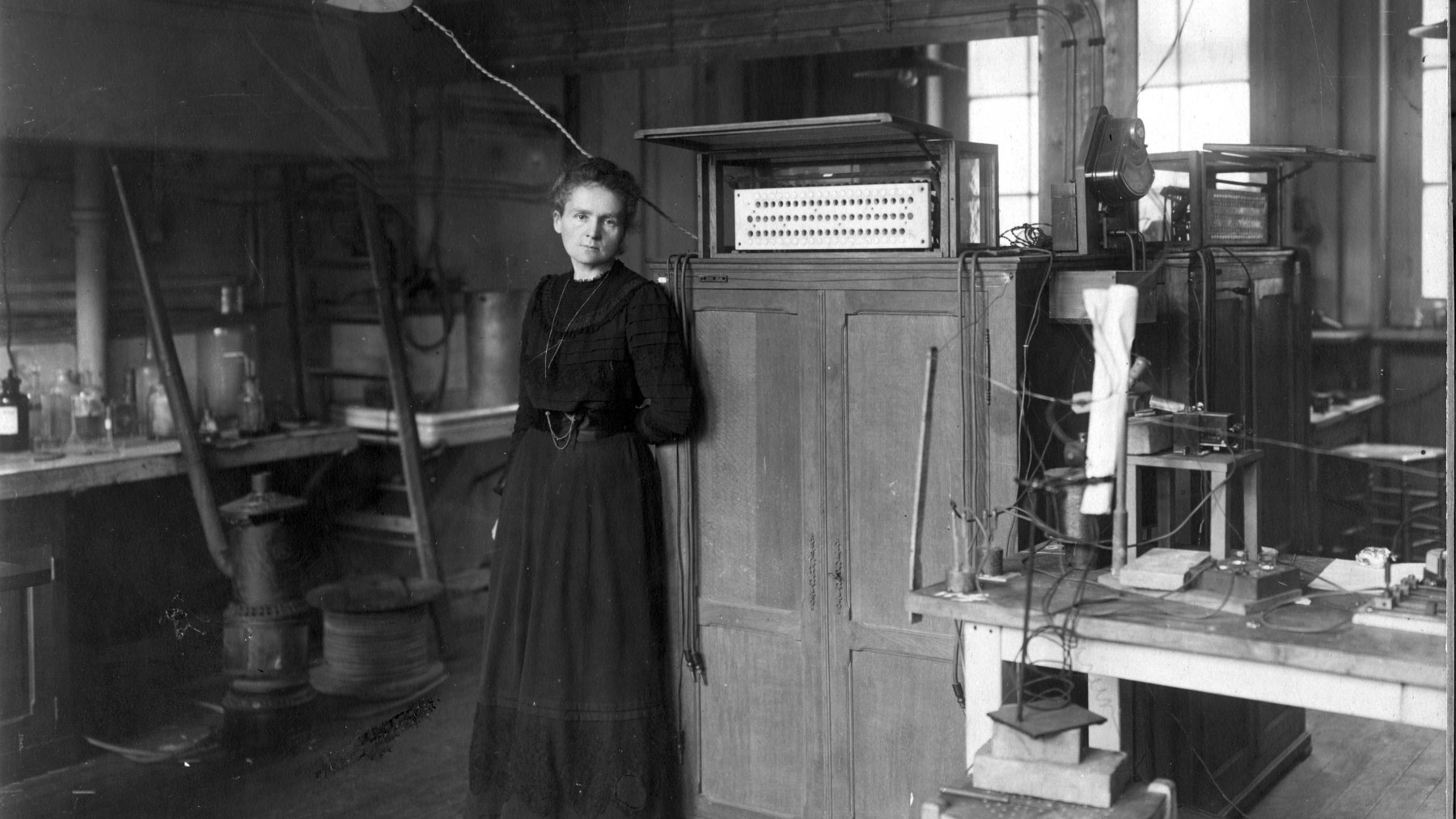
Finding the elements was only the beginning. To separate usable quantities, the Curies worked in an abandoned shed with poor ventilation and a roof that leaked, a space previously used for medical dissections. Summer heat and winter drafts made the work harder, and chemical fumes added another challenge.
Tons of residue for a tiny result
Instead of relying solely on expensive ore, they obtained residues left after uranium extraction in Bohemia. Marie processed heavy batches through repeated chemical separations and crystallizations, eventually obtaining about one-tenth of a gram of nearly pure radium chloride from several tons of starting material.
That took more than three years, even with industrial assistance. The product was a radium compound, not a lump of pure radium metal, but it was enough to help establish the new element’s atomic weight. Tiny did not mean insignificant.
Marie later recalled stirring boiling material with “a heavy iron rod nearly as big as myself.” This was exhausting physical labor as well as scientific detective work, carried out long before the full consequences of prolonged radiation exposure were understood.
Why 1,600 years is not a safety deadline
The notebooks became contaminated because radioactive particles settled on work surfaces, hands, clothing, and paper. Turning a page while handling laboratory materials could leave traces embedded in the sheet or its cloth binding, where some remain active today.
Radium-226 has a half-life of about 1,600 years, according to the Environmental Protection Agency. That means half the original radium-226 atoms decay over that period, not that the remaining material suddenly becomes harmless when a calendar reaches a particular year.
So a prediction that the papers will become safe in another 1,500 years cannot be drawn from half-life alone. Actual risk depends on the radiation dose, its type, and the circumstances and duration of exposure. A visitor behind glass and a researcher turning an untreated page are not facing the same situation.
A lesson that reaches beyond the archive
There is an environmental connection hiding in those piles of mining residue. The EPA notes that uranium processing concentrates radium in its leftover material, known as tailings, illustrating why removing a valuable mineral does not necessarily remove the radioactive hazard.
Radium also decays into radon, a radioactive gas that can accumulate inside buildings. The connection brings this history closer to everyday life, because the behavior of these elements matters well beyond a Paris laboratory or a glass museum case.
For the Curie archive, preserving scientific history includes controlling contamination and limiting unnecessary handling. The notebooks are both a record of discovery and a reminder that its physical traces still need managing.
The official account of the latest conservation review was published on the Bibliothèque nationale de France website.