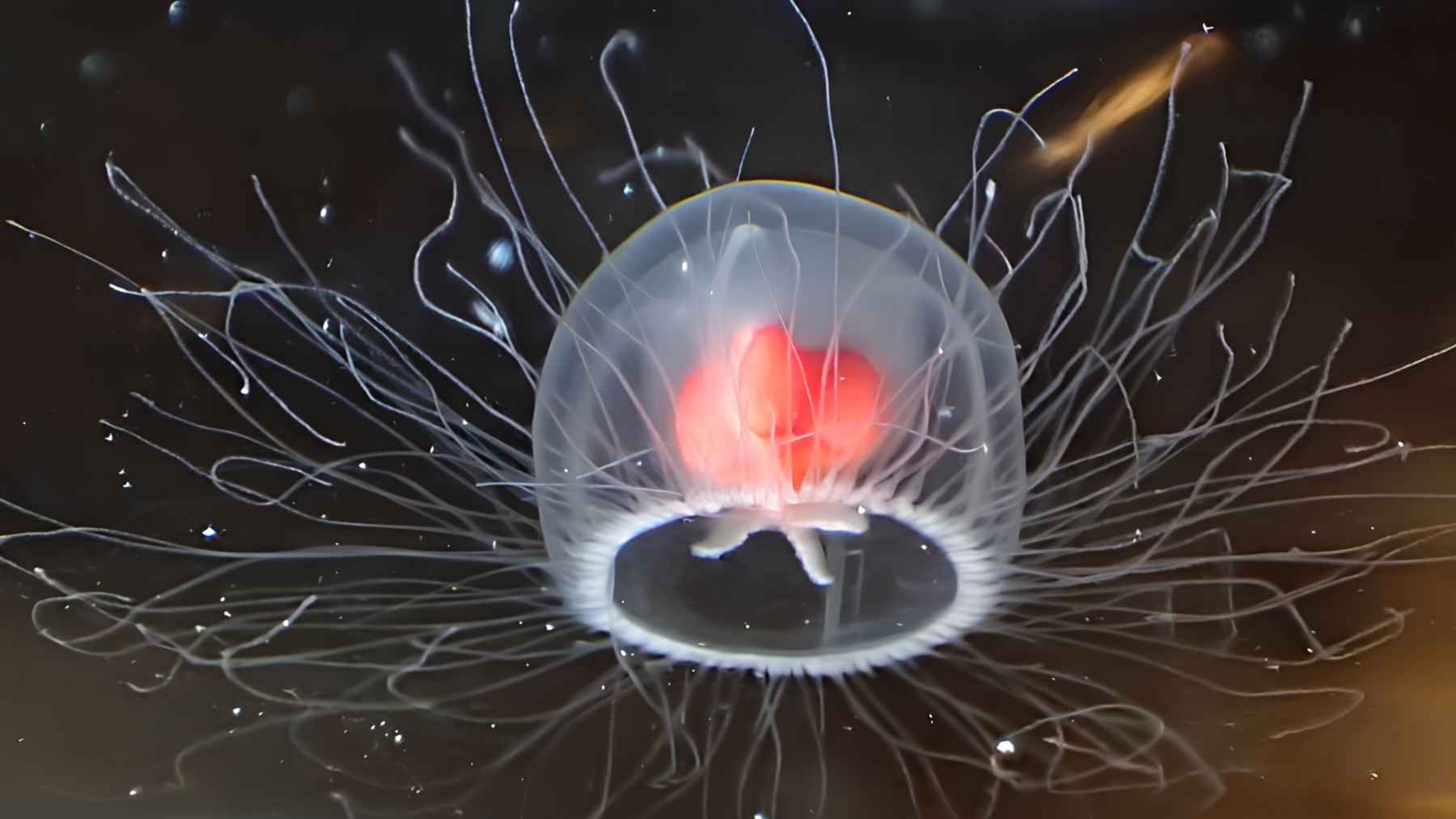
Let’s do an exercise: try and picture an animal that is smaller than your pinky fingernail. Now imagine that at first it has the form of a jellyfish but if you keep looking at it it loses its original shape and becomes a blob. Eventually, if you keep looking, that blob starts to grow back and becomes a jellyfish again.
This crazy mechanism is the survival trick developed by the Turritopsis dohrnii. A tiny tiny creature also known as the “immortal jellyfish”: a creature that can reverse its development instead of dying like every other animal.
They can still die though! They can be eaten, infected, or destroyed, but their singular ability to repeatedly return from an adult medusa to a polyp if left alone makes it one of biology’s most remarkable examples of rejuvenation and a unique model for scientists studying aging.
The jellyfish that turns adulthood backward
Most species of jellyfish move through an alternating life cycle. Free-swimming adults called medusae begin the cycle releasing eggs and sperm. That results in larvae that settle on a given surface and eventually grow flower-like polyps that bud off a new generation of medusae.
The Turritopsis dohrnii is different because when it faces critical conditions it takes a different route. First the medusae lose their familiar bells and tentacles until it settles into a mass that looks like a cyst. Then it grows back and reorganizes into stolons (that look like stems) and polyps (that look like lumps) that together can produce new jellyfish.
The whole caboodle is not just like the “healing” we are used to. Cells that had one job are reprogrammed into completely new functions in a process named transdifferentiation. Sounds crazy but instead of regenerating specific cells the whole organism divides itself into a bunch of tinier parts. Each of those parts can then work together to rebuild and/or regrow a missing limb or rework a structure that was not functioning properly!
Why the word immortal can be misleading
Because of that, to avoid any confusions, the biologists try to use the “biological immortality” terminology carefully or not use it at all. Even if the animals avoid the death timer or reverse their own aging, they are still exposed to other animals and complex diseases. Plenty of fish and other predators have jellyfish as part of their diets, also some specific diseases or even too much damage may not be curable.
These guys are definitely special regardless of that. Researchers describe Turritopsis dohrnii as exceptional since it is the only known animal able to repeatedly rejuvenate after reaching the sexually mature medusa stage. Other jellyfish species and even a comb jelly have shown forms of reverse development but none of them were repeatable.
Scientists are looking for the reset mechanism
Back in 2022 a team did a genomic study to try and compare the Turritopsis dohrnii with its relative Turritopsis rubra, a similar species that does not possess the same rejuvenation capability. The scientists did not find a magical “immortality gene”, though. What they found instead was that the individuals had differences in the structures that help their cells survive and change.
Examples include different DNA replication and repair, telomere maintenance, protection against oxidative stress, stem cell renewal and even communication between cells. The team also found changes in pathways that were linked to pluripotency: an ability that enables the cells to produce different cell types when they are in the rebuilding process.
In other words the magical reset button the scientists were looking for has been debunked, it does not exist. What exists is a whole process that coordinates a bunch of different areas together.

The recipe for human immortality does not exist
Is it possible that we can mimic the process in humans? For now there’s no evidence that the results can be replicated into humans given how much more complex our internal structure is. Even at a cellular level resetting the cells is not the same as making an entire human body younger. The scientific tests done with the jellyfish are completely different from those done with lab rats or monkeys. Their structures are not mammalic structures, also they are so tiny the scale we work on isn’t even close.
Still the animal is so unique it stands as a strong subject of further studies and can give better answers to questions about natural regeneration. If we understand the process it goes through in order to preserve its DNA, manage cellular stress and change its tissues into other structures we could maybe elucidate similar processes that occur in human cells.
A tiny animal with a worldwide footprint
An adult jellyfish of the immortal species only reaches a few millimeters, which makes it really easy to miss even despite the fact that populations have been found in seas all over the world. Scientists suspect that ship traffic and the movement of ballast water might be the most important factors that cause the spread of these tiny travelers across distant points.
It’s funny how such a tiny organism can pose questions regarding life’s most familiar rules, the idea that development always goes forward and that aging cannot be reversed.