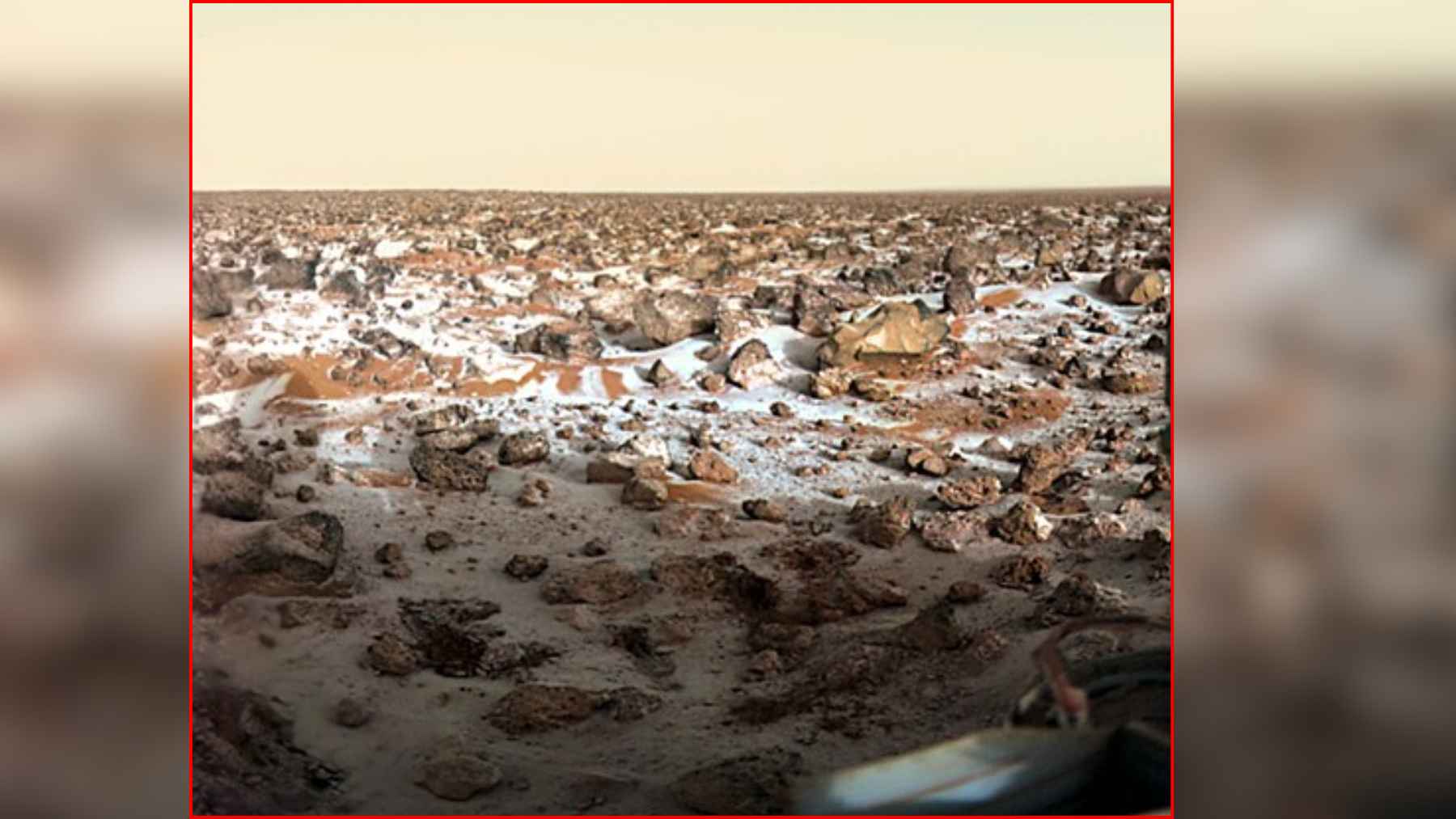
In the 1970s NASA’a Viking lander photographed a light layer of frost on the rocks of Utopia Planitia, which may have done more than merely cover the stones. According to the latest examinations, during 30 Martian days every year, the receding frost could shortly blend with calcium perchlorate salts present in the soil, producing microscopic layers of liquid saltwater.
However, it is not like Viking 2 was stationed besides a small pool. This theorized fluid would be nearly frozen, highly saline, and only present in small areas around soil particles. Nevertheless, this new discovery demonstrates that new information can be revealed by data from a mission that happened decades ago.
Records of a winter not seen again by modern rovers
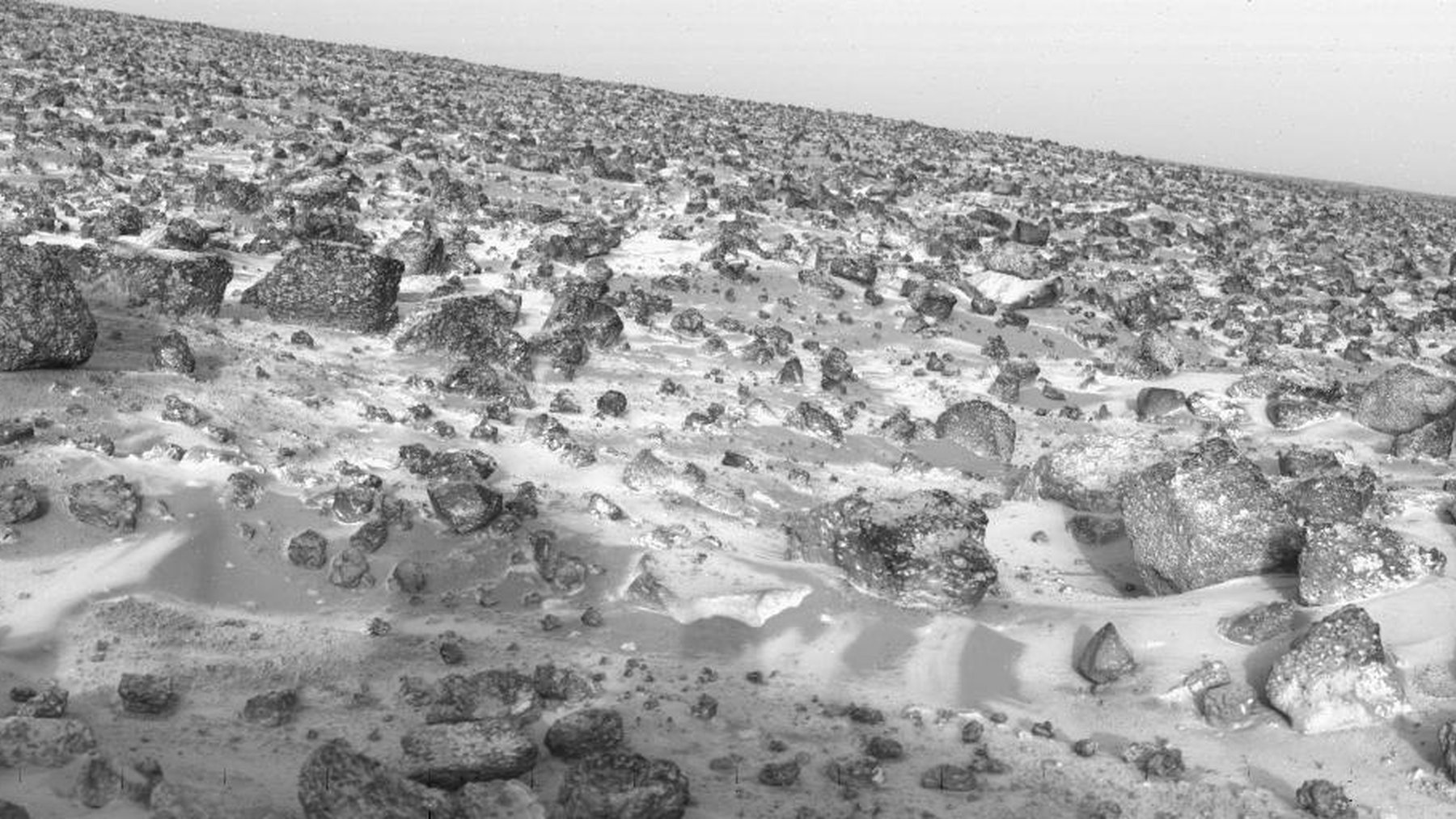
On September 3, 1976, at 47.6 degrees north of Utopia Planitia, Viking 2 made its landing. While later rovers operated in areas closer to Mars’ equator, Viking 2 endured a long Boreal winter, during which frost appeared on rocks and soil, surviving for around 250 Martian days.
Practically one Martian year after the previous frost, on May 18, 1979, the lander recorded another shiny frozen layer. Accumulating on top of rocks and in tiny cavities, a thin layer of frozen water can be seen in NASA’s image.
Measuring atmospheric pressure and air temperature, the lander was not equipped with a humidity sensor, and could not document ground temperature directly. This is important, given that the existing liquid is only micrometers thick, and is only present for a fraction of the day.
A limited interval for liquid evidenced by modern models
Using the existent weather registers and frost images from Viking 2, Vincent Chevrier of the University of Arkansas, combined them with a modern Mars climate model. This investigation provided unavailable surface information, such as ground temperature and water vapor, which allowed to examine if calcium perchlorate brine could prevent evaporating, boiling or freezing.
Even for condensed brine, the majority of winter was too cold, and when spring came and the surface became too dry, erasing the frost source. But, a narrow window during late winter provided conditions in which the soil was warm enough, raising humidity in the soil, allowing frost to remain present.
A report from the University of Arkansas claims these advantageous conditions would be present for about 30 sols, between early morning until late afternoon. This is the equivalent of almost two Earth months, given that a Martian day lasts about 24 hours and 40 minutes.
Perchlorate can modify what is considered as liquid water
On Mars, pure water battles to remain in a liquid state. Air temperatures during frost-season varies between around 155 to 220 kelvin (approximately -118 to -53 degrees Celsius) on the site of Viking 2, and atmospheric pressure can range between 7.5 and 10 millibars.
The freezing point of water can drastically drop by the presence of calcium perchlorate. With around 198 kelvin, or -75 degrees Celsius needed to reach its freezing point, a concentrated brine could remain in liquid form, whereas common water would freeze.
But, this information comes with a considerable warning. Given that Viking 2 was not able to detect perchlorate, the model has to hypothesize salts found in other places of Mars are also present in Utopia Planitia. Confirmed perchlorate in northern soil in 2008 by NASA´s Phoenix lander, Makes this assumption reasonable, but it is still a supposition instead of a concrete Viking’s recording.
30 Martian days does not guarantee an entire month of puddles
So, what would this brine solution look like? Even if these projections theorize about a 30 Martian day lapse in which the liquid could be stable, this does not mean that the surface would be constantly wet, and by no means implies the existence of streams or lakes.
The thickness of the frost layer was well under one millimeter: between tens to hundreds of micrometers. In reality, the salty solution would be like a transparent humid layer adhering to soil particles on the ground.
There is no photographic evidence showing liquid, nor any wet phase detected by any instrument. This investigation is the thermodynamic rebuilding theorizing when brine could have been present, and should not be considered as hard evidence that these droplets were accounted for almost half a century ago.
The presence of liquid does not guarantee it is habitable
Water is fundamental in the search for life, But the use of the term “liquid” can seem way more inviting than its chemistry actually means. The projected salty solution had almost 0.52 water activity, this means a large part of its water would be bound up by dissolved ions, which would be unavailable to any known organisms.
The conditions are even more hostile: extreme cold, highly reactive perchlorate chemistry and surface radiation, combine to create an uncomfortable shelter for microbial activity. There were no organisms, biosignature, or organic molecules reported by the investigation, being far from claiming the brine could assist in human exploration.
But, these periodical moist layers may have a geological importance. Recurring during many winters, they could shift salts, modify grain surfaces, or even leave mineral patterns that remain even after the moist either freezes or evaporates.
The data from Viking is still revealing its story
Equipped with humidity sensors, chemical instruments, ground thermometers and conductivity probes, future missions could witness the frost receding during the end of winter. By analyzing the same grains both in the morning and the afternoon, further studies could finally prove the existence of the theorized time lapse for the presence of liquid.
Even though Viking 2 stopped its transmissions in 1980, the records it left behind are still amplifying its importance, as researchers combine them with new Martian chemistry discoveries and the creation of better climate tools. Even though it did not reveal an ocean on its feet, the lander may have observed one of the smallest and more succinct liquid processes on modern Mars.
The study was published in the journal Communications Earth & Environment.