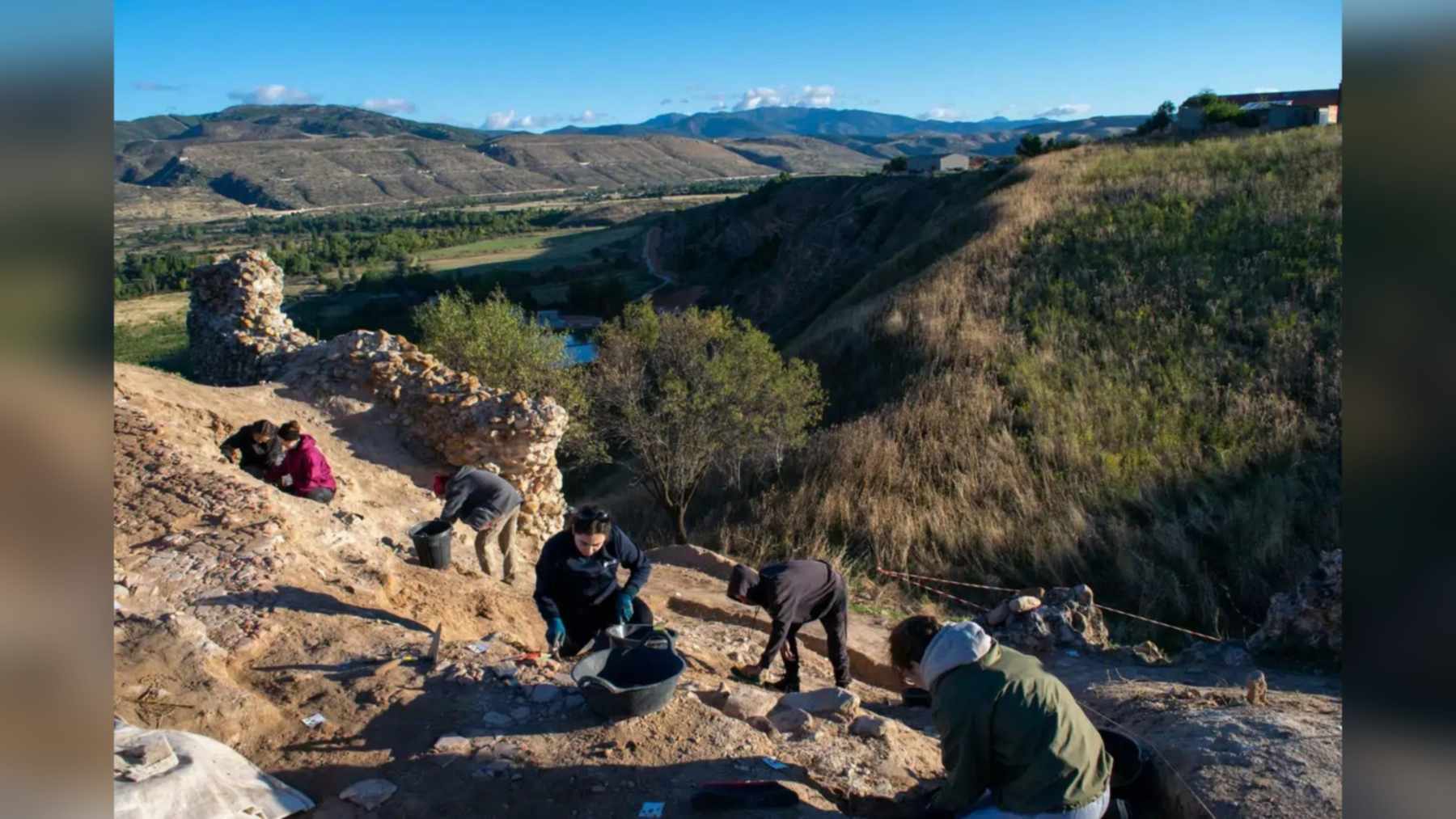
“Open to participation as volunteers,” says the poster the town hall of Uceda put out for the 2026 excavation campaign on September 2. The next line reads: “Minimum participation: 1 week.” The dig is at the town’s castle, on a cliff over the Jarama River in Guadalajara province, and around it lies a buried Islamic medina of about 30 acres (12 hectares).
September and October are listed for “excavation, documentation, archaeological drawing and classification of archaeological materials.” There is one address for information and sign-up, arqueologia@uah.es, run by the archaeology area of the University of Alcalá (UAH). The town council, the Guadalajara Provincial Council and the regional government of Castilla-La Mancha sign the poster with the university.
Six volunteers a week until October 20
The fine print came later, in Historia National Geographic. The call “will remain open throughout the whole campaign, until October 20, for anyone over 18 with a genuine interest in archaeology and a physical condition suitable for carrying out physical excavation work, as well as for regularly using construction and hand tools,” the magazine reported in September.
“In addition, the organization expressly asks volunteers to commit to attending at least one full week, equivalent to five working days,” it added. Six people per week. Sign-up stays open at arqueologia@uah.es until every place is taken.
Travel and lodging are on the volunteer. Breakfast is included. By mid-October, only the last shifts of the season are left.
Those who would rather watch can come on Saturday, October 17, from 10 a.m. to 2 p.m., when the excavation holds an open day, the town hall says on its website. Places are booked by email, through oficinaproximidad@uceda.es or the same university address. “We’ll be waiting for you to discover our heritage!” the notice ends.
Digging inside the old parade ground
Volunteers this season are mostly on one of the castle’s interior buildings and on what may have been its patio de armas, the open yard where a garrison would gather. Soil comes out, material gets moved, structures get cleaned. Some of the day goes to drawing, field records and sorting samples of sediment and finds.
The work is led by Manuel Castro Priego, dean of the Faculty of Philosophy and Letters at the University of Alcalá and a professor of archaeology, who began the project in 2022 with UAH full professor Lauro Olmo Enciso.
In July, Castro told elDiario.es about a newly located building of several floors in the parade ground area. “This year we want to excavate it. We think it may be from the 13th century,” he said.
The town hall’s website also carries a season-by-season summary of the dig. In 2024, it says, the team worked on a building of the parade ground raised in tapial, or rammed earth, and confirmed a second floor “paved with ceramic tiles and organized into different rooms.” The roof used beams and cane lattices coated in plaster. Pigmented plaster turned up as well, “with traces of blue dados and reddish ceilings or upper areas, which show a residential architecture of notable quality,” along with layers of fire and heavy collapse from the building’s destruction.
A medieval town that stayed buried
A medina is the walled urban core of a town in the Islamic world, where houses, streets and defenses shared one perimeter. To find Uceda’s, the team combined 3D ground-penetrating radar, which sends radio pulses into the soil to map buried walls, with two drones, one of them carrying LiDAR, a laser scanner that outlines structures under vegetation.
“The ground-penetrating radar work made it possible to confirm the existence of the fossilized Islamic medina,” Castro told elDiario.es. By elDiario.es’s account, the medina spread over 12 hectares and could have housed up to 2,500 people. It was “probably linked to Talamanca del Jarama,” Castro said.
“Its function would be to control the Somosierra passes, because in the caliphal period a whole defensive system of watchtowers to control the territory was created,” he added. The same kind of laser survey is now helping researchers look for the lost city of Almanzor near Córdoba.
The 2023 radar season, the town hall’s summary says, “substantially changed the known image of medieval Uceda. Compared with old proposals that depicted a practically empty enclosure, the survey revealed a dense web of structures preserved underground.”
The researchers call the medina fossilized because it was left behind in the early 16th century, when the new town spread outside the walls. “Although a large part of the old medieval city was plundered for centuries, it is, to a great extent, buried,” the team said in a 2023 interview published by the university.
From frontier stronghold to archbishop’s vault
Castilian sources already mention Uceda in the 10th century as a fortified place that was hard to take, Historia National Geographic reports. The UAH team dates the first use of the hilltop as a fortified site to the 8th or 9th century, when it sat on the Middle March, the frontier between Castilian and Andalusi lands.
Castilian troops took it in 1085, the year King Alfonso VI conquered the Taifa of Toledo, and they did so without a siege. “They found it abandoned and, from what we know, they were glad, because back then it was what we know as an ‘eagle’s nest.’ Otherwise they knew they would not have been able to conquer it,” Castro said.
Excavations point to three main stages, Historia National Geographic explains. What stands today is mostly the 15th-century fortress, built over a 13th-century castle and an earlier Islamic fortification. Castro ties that rebuild to the feud between the powerful Mendoza family and Alfonso Carrillo, archbishop of Toledo, saying it was “a castle that was built in a great hurry” and that its building defects “were probably due to the urgent need to protect themselves.”
Later, the fortress guarded weapons and money for the Archdiocese of Toledo. “Cardinal Cisneros kept a large part of the archdiocese’s weaponry there and also a large part of the revenues, the alcabalas,” Castro said, referring to a sales tax collected across the north of the archdiocese’s territory.
By the late 16th century the place was abandoned, and a forge was set up inside, elDiario.es reports. “They would have devoted themselves to plundering the metal. We believe there was also a lot of gunpowder there, because at that time there was a great explosion that destroyed the eastern facade,” Castro said. In the 19th century the ruin served as a quarry for the Pontón de la Oliva dam on the Lozoya River. “It was plundered even to build roads.”
Walls that old can outlast their own records, as with a medieval fortress hidden inside a building in Dublin, and Spain’s buried record runs much deeper, back to 8,000-year-old storage pits.
A misplaced gate and a strange burial
The 2022 season revealed a large cistern that secured water during sieges, a central courtyard and a second floor that still survives inside the fortress, the team reported the following year. Finding the way in took longer, a problem archaeologists also faced at a medieval gatehouse traced through molehills in Belgium.
“We are trying to find the access to the fortress,” Castro said. Old plans pointed to one spot, but the original entrance was somewhere else, and the team began to make out “a rather complex defensive system, made up of three towers, a moat… and a wall that was probably joined to the church.”
In 2025, the team uncovered a tower with a curved front and an open back, which forced a rethink of how people reached the inner fortress, according to Historia National Geographic. Castro also links the castle to the late Romanesque church of Santa María de la Varga. “We have discovered that this church and the castle were interconnected, probably through a long bridge, which in its final part would have been a drawbridge,” he said.
Near the wall, the diggers found an animal. “It was a hybrid between a wild boar and a pig that was pregnant with nine young,” Castro said, adding that archaeobiologists at the Autonomous University of Madrid are studying it. “It had been buried like a person, probably during the plundering phase of the castle, in the 17th century.”
Why the town wants volunteers
Castro runs Uceda as public archaeology, with local people inside the research. “In my experience, the involvement of citizens often ensures that you reorient strategies around what we should show, display in a museum or disseminate, turning archaeology into a much more horizontal activity that escapes the academic,” he said in a 2023 university interview.
For Uceda he described open days at different times of the year and one project in particular. “At present, we are working on recording and later disseminating how citizens have lived the space where the castle is located throughout their lives, and what the start of an archaeological project has meant, once again, in their memory and in their present,” he said.
The long-term plan, worked out with the town council, is to turn the ruins into a site people can visit. “We believe there is a chance to develop a rather powerful heritage program,” Castro told elDiario.es. The money comes year by year: 5,000 euros from the Guadalajara Provincial Council, between 11,000 and 18,000 euros from the town and up to 15,000 euros from the Castilla-La Mancha government, by elDiario.es’s figures. “That is why the project continues,” Castro said.
What is still uncertain
Most of the published detail comes from interviews and project summaries, with no peer-reviewed paper yet, so dates such as the 13th-century origin of the new building remain working hypotheses. elDiario.es notes that little is known yet about the castle, even though Castro says the work has “advanced enormously.”
Nobody knows why the hybrid was buried that way. “The truth is that the animal had a different appearance. Perhaps it had a ritual meaning, and it was certainly outside any Christian practice,” Castro said. A track running down from the castle to the Jarama turned up during the work too. “We believe it may be medieval.”
Then there is the town around the site. “We are concerned about what is going to happen with the historic center. We think about what could happen, in urban planning terms, with the Islamic medina; if we are not able to establish protection rules, there will be problems in the future,” Castro said.
After the parade ground building, the moat. The team intends to study it in 2027, and elDiario.es reports that it must have been about 13 feet (4 meters) high.
The official call was published by the Ayuntamiento de Uceda on September 2, 2026.
Shifts run until October 20, or until the six weekly places are gone.
Photo: Área de Arqueología, Universidad de Alcalá