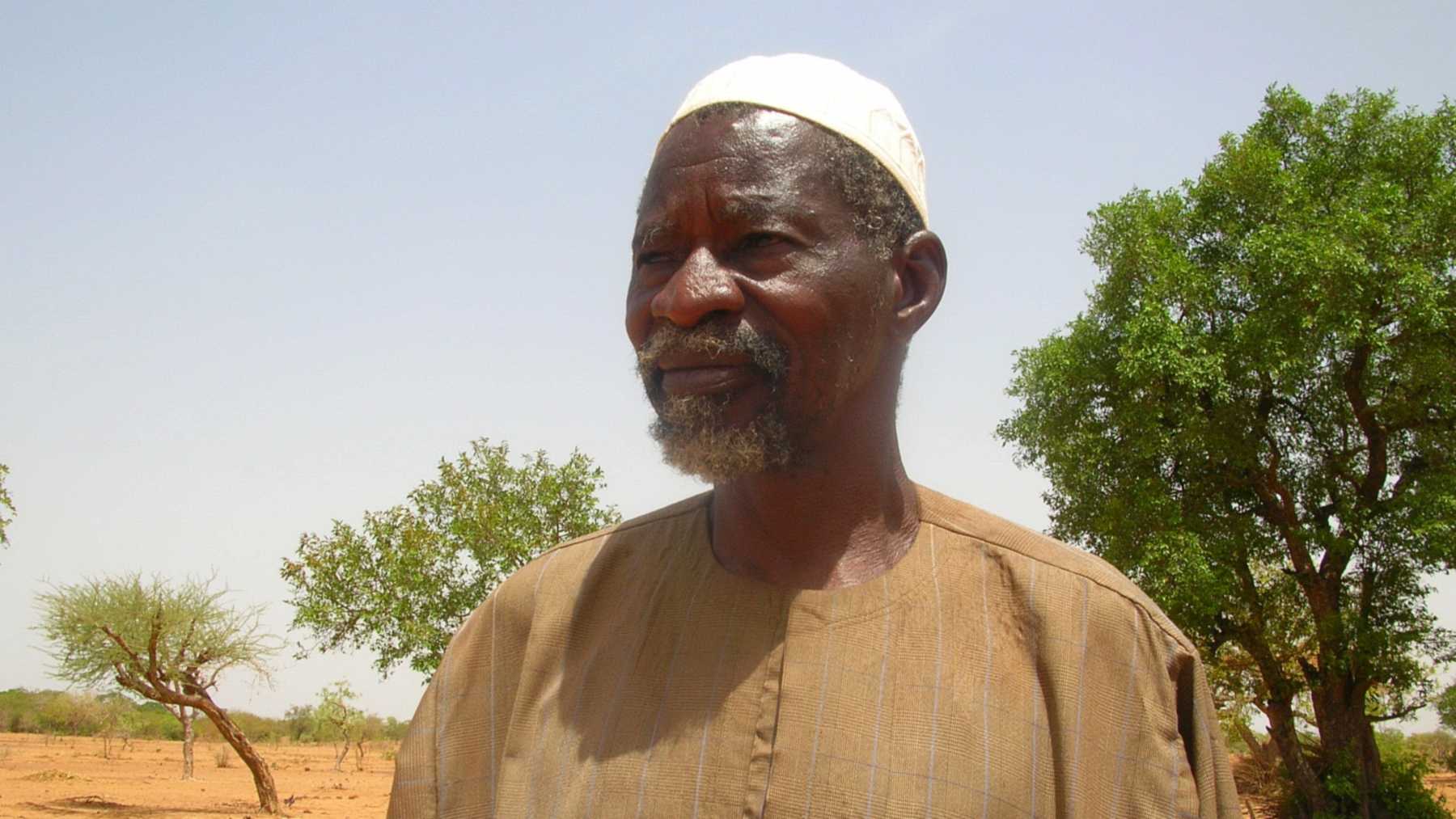
The sun was going down on another scorching day when journalist Mark Hertsgaard found Yacouba Sawadogo walking through his woods with a hatchet slung over his shoulder. On the Burkina Faso farmer’s land, the air was noticeably cooler, Hertsgaard wrote in The Nation in 2009.
Sawadogo could not read or write, Hertsgaard noted. Starting around 1980, he turned barren, abandoned ground in the Yatenga region into a forest of almost 40 hectares (nearly 100 acres) with more than 60 species of trees and bushes, according to Right Livelihood, the foundation that gave him its award in 2018.
“Climate change is a subject I feel I have something to say about,” he told Hertsgaard, speaking in Moré.
“In the drought years, people found themselves in such a terrible situation they had to think in new ways,” he said. The method he reached for, the zaï pit, was one farmers across the Sahel had dug for centuries. He made the pits bigger, put manure in them during the dry season and laid lines of stones, and termites, which feed on that organic matter, came along with it.
A pit dug before the rains arrive
“The traditional farming method used in my village allowed the rainwater to be easily washed away leaving the crops to dry up within a short space of time. That’s why I thought of a technique that would counter this problem,” Sawadogo said in 2011, in remarks reported by the Inter Press Service (IPS).
A zaï is a small hole dug into hard, degraded ground in the dry season, with organic matter dropped in. Once the rain comes, it funnels water toward the roots of millet or sorghum.
A soils bulletin from the UN Food and Agriculture Organization (FAO) describes typical pits about 6 inches (15 centimeters) deep and 16 inches (40 centimeters) across, spaced every 31 inches (80 centimeters). One or two handfuls of dry dung go into the bottom of each pit roughly two weeks before the rains, and millet is sown once they start.
Zaï means “to start early” in the Mossi language, according to the UN Environment Programme (UNEP). Sawadogo took the name at its word. “If you want to have a good yield, you have to start early,” he told UNEP when it named him a 2020 Champion of the Earth.
He went back when others were leaving
Severe drought hit the region around 1980. As harvests failed and people died of famine, many families left rural areas for the cities, while Sawadogo moved back from the city to his village, Right Livelihood says. “There was no food because of the drought and water was very scarce in my community,” he told delegates at a UN desertification conference in South Korea in 2011, IPS reported.
“People were leaving, and the animals and trees were dying,” he recalled for UNEP. “So, we had to look at a new way to farm because, all of the good soil was disappearing, and if we stayed here doing nothing, our life was at risk.”
Farmers there traditionally left their fields alone until the rainy season began. Sawadogo prepared his land well before it, dug the pits wider and deeper, and added manure during the dry season, a practice his peers derided as wasteful, Hertsgaard reported.
He also built lines of stones to slow runoff, which gave the soil time to absorb more water and hold its nutrients. At one point his forest was set on fire. “People thought I was mad when I started planting these trees,” he said in the same IPS report. “It is only now that they realise how beneficial the forest is.”
Then small trees began to come up between the rows of millet and sorghum, from seeds carried in the manure. “Since I began this technique of rehabilitating degraded land, my family has enjoyed food security in good years and bad,” he told The Nation.
Termites opened the crusted ground
Organic matter in the pits draws termites, and they do something a farmer with a hoe can’t easily do. According to the FAO bulletin, their galleries run from the surface of the pit deep into the subsoil, and that encourages rainfall to soak in.
Dorkas Kaiser, a termite specialist, went to Sawadogo’s village of Gourga to learn from him. “(It) is a scientist’s dream place to study the role of termites in the land restoration process,” she told IPS in the same 2011 article.
Kaiser was the lead author of a study, published in 2017, that picked sites in northern Burkina Faso at four stages of zaï restoration covering three decades, from barren crusted land and a millet field to two reforested sites. The team set out different organic materials to attract termites and then measured what the insects did to the soil.
Fungus-growing termites in the genera Odontotermes and Macrotermes were the key soil engineers through the year, but only Odontotermes started the restoration process. In the dry season, termites turned over 216 metric tons of soil per hectare (roughly 96 US tons per acre) each month in the most rehabilitated zaï forest, against 32 metric tons on barren ground.
“By creating tunnels, the foraging activity of termites increased the water infiltration rate by a factor of 2 to 4,” the authors write. Infiltration is how fast rain sinks into the ground instead of running off.
The researchers concluded that in the early stages of zaï restoration, the tunnels, which bring water and air into the soil, were likely more essential than the extra nutrients in the soil termites pile over their food, “since water deficit leads to sapling mortality much faster than nutrient shortage.” Organic waste has revived bare ground elsewhere too, as a Costa Rica experiment with truckloads of orange peels dumped on a barren pasture showed.
Farmers came to see the fields themselves
In 1984 Sawadogo began holding “zaï markets” on his land, two a year. Right after the harvest, farmers brought samples of the crops they had grown in their own pits, and he stored the seed in a bank at his homestead; just before the rains they came back to choose what to plant. Each market day eventually involved representatives from more than 100 villages, according to Right Livelihood.
“I’ve used my motorbike to visit about a hundred villages, and others have come to visit me and learn,” he told Hertsgaard. “I must say, I’m very proud these ideas are spreading.”
Ten years later he was still at it. “I want to design a training programme that will be the starting point for many fruitful exchanges across the region and there are so many farmers from neighbouring villages that visit me for advice on good quality seeds to plant,” he told the Italian outlet LifeGate in 2019. “I’ve chosen not to keep my farming methods as secrets to myself.”
In 1989, 13 farmers from Niger’s Tahoua region visited his fields and went home to restore degraded land with zaï. The next year brought drought, and only the farmers who had used zaï got a reasonable harvest, Right Livelihood says.
“Yacouba would have become a professor if he had been to school,” Chris Reij, then facilitator of Africa’s Re-greening Initiatives at the Centre for International Cooperation, told IPS. “Scientists come to learn from him.”
Reij, a Dutch geographer who had worked in the region for 30 years, pointed to the water tables. “In the 1980s water tables were falling by an average of one meter a year,” he told The Nation. “Since FMNR and the water-harvesting techniques began to take hold, water tables have risen by five meters, despite a growing population.”
FMNR is farmer-managed natural regeneration, letting the tree stumps already in a field grow back, a practice agronomist Tony Rinaudo championed in Niger.
The method spread across Africa
Burkina Faso’s president from 1983 to 1987 came to Gourga too. “Thomas Sankara launched an appeal to develop initiatives to stop the advancement of the desert,” Sawadogo told LifeGate, “and when he came to see my work, he asked me what technique I was using and I told him it was zai. That’s why I’m also known as Yacoub Zai.”
By 2020, he told UNEP, around 95 percent of farmers in his region were proponents of zaï. UNEP counted farmers using his technique across a 6,000-kilometer (about 3,700-mile) stretch of Africa, through Ghana, Chad and even Kenya, “where semi-arid lands are threatened by the same cycles of drought and rain.”
Reij had been harsher about the experts in 2011. Masses of money had gone into finding solutions to desertification, land degradation and drought, he told IPS, and so far those efforts had been fruitless. “It took a smallholder farmer to come up with a system that works where global agencies have failed.”
“By 2016, it is estimated that the zaï technique had helped to restore the productive capacity of tens of thousands of hectares in Burkina Faso’s Yatenga and Gourcy provinces alone,” Right Livelihood says.
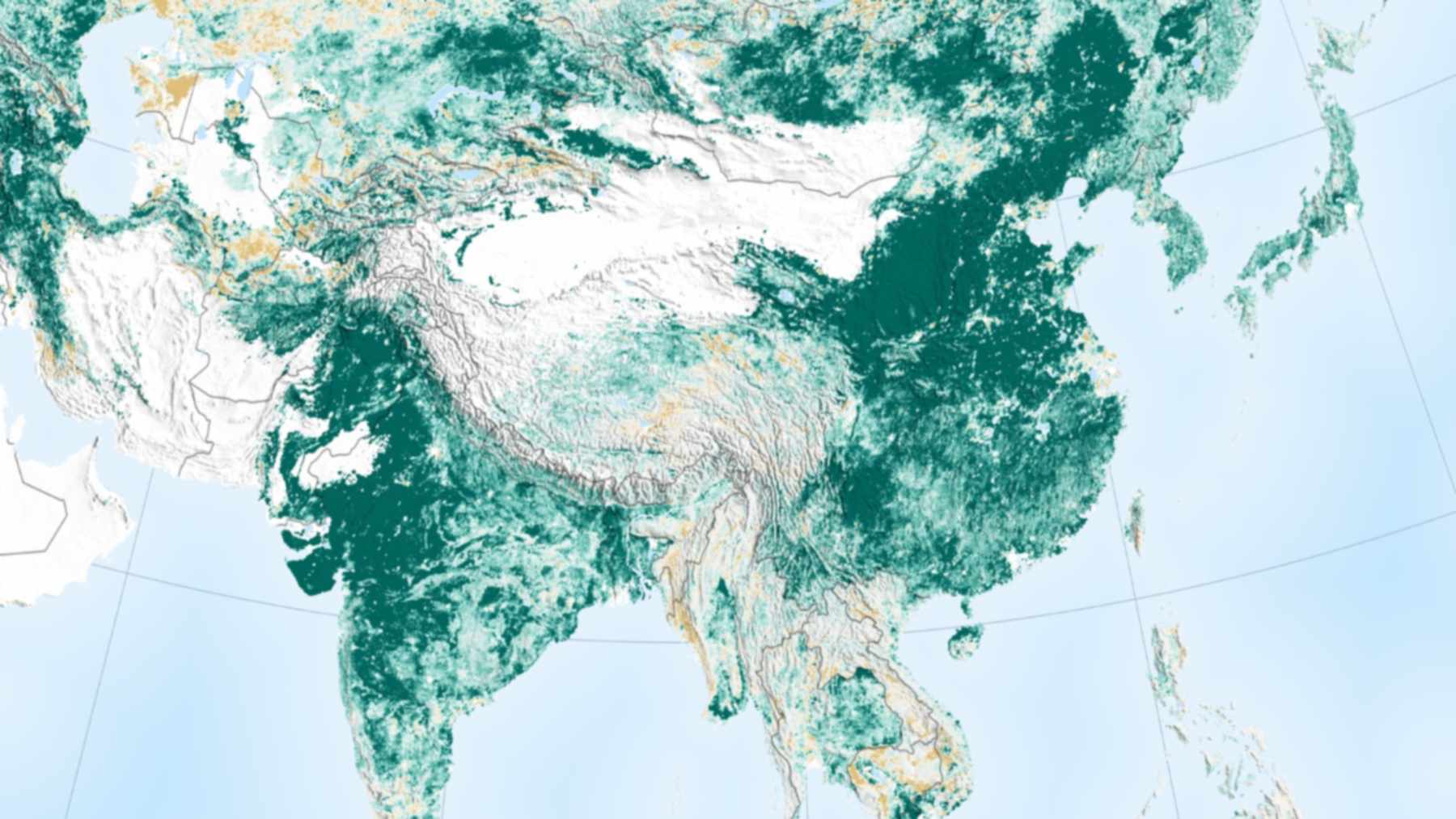
Writing in 2009 about Burkina Faso, Niger and Mali, Hertsgaard said the new greenery was “visible from outer space via satellite pictures,” part of a wider story of trees reappearing in Africa without anyone having planted them. “This is probably the largest positive environmental transformation in the Sahel and perhaps in all of Africa,” Reij told him.
Limits on the numbers, and on the land
“The biggest challenge for our farmers is drought. A warming earth means lower yields,” Sawadogo told UNEP in 2020. “Even those among us with no formal training know that trees and grasses and other plants can stave off the effects of climate change. But they can’t fix our harvests.”
He admitted the work was labor-intensive. The FAO bulletin lists two big obstacles, digging pits in the dry season and the scarcity of manure.
UNEP’s 2020 profile cited studies suggesting farmers may increase their yields “by anything from 100 to 500 per cent,” without tying those figures to Sawadogo’s own fields. By 2026 the agency was saying his version “can boost yields five-fold.”
Even the size of the forest varies by source. IPS put it at 15 hectares in 2011 and the Thomson Reuters Foundation at 25 in 2016; Right Livelihood and UNEP say about 40.
Kaiser’s team found the termite effect depended on the species involved. “Further studies in other areas are urgently required to clarify how generally valid our results are,” the authors write.
Some analysts credited the higher water tables to increased rainfall beginning in 1994, Hertsgaard reported. Reij disagreed: “The water tables began rising well before that. The effect is felt within one or two years’ time.”
In 2011, IPS reported that the government was repossessing his land for development; he had acquired it through the traditional system and had no title deed. In 2016 he told the Thomson Reuters Foundation that investors building a housing project had annexed parts of it, and that one of the new plots held the graves where he buried his parents.
“All I hope for today is to be able to protect my forest … My idea is my work will give knowledge to people, feed people and allow them to keep good health,” he said then, through an interpreter, at the Slow Food festival in Turin.
He died on December 3, 2023. He had been born sometime in 1946, according to Right Livelihood, which still quotes him: “This project is for future generations. I don’t want to eat today and leave future generations with nothing to eat.”
The full study was published in Agriculture, Ecosystems & Environment.
UNEP returned to his story on August 7, 2026. His version of zaï, with rocks to trap moisture and termites to break up hard ground, “is used from Ghana to Kenya and has become a critical tool for communities grappling with droughts linked to climate change,” the agency wrote.
Photo: Right Livelihood