Boats fishing inside the Seychelles’ own waters are the most likely source of the fishing debris that washes up on its islands, according to a University of Oxford-led study published in Marine Pollution Bulletin. The team combined satellite-tracked shipping and fishing data with a model that follows virtual plastic particles through the western Indian Ocean.
“We find most fishing debris originates from within the Seychelles’ own exclusive economic zone,” the authors write in the paper’s abstract. That cuts against a “historical focus on terrestrial inputs,” they note, although “recent research suggests that most pollution arriving at some islands may come from fishing and shipping activity.”
The authors are Alex Albinski, Helen Johnson and Noam Vogt-Vincent of Oxford’s Department of Earth Sciences, Jessica Savage of the Zoological Society of London and April Burt of the Seychelles Islands Foundation, which looks after Aldabra Atoll.
The question was which boats
To work out which boats matter most, the team set virtual particles, each standing in for a piece of plastic debris, adrift from where satellite data showed fishing and shipping vessels operating, and followed them with a 2D particle-tracking model.
The currents came from a regional ocean model with cells about 1.2 miles (2 kilometers) wide, and the virtual particles were released every month over several decades of simulated ocean.
Most nets start inside the zone
An exclusive economic zone stretches 200 nautical miles from a country’s coast, and inside it that country controls marine resources, including fisheries.
Two hundred nautical miles is about 230 miles. At the EGU General Assembly in Vienna in May the team gave a number, saying in its abstract that “50-66% of fishing debris that beaches at the Seychelles is discarded within its own exclusive economic zone, depending on the island group.”
Whose boats, though
The model only says where gear was likely lost. It doesn’t say whose it was, and the authors were careful about that.
On July 27 the EU and the Seychelles signed a new four-year fishing protocol in Brussels. It lets up to 30 EU purse seiners and eight longliners take about 121 million pounds (55,000 metric tons) of tuna and other migratory species a year, for an EU payment of €23 million over four years.
“Today’s renewed partnership with Seychelles shows what the EU stands for: trusted cooperation, sustainable fisheries and a stronger economy,” Costas Kadis, the European commissioner for fisheries and oceans, said that day.
Shipping lanes and Chinese bottles
Cargo traffic leaves a different trail. The study finds that “sources of shipping debris are concentrated along major shipping routes” across the region.
That fits what Oxford reported in 2023 about an earlier model led by Vogt-Vincent, then a doctoral student. The university said “the large numbers of bottles beaching at these islands with labels suggesting they come from Malaysia, Thailand and, in particular, China, were probably discarded from ships rather than floating from those countries directly.”
Tons of plastic on Aldabra
In March 2019, a Seychelles Islands Foundation cleanup on Aldabra removed about 55,000 pounds (25 metric tons) of plastic litter, around 5 percent of what was estimated to be on the atoll.
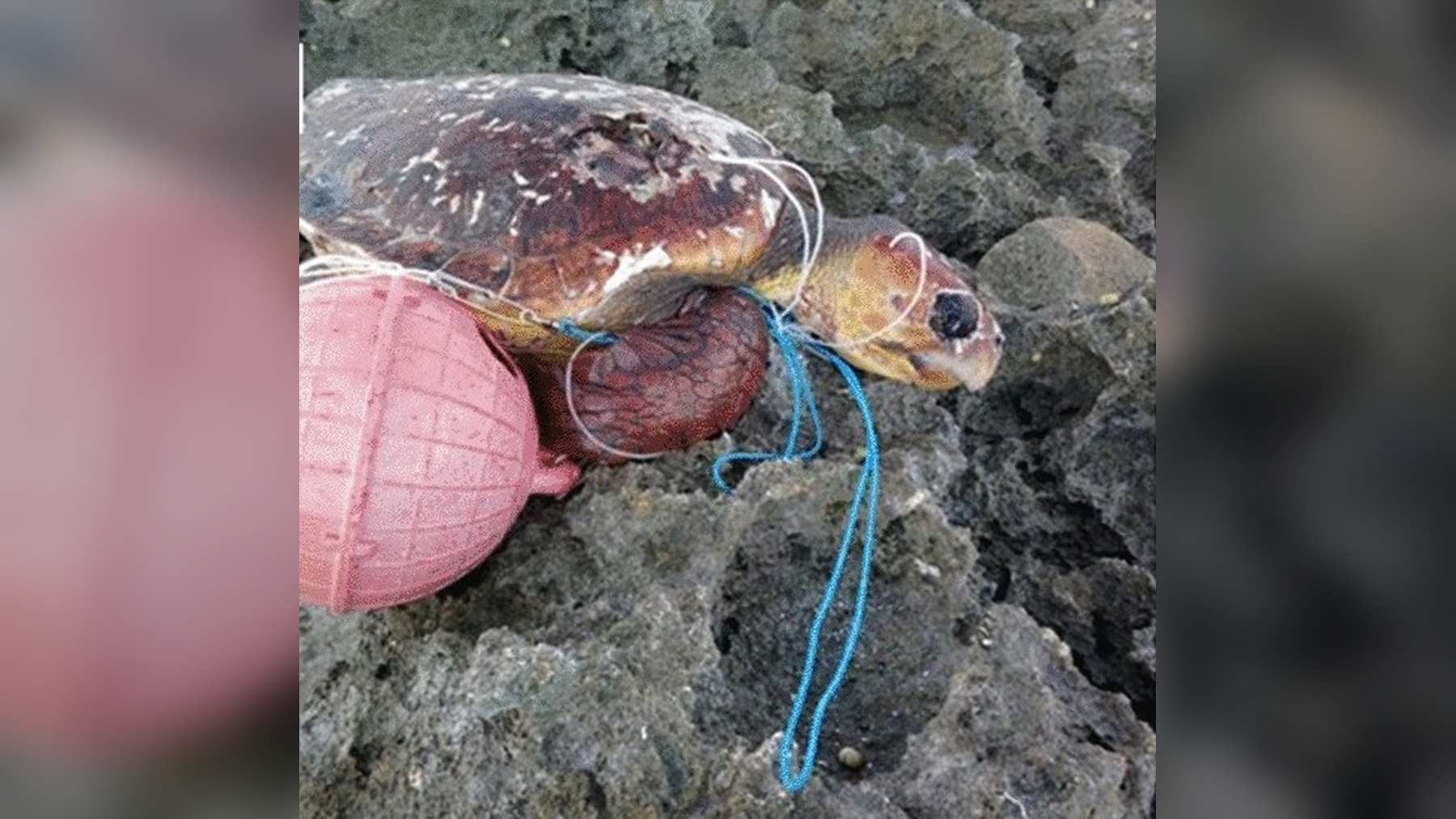
A paper led by Burt in Scientific Reports estimated 1.13 million pounds (513 metric tons) still on the atoll, about $4.68 million and 18,000 person-hours to clear, and 83 percent of it by weight from the regional fishing industry. Its photos show a giant tortoise dead inside a plastic barrel and a loggerhead turtle that died tangled in fishing gear, the same kind of trap that catches a gull in a plastic bag or a humpback in crab pot lines.
Far away and close by
In 2023 an Oxford model led by Vogt-Vincent traced most land-based plastic on Seychelles beaches to Indonesia, with India and Sri Lanka behind it. Burt said then that the islands “are faced with the deeply inequitable situation of bearing the costs of removing waste they were not responsible for generating, contrary to the ‘polluter pays’ principle.”
Some bottles and sandals do drift in from Asia, as the 2023 model showed, the way trash gathers in the Great Pacific Garbage Patch. The nets and ropes look more local, like the gear a robot found on the Argentine seafloor.
Monsoons move the targets
The sources also shift with the season. “Sources vary seasonally, due to wind-induced reversals of surface currents between monsoons. Finally, we find variation in the quantity and seasonality of debris accumulation on a sub-island scale,” the authors write in the paper’s abstract.
It’s still a model built on where boats were, and it can’t pin a net on one crew.
The full study was published in Marine Pollution Bulletin.
The authors also say “higher-resolution models that resolve local currents and kilometre scale islands may play a vital role in clean-up and management efforts.”
Image: Burt et al. (2020), Scientific Reports (CC BY 4.0)