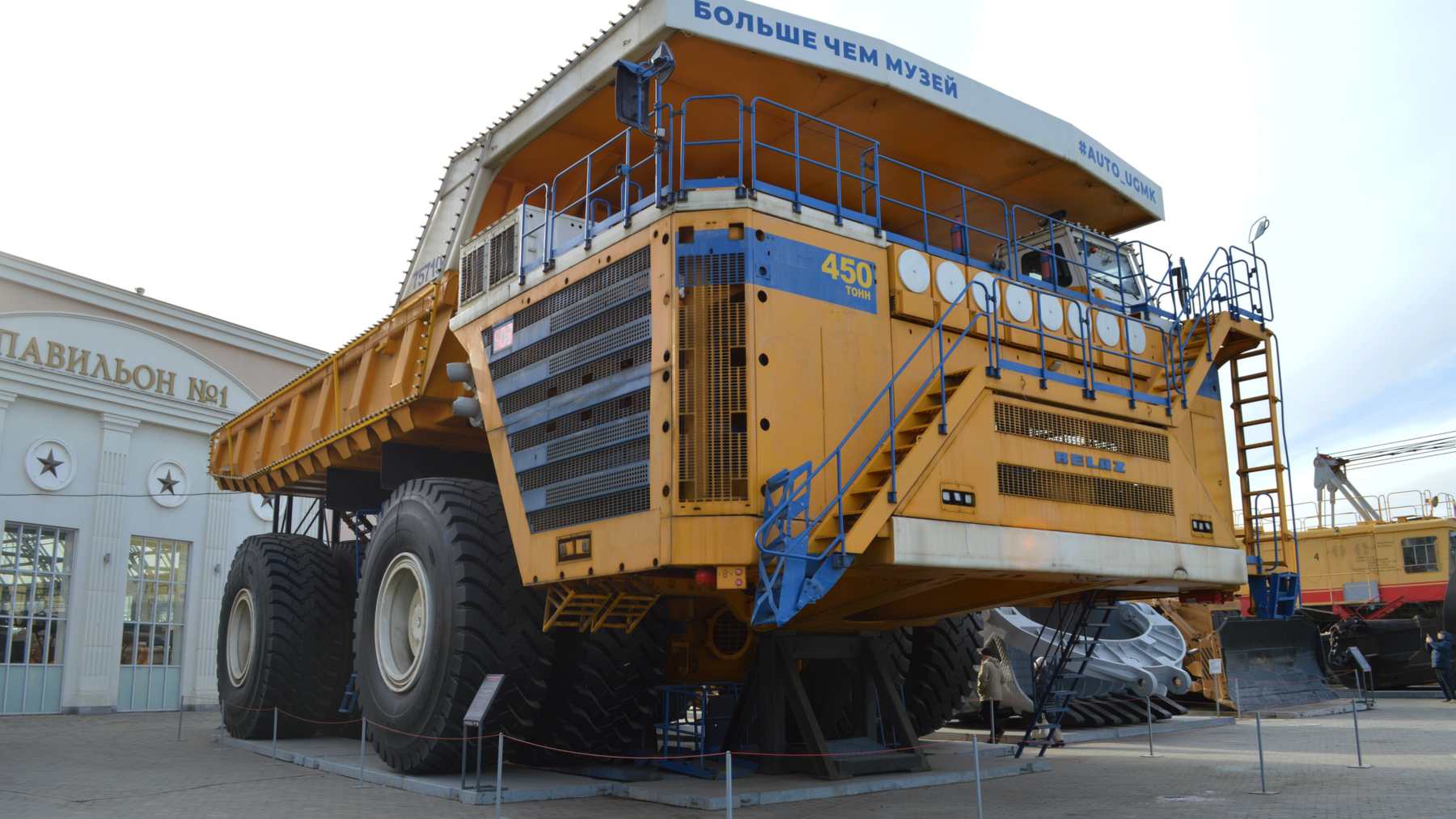
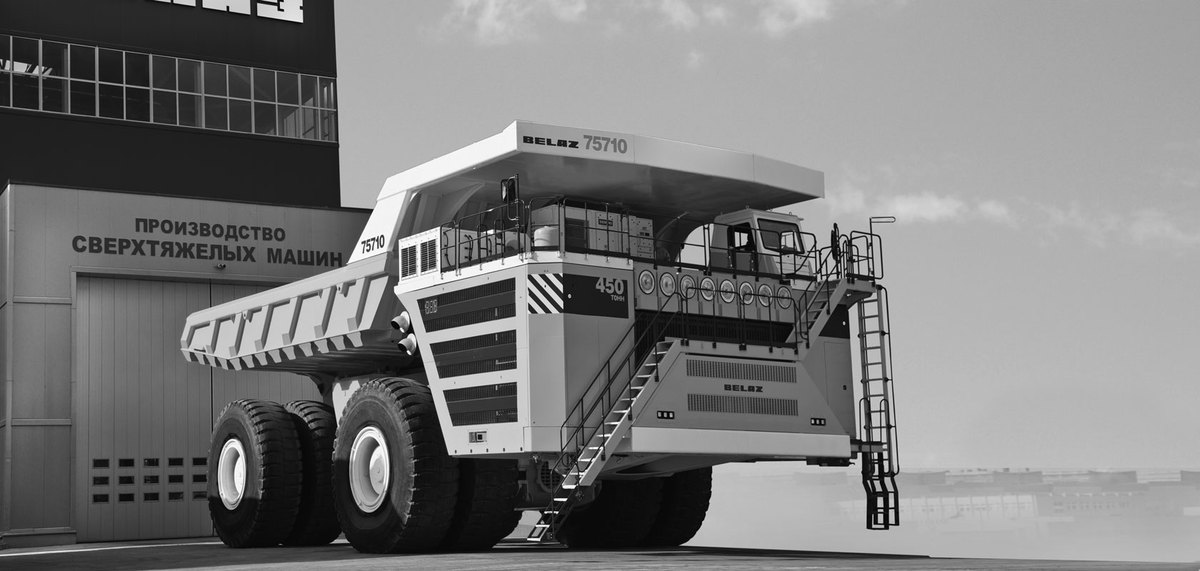
The BelAZ 75710, built by the Belarusian manufacturer BELAZ, is rated to haul 450 metric tons in a single load. That is about 496 U.S. tons, or roughly 992,000 pounds of rock and coal. The truck left the factory in late 2013, and the company’s website still credits it with the world’s highest payload capacity.
Electric motors turn its wheels, but the power behind them comes from diesel. A World Steel Association profile says the truck carries two 16-cylinder engines of 2,300 horsepower each. Their only job is to make electricity.
Eight tires carry the weight
BELAZ wanted 25 percent more payload than the conventional giants already working in mines. The Swedish Steel Prize, which honored the 75710 in 2014, explains the obstacle. Payload in these trucks is tied to tire size, and the biggest tires available already sat on the company’s 360-ton model.
On a conventional dump truck, the rear axle carries roughly 70 percent of the load. BELAZ shifted weight forward and fitted four tires at the front and four at the rear. Both axles sit on a movable system with slewing bearings, and Siemens says each wheel is designed for about 100 tons.
The prize page says the finished truck carries 90 tons more than the company’s next largest model. Leonid Trukhnov, chief design engineer for mining equipment at BELAZ, described the goal in plain terms. He wanted a truck that “could deliver the most capacity with the lowest fuel consumption.”
Weldox plates up to 125 millimeters
Two steering axles needed a new suspension part, the swivel carriage that links each axle to the frame. BELAZ made it from Weldox 700F, a high-strength steel from the Swedish steelmaker SSAB. The plates are 110 and 125 millimeters thick, about 4.3 and 4.9 inches.
“We saw that high-strength steel was the best choice when we began discussing the movable suspension,” said Vladimir Zagorsky. He heads suspension design at BELAZ and spoke in the World Steel Association profile. SSAB prefabricated the parts in Sweden, and the body uses its Hardox 450 wear steel.
The same profile lists the truck at 20.6 meters long, 9.87 meters wide and 8.16 meters high. In feet, that is about 68 by 32 by 27. Empty, it weighs around 360 metric tons, and fully loaded it reaches roughly 810 metric tons, close to 1.8 million pounds.
Two diesels feed four motors
Siemens described its drive package for the 75710 in a 2014 announcement. The system, called MMT500, has two traction generators and four electric motors of 1,200 kilowatts each. Blowers, a brake resistor unit and two inverters complete it.
Those ratings describe what each motor can handle. Adding them up does not mean the truck makes 4,800 kilowatts, because the diesel engines remain the only real energy source on board.
According to Siemens, the all-wheel drive also adds an emergency mode. With one drive down, the truck can still limp to the service station on its own. The motors were built in Nuremberg, Germany, and the project took under two years from order to commissioning.
This is what “diesel-electric” means in a mining truck. Electricity carries the energy through the drivetrain, but combustion produces it. That sets the 75710 apart from battery trucks such as the electric freight trucks a Chilean operator says now match diesel on cost.
Fuel per load, not per mile
The World Steel Association puts the truck’s diesel use at 1,300 liters per 100 kilometers. That is roughly 5.5 U.S. gallons for every mile. To save fuel, the truck can run on a single engine when it drives back empty.
The case for size rests on the number of trips. Moving 1,800 metric tons takes four full loads at 450 tons and five at 360 tons. On paper, that removes one loaded trip in five.
BELAZ also lowered the truck by 180 millimeters, about 7 inches, compared with the older model. Trukhnov told the prize jury this is “very important for loading mechanisms as well as stability and safety.” Fuel savings per trip still depend on grades, loading waits and empty returns, as they do for other giant mining machines, like the 16.5-million-pound excavator with 19 electric motors.
Hydrogen tests at 220 tons
BELAZ is now trying other power sources on smaller trucks. On April 27, 2026, the Russian state corporation Rostec announced a joint venture with the manufacturer, called Robleks. It will build a hydrogen truck based on the 220-ton BELAZ-7530 and a driverless 130-ton BELAZ-7513R.
Rostec said the hydrogen truck will pair fuel cells with lithium-ion batteries and emit no CO2. Dmitry Lelikov, Rostec’s deputy general director, said trial runs at active quarries were “to start this year.” Driverless haul trucks already work elsewhere, as in the open-pit mine run by more than 200 unmanned trucks.
No published fleet fuel figures
In 2014, the prize page said one 75710 was hauling coal at a mine in Siberia, a second was in production and five more were on order for 2015. Siemens named the coal pits of Russia’s Kuzbass region, plus strip mines in Chile and North America, as markets. BELAZ has not said how many trucks work today or how much diesel they burn per ton on a real route.
The truck is rated to work down to minus 60 degrees Celsius (minus 76 Fahrenheit) and nearly 5,000 meters (16,400 feet) above sea level. Rostec, for its part, has not released quarry results for the hydrogen truck.
The Swedish Steel Prize published its account of the BelAZ 75710 in 2014. Rostec announced the hydrogen joint venture on April 27, 2026.
Photo: Lapot / Wikimedia Commons, CC0