Orange hydrogen could come from iron-rich rocks beneath Western Australia, according to modeling by CSIRO, Australia’s national science agency. The plan is to pump water loaded with carbon dioxide into the rock. Done right, that one reaction could give off hydrogen gas and lock the carbon inside new minerals.
The study was led by Lingping Zeng, an energy research scientist at CSIRO, and it centers on the Yilgarn Craton. The region is one of the oldest and best-preserved geological areas in Australia. The co-authors were Regina Sander, Saeed Salimzadeh, Nicholas Lupton and Michael Camilleri.
Their simulations put the best window for carbon storage at about 302 to 392°F (150 to 200°C). Above that range the rock kept making more hydrogen, yet the stored carbon did not necessarily rise with it.
Oxidized iron behind the name
According to CSIRO, the color in the name refers to the oxidized iron produced underground. The method speeds up serpentinization. In that natural process, water reacts with iron-bearing minerals, the iron oxidizes and hydrogen gas forms.
“Orange hydrogen uses a naturally occurring geological process called serpentinisation, but stimulates it by injecting CO2-saturated water into iron-rich rocks underground,” Zeng said in the agency’s announcement.
Nature already runs this chemistry on the Atlantic seafloor, where Lost City’s alkaline hydrothermal vents sit on altered mantle rock. Interest in natural hydrogen from the crust has grown fast. The CSIRO approach tries to trigger the reaction on purpose.
Carbon dioxide turned into stone
According to Regina Sander, a principal research engineer at CSIRO, these rocks can do a second job. “When carbon dioxide dissolved in water flows through these rocks, it can react with minerals and become permanently trapped as solid rock,” she explained.
Geologists call this carbon mineralization. The gas ends up inside stable carbonate minerals that can stay locked underground. In theory, one rock formation could supply a fuel and store a greenhouse gas.
Some labs pursue the same pairing above ground, like a reactor that turns plastic waste into hydrogen and solid carbon. The Australian idea would do it inside the crust instead.
Hotter rock makes more gas
The researchers used PHREEQC, a thermodynamic geochemistry program, to simulate how iron-rich minerals react with bicarbonate brines. They varied temperature, salt content and pH, according to the study’s abstract.
Of those three factors, temperature was a major control on hydrogen output. Higher temperatures sped up the reactions that make hydrogen and released more gas from the rock, CSIRO reported.
Carbon storage followed another curve, peaking at about 302 to 392°F (150 to 200°C) when bicarbonate was limited. As the models ran hotter, the carbonate minerals also shifted from calcite-rich mixes to ones dominated by magnesite.
“However, the conditions that maximise hydrogen generation are not always the same conditions that maximise carbon storage. Understanding these trade-offs is essential if orange hydrogen is to become a practical energy solution,” Sander said.
Salty brines cut the yield
What goes down the well matters as well. Lower-salinity water generally produced more hydrogen in the models, while highly saline brines held output back.
Alkaline fluids, meaning those with a higher pH, pushed hydrogen yields up. CSIRO says they encourage reactions that produce both hydrogen and iron-bearing minerals.
Those salinity and pH results came from the same computer runs as the temperature tests. Laboratory experiments with real rock still have to confirm them.
Zircons older than four billion years
The Yilgarn Craton stretches across south-central Western Australia, and its name comes from a local Indigenous word meaning “white stone” or “quartz.” It has stayed largely intact through aeons of tectonic movement and holds zircon crystals more than 4 billion years old.
For this project, its value lies in extensive deposits of iron-rich and magnesium-rich rocks. Geologists call these mafic and ultramafic rocks, and the models indicate that the Yilgarn’s have strong potential to support orange hydrogen.
Western Australia is also planning several major renewable energy and hydrogen projects across the craton’s northwestern reaches. Those projects will need significant energy storage.
The Yilgarn has no large underground gas reservoirs. Still, CSIRO says depleted gas fields elsewhere in the state far exceed the near-term storage needs of those projects. Hydrogen made in the craton could be moved there and held underground until needed, helping store clean energy for later.
For a country with vast areas of this kind of rock, Sander thinks the idea is worth pursuing. “Orange hydrogen is still at an early stage of development, but Australia’s geology gives us a unique opportunity to explore a new pathway for clean energy production,” she said.
Flow rates are still unmeasured
Because the study relied on thermodynamic modeling, it describes which reactions and minerals the chemistry favors. Such models leave out how quickly gas would flow from a real well and what that would cost.
Australia has no commercial-scale orange hydrogen projects yet, and CSIRO calls the work a first step. “The next phase of research will focus on laboratory experiments, field trials and identifying the geological settings best suited to combining hydrogen generation with long-term carbon storage,” Zeng said.
At CSIRO’s Subsurface Energy Laboratory in Clayton, Zeng is setting up an orange hydrogen experiment in a high-pressure, high-temperature reactor.
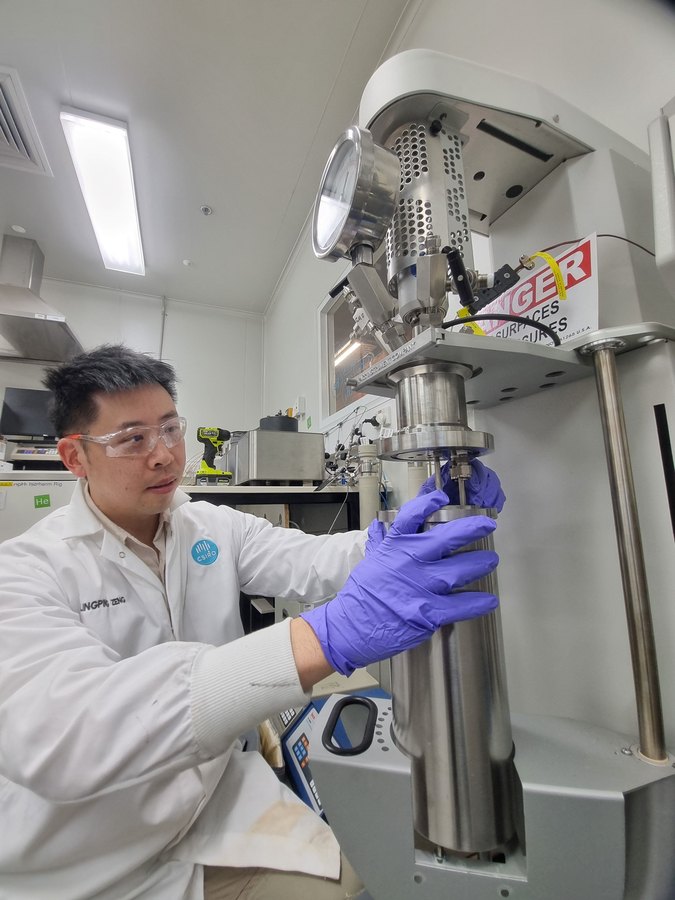
The team also plans to check how these systems perform over time and whether they can run at commercially meaningful scales. Those answers will show whether the carbon stays mineralized and the hydrogen keeps flowing. A computer model cannot settle that alone.
The full study was published in the International Journal of Hydrogen Energy, and CSIRO described the results in a research update on September 4, 2026.
Photo: CSIRO