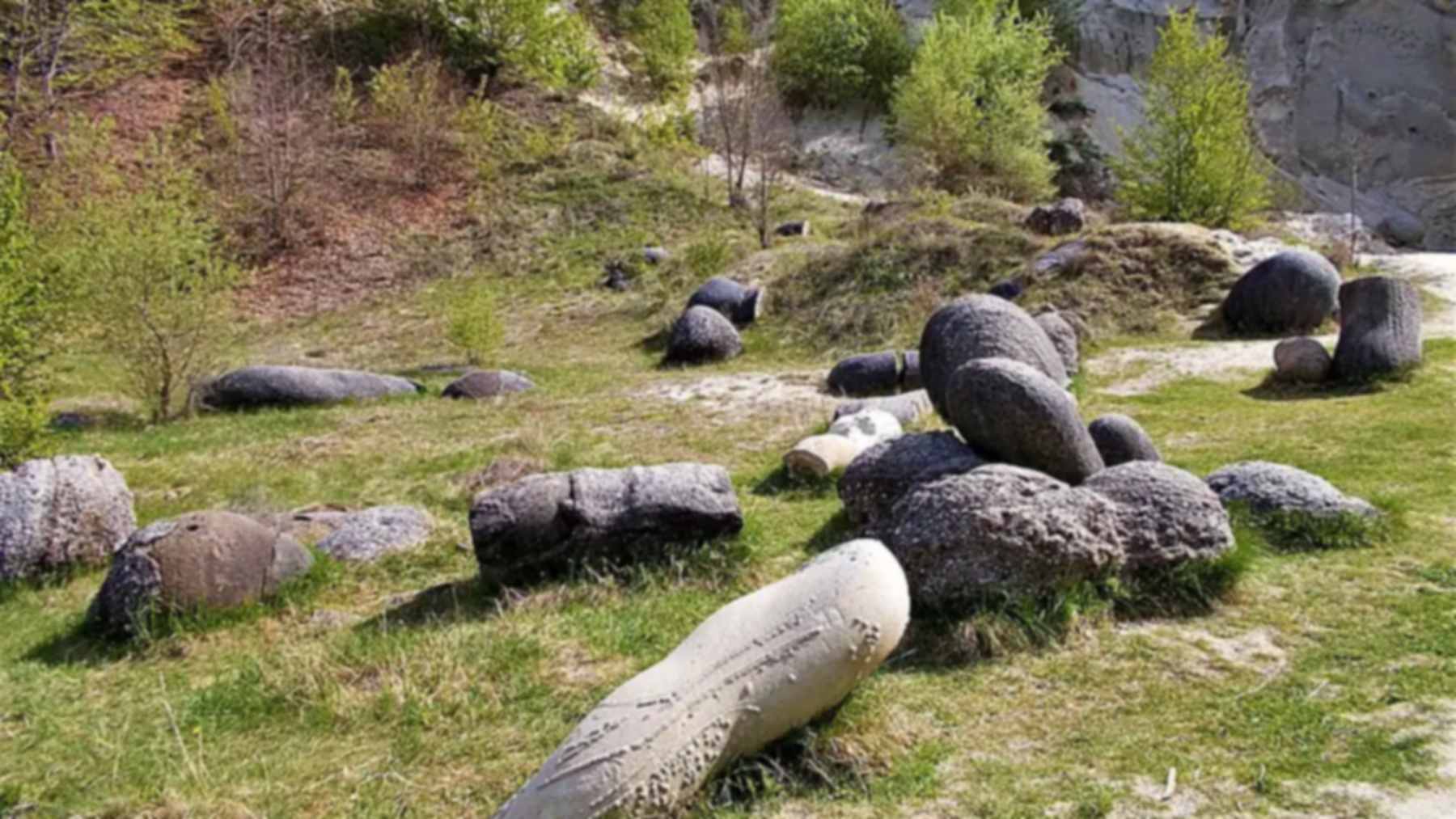
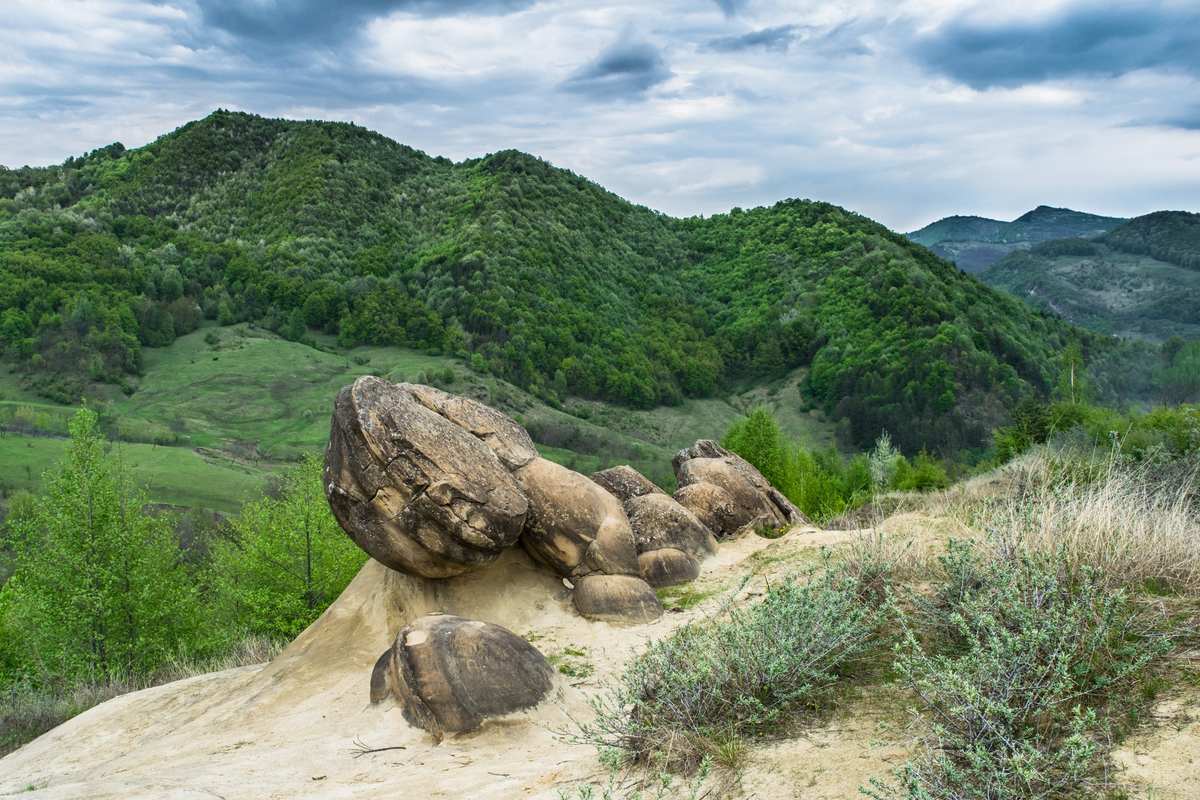
In Costești, a village in Romania’s Vâlcea County, a protected site at the foot of a sand quarry holds rounded sandstone boulders known as living stones. Local lore says they keep growing. Geologists call them trovants, and a microbiology study published in 2025 adds bacteria to the story of how they form.
The rocks are not alive, of course. Research on them points to sand cemented slowly by minerals, plus wind and rain stripping away loose sand around each stone. Neither of the two studies described below measured a boulder swelling after a storm.
Sand from a 14-million-year-old shore
About 14 million years ago, the material in trovants was fine sand on prehistoric beaches and sandbanks. That timeline comes from Buzău County Council in eastern Romania, in its overview of its trovant sites.
Much later, probably within the last few hundred thousand years, parts of that sand hardened, the council says. Mineral-rich water seeped into it and left behind a natural cement.
Geologists class trovants as concretions. The North Dakota Geological Survey defines a concretion as a clearly bound body of rock inside softer sediment of the same composition. Dissolved minerals, most often calcium carbonate, settle out of groundwater and fill the gaps between grains.
The word trovant has been in use for more than a century. Romanian geologist Gheorghe Murgoci introduced it in work published in 1907, according to a later study of the Costești stones.
Rain uncovers what is already there
Rain does play a part, but Buzău County Council ties it to exposure rather than growth. Wind and rain clear away the soft sand, the council explains, and bring cemented spheres, cylinders and spirals into view.
A bump that seems to appear overnight may simply be a buried part of the stone that a storm has uncovered. Erosion works the same way on much larger features, such as the giant “eye” in the Sahara seen from space.
To prove real growth, someone would have to measure the same stone again and again for years. They would also need to track how much sand washed off around it. The county council’s page and both studies below skip that kind of record.
X-rays inside a Costești trovant
Vlad C. Manea and colleagues at the Centro de Geociencias of the National Autonomous University of Mexico described one small trovant in a chapter published in April 2023. Their work focused on the trovant reserve at Costești.
The team scanned a centimeter-sized stone with an X-ray micro-CT scanner, which builds a 3D image of the inside without cutting it. Each voxel, the 3D version of a pixel, measured 28.5 micrometers.
Inside, the scans showed rounded structures arranged around a central core, which turned out to be a whole shell. In a tiny cube of the sample, connected pores made up 5 to 9 percent of the volume.
Those pores, the authors write, provide the main “permeability fluid-paths that control trovants formation through mineral precipitation around the inner shell structures.” Put simply, water moving through the gaps leaves minerals behind around a core, much like the mineral layers that built up inside the Pont du Gard aqueduct.
Bacteria that precipitate minerals
A team led by Beatrice Farda and Marika Pellegrini at the University of L’Aquila in Italy took a different route. Their paper ran in the March 2025 issue of Acta Biomaterialia.
They examined calcareous living stones for their microbial communities. The methods included DNA metabarcoding, which reads a marker gene to identify bacteria, along with lab cultures and electron microscopy.
From those cultures came 19 calcifying isolates, meaning bacteria able to precipitate minerals. Three with strong mineralizing properties were identified as Stenotrophomonas maltophilia, Lysinibacillus fusiformis and Microbacterium ginsengiterrae.
In lab regeneration tests, the stones’ own microorganisms took an active part in forming new mineral material, the authors report. “Microorganisms play a crucial role in forming these masses,” they write, about structures earlier described as having a purely non-biological origin.
The team also sees uses for the isolates in bioremediation, construction and the restoration of cultural heritage. Mineral-making microbes are drawing attention in other settings too, such as the bacteria in an abandoned German uranium mine that lock up dissolved radioactive material.
A 2.7-acre museum below a quarry
Costești’s Trovants Museum covers 1.10 hectares, or about 2.7 acres, according to the municipality’s official description of the reserve. A government decision of December 8, 2005, made it a protected area, and it now sits inside Buila-Vânturarița National Park.
The municipality calls the site an open-air geological museum on uneven ground at the base of a sand quarry. Its formations range from a few centimeters to a few meters across, in irregular, spherical or ellipsoidal shapes.
The stones lie in the open air where wind and rain exposed them. The cave pearls found in a Vietnamese cave form in a comparable way, as mineral-laden water coats a core one layer at a time.
Nobody has clocked a trovant growing
Manea’s group scanned one stone a few centimeters long, so other trovants may look different inside. The L’Aquila paper is paywalled, and its abstract leaves out where the samples were taken and how big the lab-grown clumps got.
Neither team measured a stone outdoors after a real downpour. The bacterial study’s authors frame a biological role in the cement as a hypothesis for future work. How fast new material builds up at Costești remains unmeasured.
The full study was published in Acta Biomaterialia.
Photo: Costești Municipality