
Is your brain quietly rewiring itself in the background while you juggle homework, work deadlines, or a new hobby? A large new analysis suggests it does, but not in a smooth, year-by-year slide. Instead, researchers report four clear turning points around ages 9, 32, 66, and 83 when the overall pattern of brain connections often shifts direction.
The peer-reviewed work, published on November 25, 2025, combines advanced MRI scans from 4,216 people ages 0 to 90 across nine major research projects. These ages are not “switch-flip” birthdays, and the authors emphasize they reflect group averages, not a schedule written into every individual brain.
A map of the brain’s wiring
The researchers focused on white matter, the bundled “cables” that help distant brain regions communicate. They used diffusion MRI, a scanning method that tracks how water moves through brain tissue to infer the major routes signals are likely to travel.
The analysis was led by Alexa Mousley, working with Richard A. I. Bethlehem and Duncan E. Astle at the MRC Cognition and Brain Sciences Unit at the University of Cambridge, alongside Fang-Cheng Yeh at the University of Pittsburgh.
For their core analyses, they used a neurotypical subset of 3,802 people and described the brain as a network, similar to how scientists study airline routes or social connections.
How scientists spotted the bends
To compare brains across ages, the team calculated 12 measures of network organization, including how efficiently information could move across the system and how strongly the network splits into smaller communities.
This branch of math is called graph theory, and in plain terms it asks whether the brain’s “road map” looks more like one big connected city or many tight neighborhoods.
Then they used Uniform Manifold Approximation and Projection (UMAP), a method that squeezes many measurements into a simpler map while keeping similar patterns close together. In that map, they searched for points where the developmental path noticeably changes course, and the same four ages kept showing up across many different model settings.
Four ages that stand out
The turning points clustered around 9, 32, 66, and 83 years old, and the authors caution against treating them as exact cutoffs. Anders Martin Fjell, who directs a center in the psychology department at the University of Oslo, told ABC News that the wide age range offers a big-picture view, but it also means researchers must compare averages across groups.
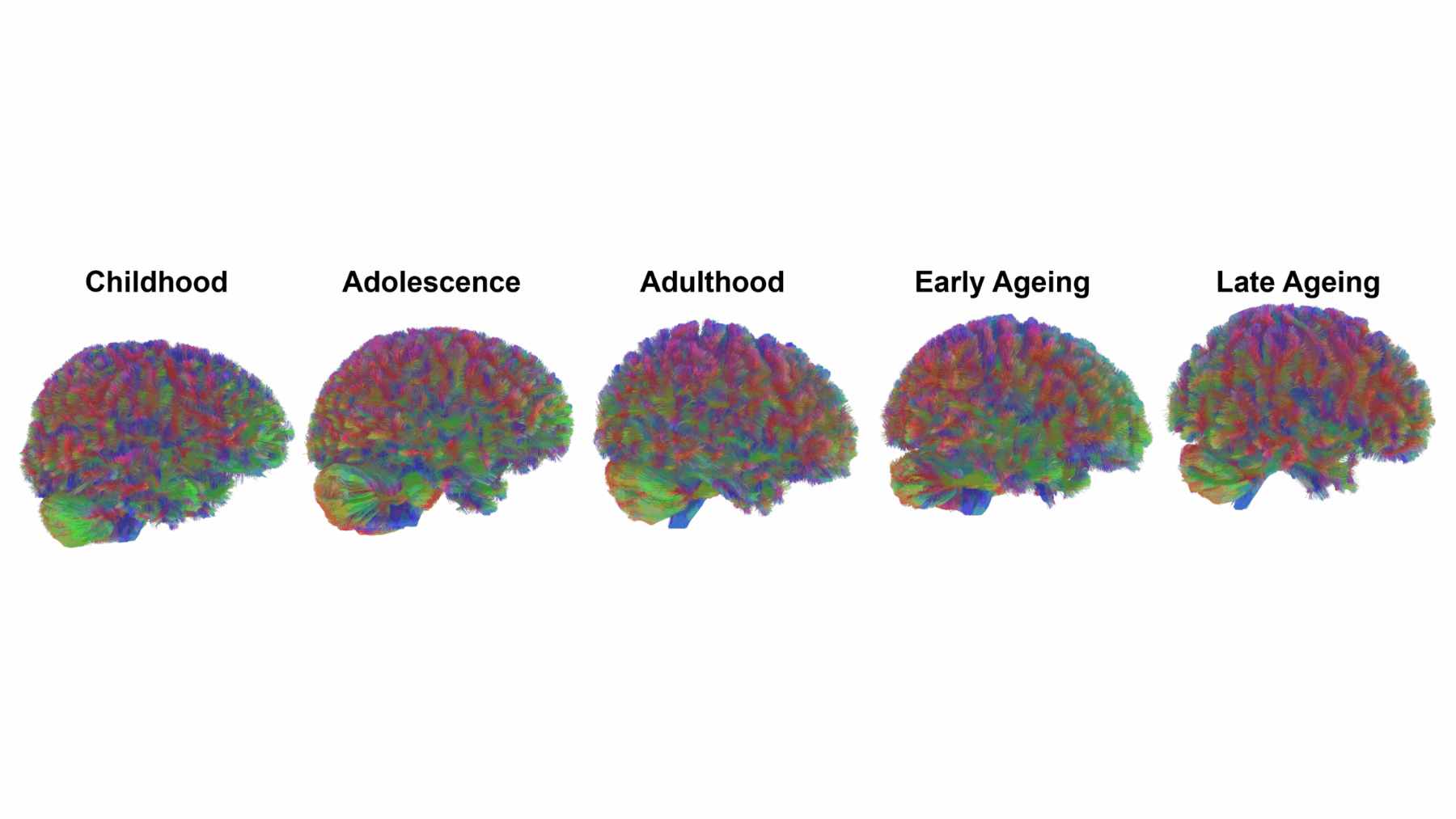
The new work fits into a growing effort to chart how the brain changes across decades. For example, a large 2022 project built population “brain charts” across the lifespan, aiming to define typical patterns the way pediatricians use growth charts.
Five life phases in plain language
From birth to about age 9, the brain’s network tends to look densely connected, with many links that are still being refined. During childhood, the brain strengthens heavily used connections and trims others, a process often compared to pruning branches so the healthiest growth gets the most resources.
From about age 9 into the early 30s, the network shifts toward a more adult-like architecture. In practical terms, it becomes better at balancing long-range communication with specialized clusters, which lines up with the real-world sense that skills can sharpen fast through adolescence and early adulthood, even if it does not always feel smooth day to day.
Between the early 30s and mid 60s, the study found a long stretch of relative stability in overall organization, more like gradual fine-tuning than a rebuild.
After that, patterns associated with aging became more visible, first with a reorganization up to the early 80s and then, later on, a shift toward more local organization, although the oldest ages were represented by fewer participants.
Why the timing could matter for learning and health
So why do these turning points matter outside a lab? The researchers argue they may help explain why some life stages seem more changeable than others, and why certain challenges tend to cluster at particular ages.
Around age 9, the network shift overlaps with rapid cognitive development and, in other research, a rise in risk for some mental health conditions in early adolescence. That is the period when school can suddenly get harder and social life can get louder, which makes the idea of a vulnerable window easier to picture.
The paper also notes that many developmental disorders, mental health conditions, and neurological diseases relate to how the brain is connected.
The 60s turning point is striking because it sits near ages when risks tied to brain health rise, including high blood pressure, and there is evidence that the brain’s structural connection patterns change across adult aging as well.
What this study cannot tell you
For all its size, the research is mostly cross-sectional, meaning it compares different people at different ages rather than following the same individuals from birth to 90.
That approach is strong for spotting population patterns, but it cannot promise that your brain will hit a turning point at the same age as the average, or that the change will look the same across people.
The late-life phase after about 83 also comes with extra uncertainty because the sample is smaller and healthy older adults in research studies may not represent everyone their age.
The authors describe the work as a detailed map, and they argue that turning it into practical guidance will require long-term studies that connect these network shifts to everyday outcomes, alongside established prevention advice such as the World Health Organization recommendations on reducing dementia risk.
The main study has been published in Nature Communications.