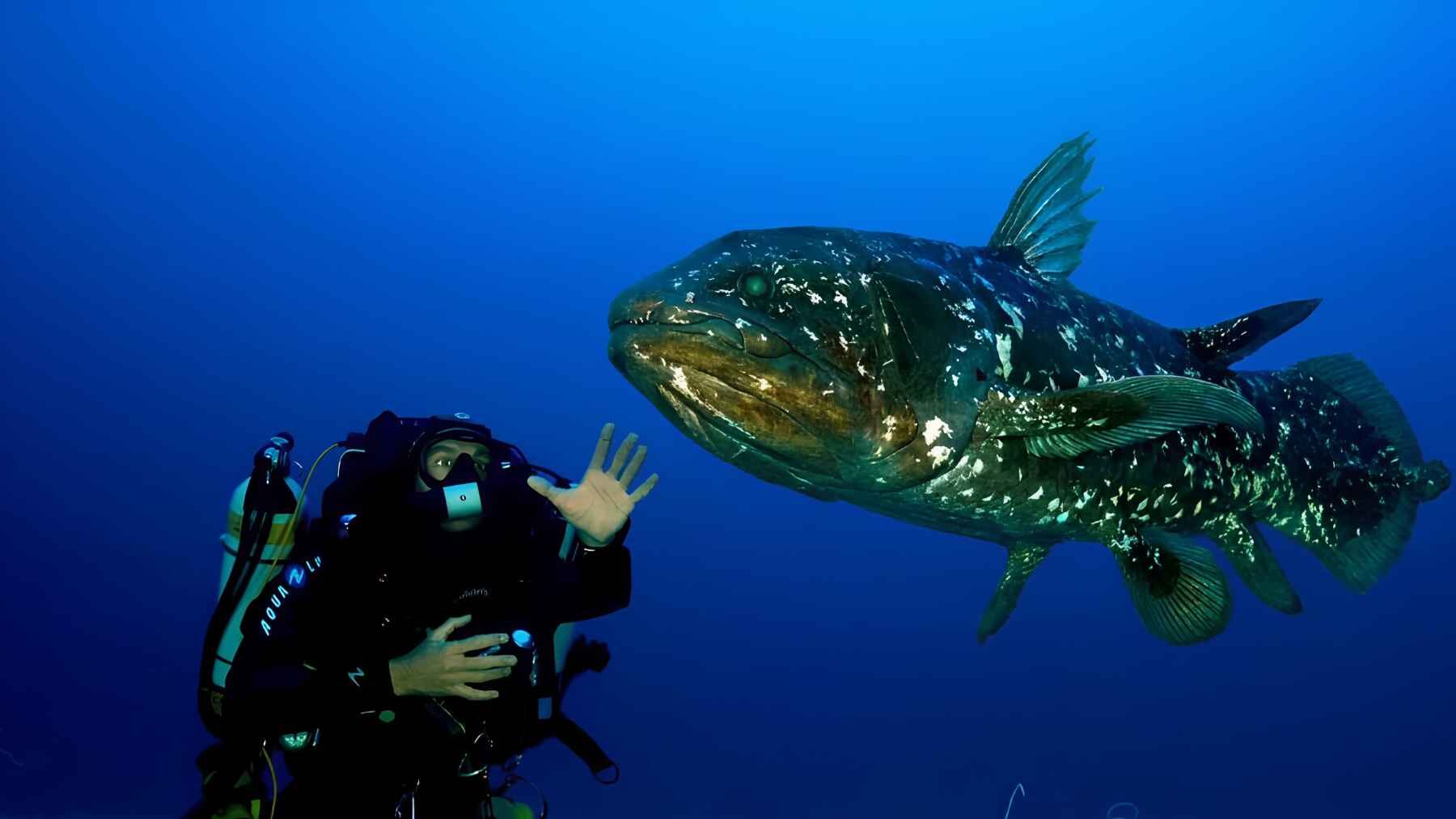
A routine fishing trip in the Comoros turned into a rare encounter on July 5, 2026. Local reports said two fishermen identified as Daoud and Chunoi Prince accidentally hauled up a coelacanth near Sandampoini on the island of Anjouan, bringing the deep-water fish aboard a small boat known as a kwassa kwassa.
The catch matters far beyond one day on the water. The West Indian Ocean coelacanth is listed as Critically Endangered, and research suggests it grows and reproduces so slowly that the loss of even one mature animal can be difficult to replace. The initial accounts did not confirm whether this fish was alive when landed, whether it was released, or what happened afterward.
A rare catch
The capture happened on Sunday, July 5, near the village of Sandampoini. Reports described the animal as a coelacanth, a fish known locally as the “gombessa,” and celebrated across the Comoros as part of the country’s natural heritage.
Important details remain missing. No official measurement, weight, sex, scientific examination, or release record appeared in the initial reports reviewed for this article. That does not make the catch less significant, but it does mean readers should be cautious about unsupported claims spreading online.
Why does that gap matter? A photograph can document a remarkable fish, but conservation teams also need to know whether it survived, where it was hooked, and how long it remained out of the water. Those facts can shape what happens next.
Not a dinosaur
The nickname “dinosaur fish” is catchy, but it is not scientifically accurate. Coelacanths belong to a fish lineage whose fossils reach back about 420 million years, long before the first dinosaurs, yet today’s species have continued evolving rather than remaining frozen in time.
The first living specimen recognized by modern science was found in a South African trawler’s catch on December 22, 1938. Museum curator Marjorie Courtenay-Latimer noticed the unusual animal, and fish expert J. L. B. Smith later described it as Latimeria chalumnae. A second specimen caught off Anjouan in 1952 proved the first discovery was not a lone survivor.
For people in the Comoros, of course, the animal was never just a scientific curiosity. It became a national symbol and even gave its name to the country’s soccer team. Fouad Abdou Rabi of the Comoros National Parks Authority has called it “a great national pride,” and an emblem of ecosystem protection.
Made for deep water
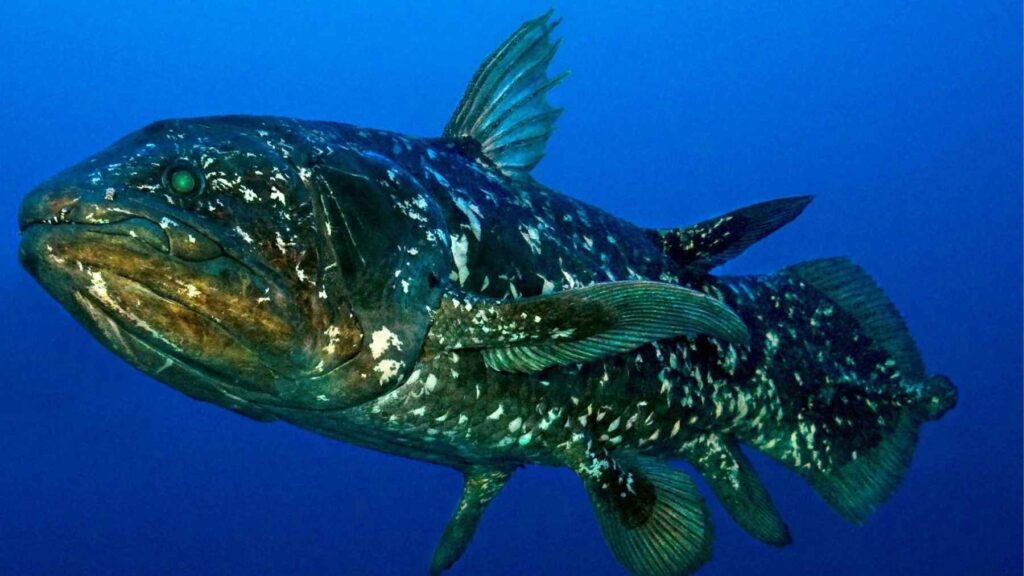
A West Indian Ocean coelacanth can grow to roughly 6.5 ft. and weigh about 220 pounds. It usually shelters in cool, dark caves and along steep underwater slopes about 300 to 1,000 ft. below the surface, resting by day and moving out at night to hunt fish and squid.
Its body looks strange because it is built differently from most familiar fish. Fleshy, bone-supported fins move in coordinated pairs, while a sensory organ in the snout detects weak electrical signals from prey in the darkness. A hinge in the skull also helps the mouth open unusually wide.
Then there is its pace of life. A 2021 study in Current Biology led by Kélig Mahé of the French marine institute IFREMER estimated that coelacanths may live close to 100 years, reach reproductive maturity at around 55, and remain pregnant for about five years. In everyday terms, this fish may spend half a human lifetime growing up before it can reproduce.
Why one fish matters
Coelacanths are not usually the target of small-scale fishing. Trouble begins when handlines or nets set for other deep-water species cross the steep slopes and caves where the fish live. This is bycatch, the unplanned capture of an animal fishermen were not trying to take.
One accidental catch does not prove that the Anjouan population is collapsing. Scientists still lack a complete island-by-island count, and recent research has been exploring possible coelacanth habitat around Anjouan. However, the species’ slow growth means every mature animal carries unusual reproductive value.
The International Union for Conservation of Nature classifies Latimeria chalumnae as Critically Endangered. The Convention on International Trade in Endangered Species, known as CITES, also places it in Appendix I, its highest protection category. Those labels are not ceremonial paperwork because they reflect how little room the species has for repeated losses.
Protection starts on the boat
When a coelacanth reaches the surface alive, speed and careful handling matter. Conservation guidance calls for keeping the fish in the water as much as possible, minimizing contact, removing or cutting the line when safe, and returning it quickly to sufficiently deep water. A long photo session on deck would work against that advice.
Revue Gecko reported that a new awareness operation is expected after the Anjouan capture. A practical campaign could use identification cards, local-language radio messages, a clear reporting number, release equipment, and compensation for verified live releases. Researchers studying catches in the western Indian Ocean have recommended both public education and incentives.
At the end of the day, the issue is not fishermen versus wildlife. It is whether practical rules can protect an irreplaceable fish without ignoring the people who depend on the sea for food and income. This accidental catch is a warning, but it is also a chance to get that partnership right.
The original reports on the July 5 capture were published on Comores Infos.