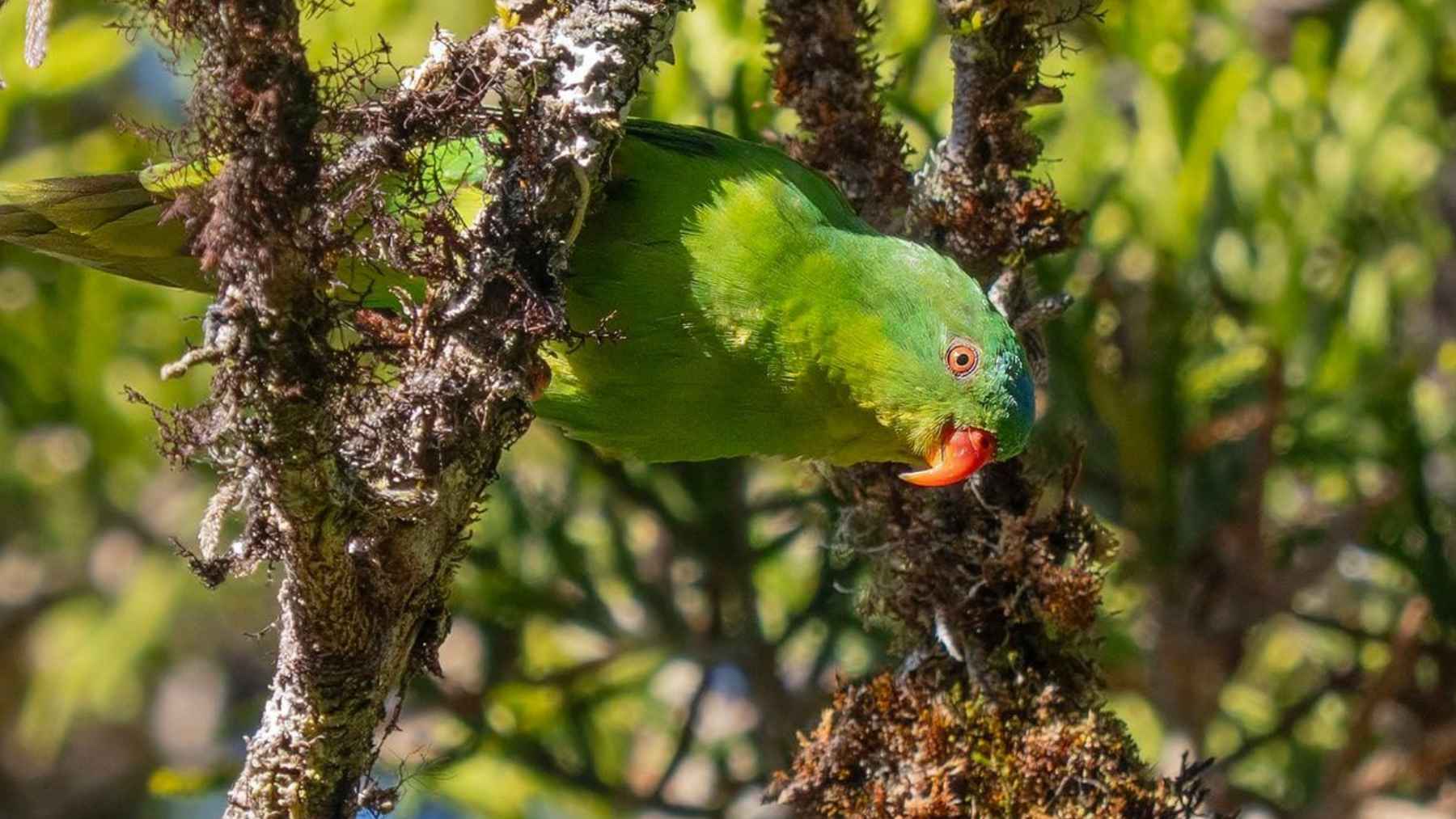
A tiny green parrot that many bird experts knew mostly from old museum specimens has turned up again in one of Indonesia’s hardest-to-reach mountain forests.
The Blue-fronted Lorikeet, found only on Buru Island, was photographed in April 2026 during a punishing expedition to Mount Kapalatmada, giving conservationists just the second confirmed record of the bird since it was described more than a century ago.
The rediscovery is thrilling, but it is not a neat happy ending. The bird’s cloud-forest hideout may have protected it for years, largely because getting there meant crossing jagged limestone, thorny plants, insects, rain, and a summit that rises about 8,900 feet. Now that people know where to look, the big question is simple. Can Buru protect the forest before curiosity and development move faster than conservation?
A bird that slipped out of sight
The Blue-fronted Lorikeet is small, bright, and easy to miss in the wrong forest. It has lime-green feathers, an orange bill, a blue marking on its head, and a pointed tail, the kind of color mix that sounds obvious until it flashes through thick leaves.
The species was first described from seven specimens collected in the 1920s. After that, it all but vanished from the scientific record, even though researchers searched in lowland and mid-elevation forests linked to the original specimens. It was photographed in 2014 by Craig Robson during a birding tour, but that lone modern sighting raised as many questions as it answered.
Was the bird nearly gone, or simply hiding higher than scientists had been looking? For the most part, the new expedition points toward the second possibility, though experts are being careful not to treat that as proof that the species is safe.
The climb that changed the search
The April expedition was led by Indonesian mountaineering group Kanal Buru and expedition leader Handoko. The team included members connected with American Bird Conservancy, Birdtour Asia, and Yayasan Planet Indonesia, and it followed a newly mapped route into Mount Kapalatmada’s upper forests.
This was not a casual bird walk. The route cut through slippery rocks, steep boulders, rattan thorns, and biting insects before the team reached a mossy highland plateau full of birdsong. After six days of climbing, two small birds flew into a nearby tree, and John C. Mittermeier of American Bird Conservancy raised his binoculars expecting a different species.
Instead, he saw the lorikeet. He later said he “short-circuited with excitement” when he realized what was in front of him. The bird disappeared before anyone could photograph it, but two days later another lorikeet appeared near camp, giving the team time to capture the proof they had come for.
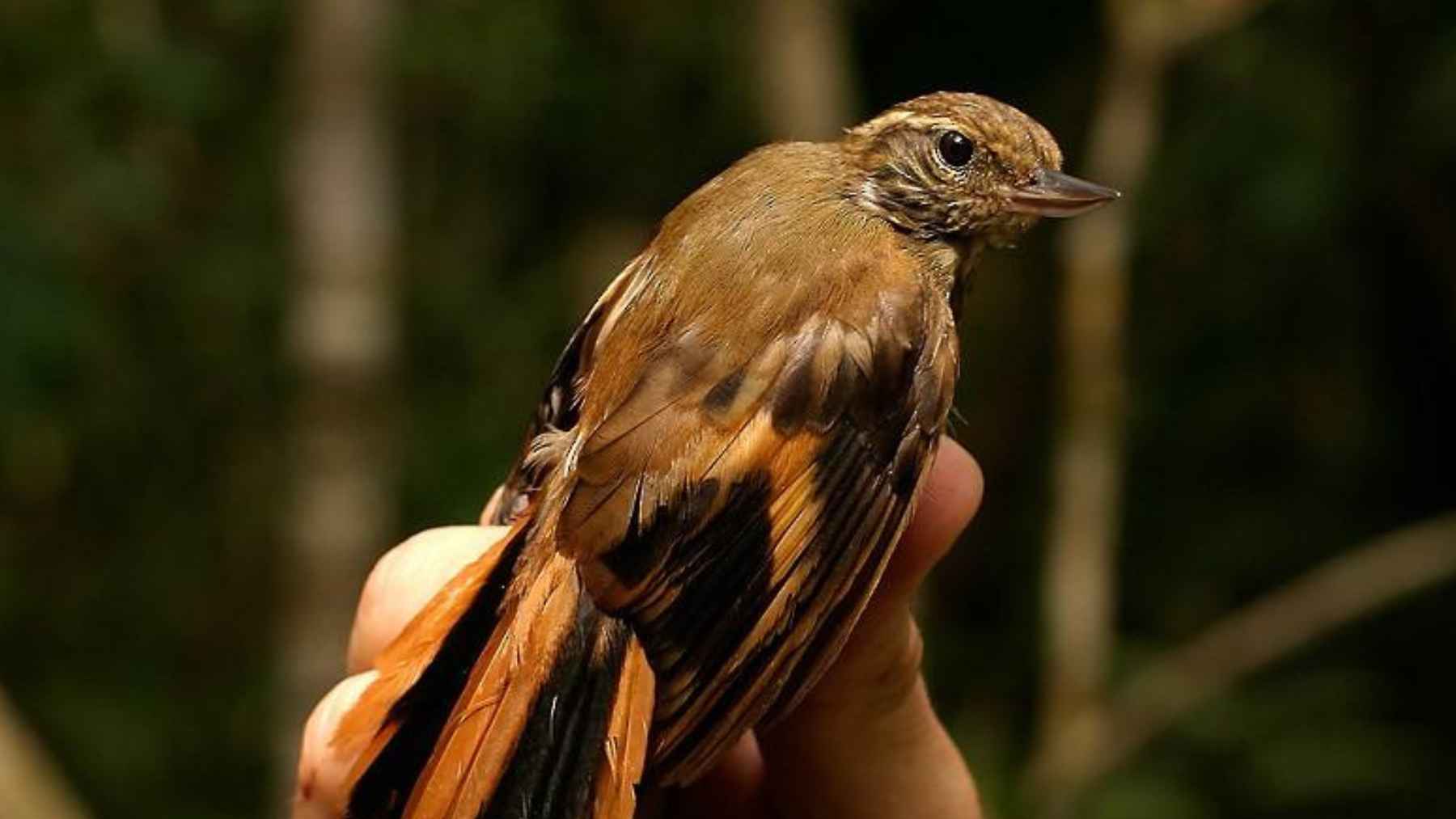
Researchers examined a rare forest bird during the Mount Kapalatmada expedition on Buru Island, an expedition that also led to the rediscovery of the elusive Blue-fronted Lorikeet and several other remarkable bird records.
Tiny bird, huge clue
The photos matter because they help narrow the search for a species that has long confused conservationists. If the Blue-fronted Lorikeet is mostly tied to high-elevation cloud forest, then decades of missed surveys in lower forests suddenly make more sense.
That does not make the bird common. Search for Lost Birds reported that the team later recorded its high-pitched calls for the first time, another basic piece of evidence scientists had been missing. Bird songs are not just pretty background noise. They are field tools that help researchers find, identify, and monitor animals that are hard to see.
There were other surprises too. The same plateau produced new records of the unusual Madanga, a likely undescribed Island Thrush taxon, and an island record of Meyer’s Goshawk. In practical terms, the lorikeet may be the headline, but the whole mountaintop is starting to look like a biological treasure chest.
Why the rediscovery is not enough
The Blue-fronted Lorikeet was listed as Data Deficient on the IUCN Red List in 2024, reflecting how little is known about its population, trend, and real range. Before that, it had been treated as Critically Endangered, largely because so few records existed and scientists feared the population was tiny or shrinking.
That uncertainty is the hard part. BirdLife International cited Benny A. Siregar of Burung Indonesia, who warned that rare records point to very restricted habitat use and that the species remains extremely small and vulnerable. In other words, seeing the bird again does not tell us how many are left.
There are warning signs around the island. Search for Lost Birds noted that Konservasi Kakatua Indonesia surveys from 2023 to early 2025 documented habitat destruction by logging companies at elevations of roughly 1,640 to 3,940 feet, along with bird hunting for consumption and trade.
Several parrot species were among those hunted, which makes the lorikeet’s future feel far from settled.
Buru’s hidden forests need time
For years, Mount Kapalatmada’s difficult terrain acted like a locked door. That was frustrating for scientists, but it may also have bought the lorikeet time while lower parts of the island faced deforestation and pressure from human activity.
Now the door is partly open. That could lead to better science, local pride, and more carefully planned conservation, especially if researchers work with people in Buru who know the mountain best. But it also means the habitat needs clear protection before its remoteness stops being enough.
Handoko said he hopes the expedition can help empower people in Buru to protect the area. That may be the real lesson of this little green parrot. Sometimes rediscovery is not the finish line. It is the first warning bell.
The official statement was published on American Bird Conservancy.