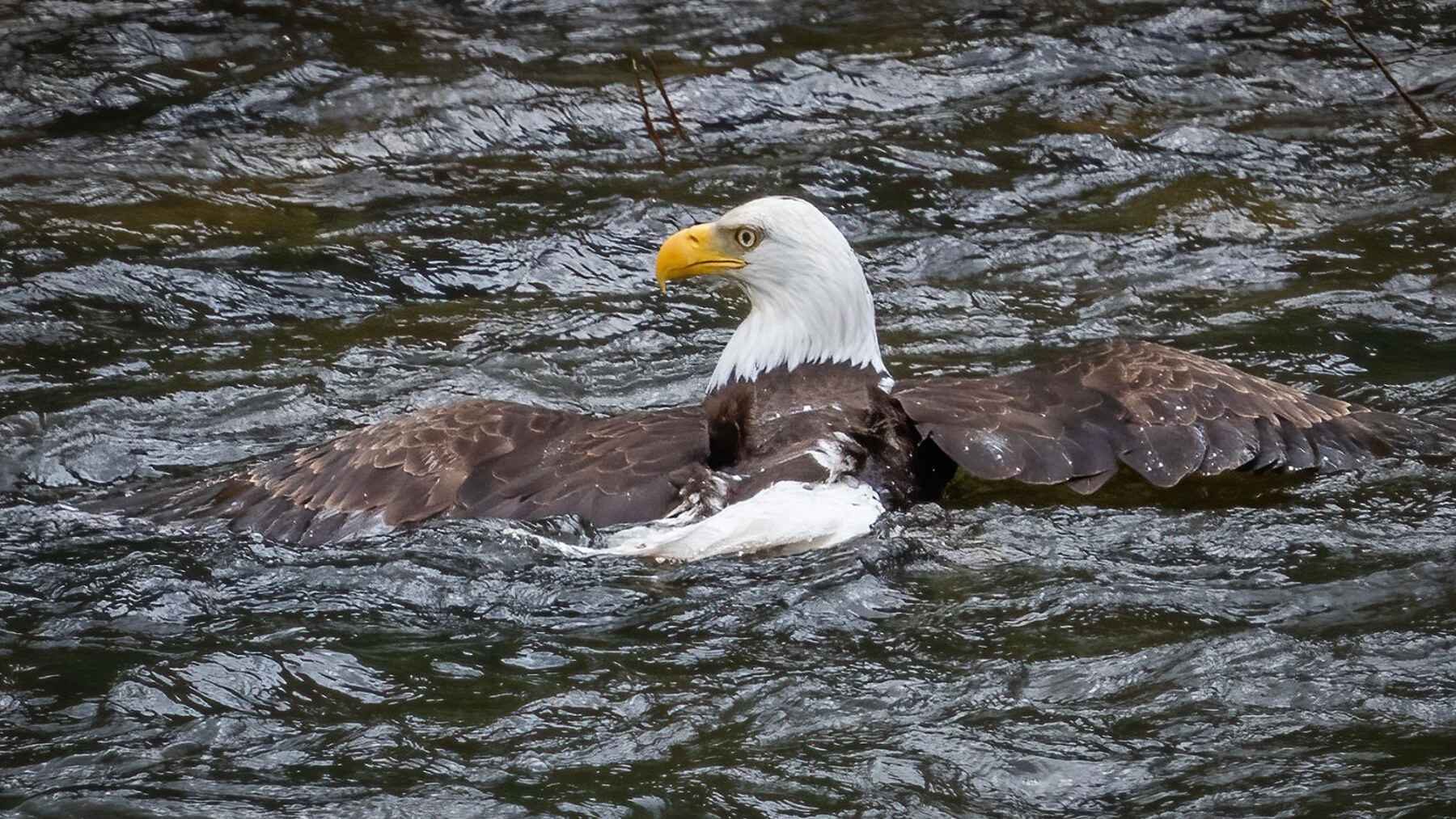
A bald eagle flying above is almost impossible to confuse. You can recognize it by its big wings,white head, yellow beak, and serious look, appearing in everyday symbols such as murals, money, and in many Fourth of July celebrations. But does it match the real eagle match with the popular and national image we have of it? Well, let me tell you, it is not quite like that.
Bald eagles were almost about to disappear. It may be hard to believe this, but even the sounds that movies show us are actually from other flying animals and their way of acting is completely different from what is seen and imagined. People would also be surprised that their nests are bigger and stronger than what is known.
A comeback from 417 nesting pairs
Unfortunately, at the beginning of the 20th century, bald eagles were shot and hunted. This usually happened because people supposedly wanted to keep their feathers or actually even saw them as pests. This pushed the Congress to take real action about the situation with the Bald Eagle Protection Act in 1940. Under this new protection, killing, selling or possessing them without authorization became completely illegal.
Around that same time, bald eagles had to deal with a bigger threat. In this case, DDT, a very strong pesticide, spread through the entire food chain after it leaked into rivers, moved into fish, and eventually affected eagles. In other words, eagles ate contaminated fish and the pesticide ended up inside them. But in what way did this pesticide affect eagles? By weakening eggshells to the point where they became dangerously thin, leaving many eggs unable to survive.
Once again, the United States had to make decisions to stop the extinction. By 1963, only 417 known nesting pairs remained in the lower 48 states. And what was actually done? Most of the DDT uses were banned in 1972. Not stopping there, Nixon signed the Endangered Species Act the following year. Because of this, numbers completely changed, to the point that they no longer appeared as endangered animals in 2007. To close, it is important to refer to federal estimates that calculated around 316,700 current birds in the lower 48.
Hollywood gave the eagle another bird’s voice
Can you imagine the typical eagle scene? The bald eagle flying around the sky, over the big mountains and hearing its powerful scream while the background music also increases. I am sorry to tell you, but that sound is almost never a bald eagle.
The truth is that sound editors tend to use the rasping call of a red-tailed hawk. They simply do this in movies because it feels more powerful. The bald eagle’s real voice is higher and thinner. Also it can be compared to the squawk or to a short laugh. And probably this is done because yes, it is majestic to look at them, but to really hear them can be a different story.
Water and age reveal what you are seeing
Have you ever wanted to spot a bald eagle? Let me tell you that the first step is to be near the water. Traditionally their nests are around rivers, lakes, marshes, reservoirs, estuaries, and some coastlines. Here fish are available and strong trees offer them safe places to build their nests. You can also find them in farmland and urban areas. This means that not all of them are close to water. Maybe it is just a matter of being lucky.
Possible landscapes? Ready. But what about how they actually look? Adult eagles have that white head, while young bald eagles are mostly brown with irregular, lighter patches. It is not until they are four or five years old that they have the classic white head and white tail. That is why a brown eagle flying over you can still be what you think: America’s most recognizable bird, but in its teenage phase.
Their table manners are not always noble
Eagles are excellent hunters, mostly when they are around fish-rich waters. But that does not mean that still they are not capable of preferring to eat a corpse that is already dead instead of following live prey.
They also have enough strength to fight with other smaller birds until they can steal the fish hunted by them. Surprised? Another example to show how the heroic image they have is one more thing the government wants to sell you.
That gap between the reputation that was built around eagles and the reality brought big consequences. The way information is used is very important since many farmers incorrectly believed bald eagles regularly carried away lambs, calves, and other livestock. A misconception of this size motivated eagles being shot and harassed well into the 20th century.
Bald eagle nests can become enormous
What about their nests? A typical bald eagle nest can be about four to six feet across and roughly three feet deep. Pairs often return to the same structure and add more sticks, grass, and other material, allowing the nest to expand over time. The key point here is that the trees are strong enough considering that their homes can surprisingly weigh more than 1,000 pounds. And to give you a more “extreme” example there is the nest near St. Petersburg, Florida, in 1963. A nine feet six inches wide, 20 feet deep, and about two-ton nest was registered. For you to have an idea, that can be quite similar to the weight of a car resting at the top of a tree.
Many zoo eagles are wild survivors
Many bald eagles that got injured in nature were treated by rehabilitators and considered unable to fly, hunt or even survive on their own. That is why many of them live in zoos or wildlife centers not because they were born as captive animals, but because of the injuries they suffered throughout their lives. In this way, human care gives them a permanent home.
Acadia, a female eagle from Florida, was rescued after she broke her wing falling down from a tree. She now lives with a male named Connick at a Washington, D.C. zoo, where visitors can now see in detail how they look.
As with everything in nature, the bald eagle,the national symbol of the United States, also has its own history and background. And here conservation works best when laws, habitat protection, pollution control, and public understanding move together. The bald eagle’s recovery shows what can happen when those pieces finally line up.
The original feature by Mike Bock was published on July 2, 2026, by the Smithsonian’s National Zoo and Conservation Biology Institute.