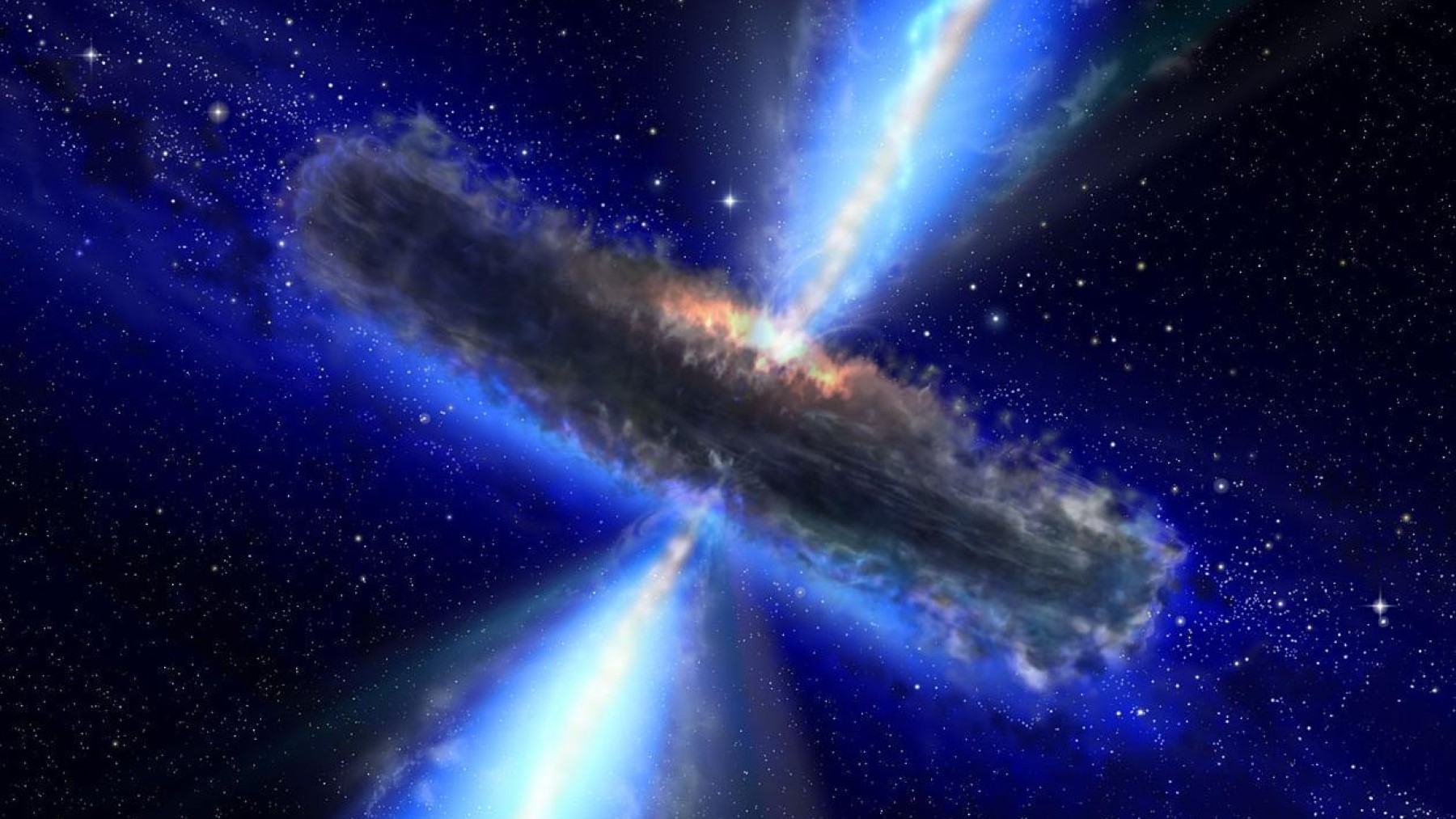
In a new realm of the universe, where astronomy helps navigate unfathomable depths of creation a remarkable achievement of the most outstanding water reservoir has been discovered. It has as much water as 100 trillion times of all the oceans on the Earth and it is situated around an active quasar called APM 08279+5255 some 12 billion light years away.
A glance into the cosmic universe: Quasar APM 08279+5255’s massive water cloud
APM 08279+5255 is not a typical quasar. A supermassive black hole which lies at its center weighs 20 billion suns, thus classifying it among the strongest known objects in the universe. The black hole has an enormous amount of water vapor, which extends several hundred light-years away. The energy output of the quasar is equivalent to that produced by 1 trillion suns, and it feeds the gas, dust and everything else that is falling into the hole.
What is even more astounding about this finding is the amount of water vapour. In contrast, the Milky Way only contains 4000 times less gaseous water, the majority of which exists in frozen form. The presence of this enormous concentration of water in APM 08279+5455 indicates the existence of an environment capable of heating up the gas encircling the quasar to extreme X-rays and Infrared radiations thereby making the gas hot and dense.
Discovery of water vapor provides new insights into early quasar environments and the growth of black holes.
The discovery of water vapor in this faraway quasar is related not only to the quasar itself but also to the atmospheric conditions of such objects. From an astronomical point of view, water is usually categorized as a minor molecule, however, it is very useful in determining the thermodynamic properties such as temperature and pressure of the gas. Even though the temperature of the gas surrounding the quasar is still quite low at about minus 63 degrees Fahrenheit, it is much hotter and thicker than what is usually found in galaxy types such as the Milky Way.
The detection of water vapor in the redshifted quasar finds its significance as it indicates the earliest epochs in the universe at a redshift of z= 3.9 in a quasar that is only 1.6 billion years old and helps in understanding the evolution of supermassive black holes. In the case of this quasar, the prospect for the black hole to increase in size up to 6 times the current size owing to gas availability is also realistic. Astrophysicists, however, do not know if the black hole will consume all that gas, or if some of it will turn into new stars or be blown out of the host galaxy of the quasar.
Innovative instruments trace water vapor in quasar paving way for the study of the cosmic dawn
This enormous water reservoir was discovered thanks to the development of more advanced millimeter and submillimeter technology. At the Caltech Submillimeter Observatory in Hawaii, water vapor was observed in a quasar at redshift using the Z-Spec spectrograph. Subsequent observations with the Plateau de Bure Interferometer and CARMA have confirmed not only the existence of but also the huge amount of water present. Such instruments, that have been barely available for a while, are important in investigating the infant universe and her expansion, with future projects such as the CCAT telescope aimed at even wider galactic development studies.
Discovering the facts about the recent find of the biggest and the furthest water reservoir in the universe opens a new perspective to the cosmic evolution at archetypal stages. The large region of water vapor present surrounding a quasar driven by an ultra-massive black hole. It showcases the extreme richness of the distant universe and how there is room for even more growth in black holes. In the light of progressing technology, there is every likelihood that more discoveries towards knowing how the universe began and how it has changed will be made by astronomers.