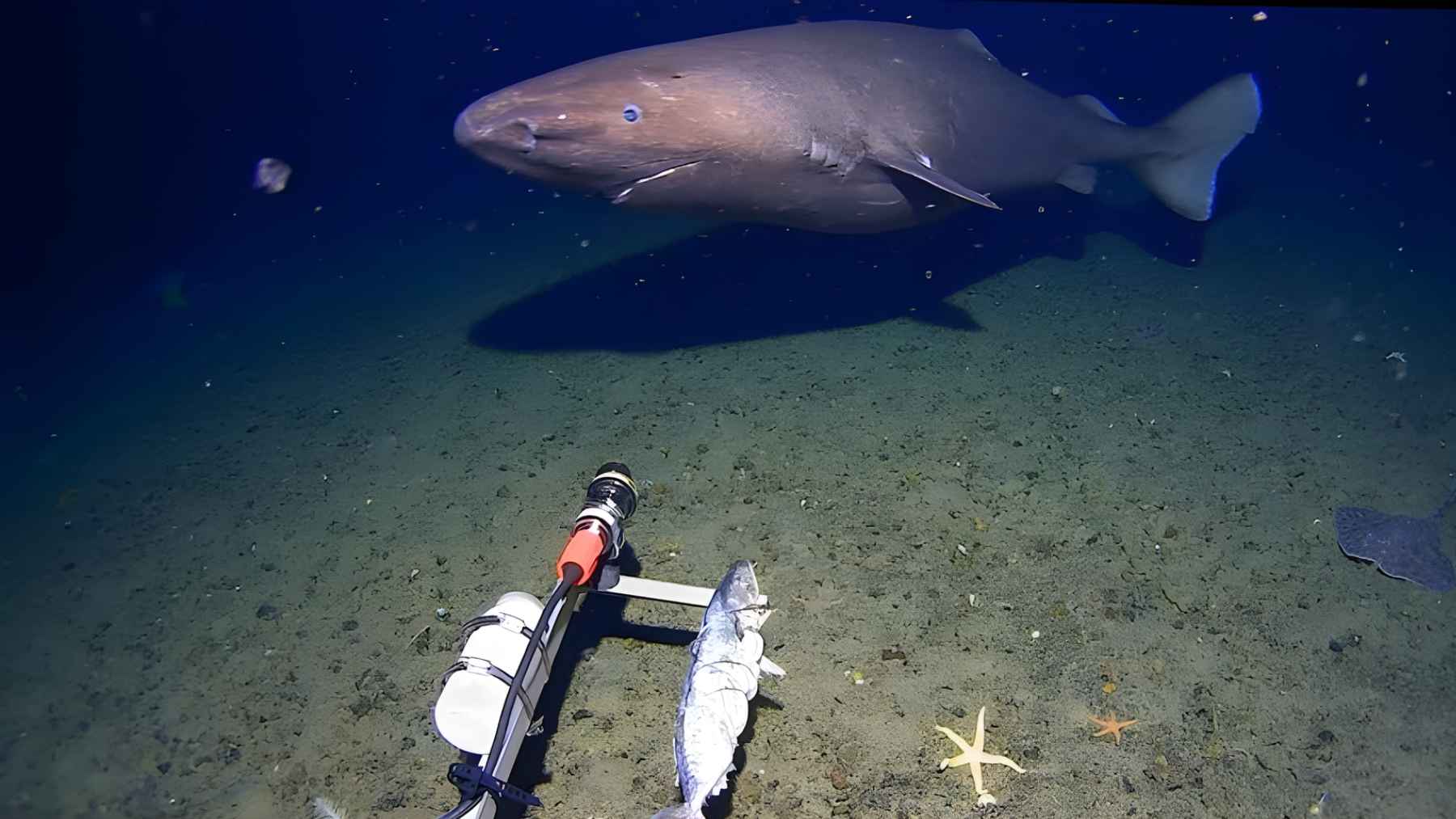
A deep-sea camera lowered into Antarctica’s Southern Ocean has captured a shark in Antarctic waters for the first time on video. Oceanographer Jessica Kolbusz, working with theMinderoo-UWA Deep-Sea Research Centre at the University of Western Australia, said, “It was surprising since this is the first footage obtained of a Somniosidae or any elasmobranch in situ in the Southern Ocean.”
Somniosidae refers to sleeper sharks, and “elasmobranch” is the broader group that includes sharks, rays, and skates.
How does a shark end up where many people assume sharks simply do not live? Deep-sea researcher Alan Jamieson said, “We went down there not expecting to see sharks because there’s a general rule of thumb that you don’t get sharks in Antarctica,” adding, “These things are tanks.”
Where the shark showed up
The animal appeared near the South Shetland Islands, roughly 75 miles north of the Antarctic Peninsula, in a region that is remote even by polar standards. It was spotted at a depth of about 1,608 feet, and the moment was later found buried inside roughly 400 hours of recorded video.
In the footage, the shark looks roughly 10 to 13 feet long and swims through water around 36 degrees Fahrenheit, hinting that large animals may have been living there unnoticed.
At that depth, the world can look empty at first glance. It is dark, cold, and under intense pressure, and even basic tasks like keeping a camera running become an engineering problem.
One clue may be the “layer cake” structure of the Southern Ocean, with bands of water stacked on top of each other. Some researchers say the warmest layer can sit deeper down, creating a slightly less frigid corridor that could help a shark survive farther south than expected.
What makes a sleeper shark different
The video suggests the animal is a sleeper shark, part of a deep-water family known for slow movement and energy-saving behavior. These sharks tend to drift, scavenge when they can, and tolerate conditions that would stress many other fish.
Their most famous relative is the Greenland shark, a species whose age stunned researchers when scientists used radiocarbon dating on eye tissue, a technique that uses radioactive carbon to estimate age. A 2016 study in Science estimated lifespans of at least 272 years, making it one of the longest-lived vertebrates ever studied.
The Antarctic visitor is thought to be the southern sleeper shark, likely Somniosus antarcticus, a deepwater species tied to the wider Southern Ocean, though its day-to-day life is still poorly documented. A 2023 Australian government report card describes it as widespread across southern waters and mostly caught as bycatch, which is an accidental catch in deepwater fisheries.
How the team filmed it
The sighting came from a baited camera “lander,” a rugged camera system lowered to the seafloor, left to record, then hauled back up. If that sounds like a trail camera for the ocean, that is not a bad comparison.
This approach has already paid off for the same research group in other extreme places. In January 2025, that university published footage from the Tonga Trench that captured another sleeper shark at great depth, underscoring how rarely these animals are seen alive.
Antarctic work adds extra hurdles, including rough seas, sea ice, and short operating windows. That is one reason scientists say much of the deep sea around Antarctica is monitored only in short bursts, not continuously at the right depths. That is why one short clip is getting so much attention.
Why sharks were assumed to be missing
For decades, Antarctica was treated like a natural “no sharks allowed” zone. Only a small number of shark species have been documented in the Southern Ocean, and many researchers suspected the coldest Antarctic waters were off-limits.
Scientists still do not know whether this sighting reflects a changing climate or simply a long-standing blind spot in deep-ocean monitoring.
Many Antarctic fish survive with chemistry that works a bit like “antifreeze,” helping stop ice crystals from growing inside their bodies. Researchers have studied these antifreeze proteins for decades because they are one of the clearest examples of life adapting to extreme cold.
Sharks do not use the same trick, but they have their own unusual toolkit. Scientists have found that sharks and their relatives carry high levels of urea and other natural chemicals, paired with compounds like trimethylamine N-oxide that help proteins keep working instead of falling apart.
A mystery that goes beyond one clip
Even if the shark “looks like” a southern sleeper shark, taxonomy – the science of naming and sorting species – is harder than it sounds. A major 2004 review in Ichthyological Research laid out how sleeper shark species can be difficult to separate using body measurements alone, which helps explain why scientists still debate where one species ends and another begins.
Genetics might clear up some of that fog, but the results can raise new questions too. A 2023 study in the Journal of Heredity reported strong genetic similarity between sharks labeled as southern sleeper sharks and those labeled as Pacific sleeper sharks, suggesting the family tree may be messier than the names imply.
That is where environmental DNA comes in, using water samples to detect tiny traces of genetic material animals leave behind. Scientists say water collected during the expedition could help confirm the shark’s identity once lab work is complete, and the technique is already being tested in Antarctic waters for other monitoring goals. For now, the lab work will do the talking.
The main official footage has been published by Inkfish Expeditions on YouTube.
The official expedition summary was published on the Deep-Sea Research Centre’s website.