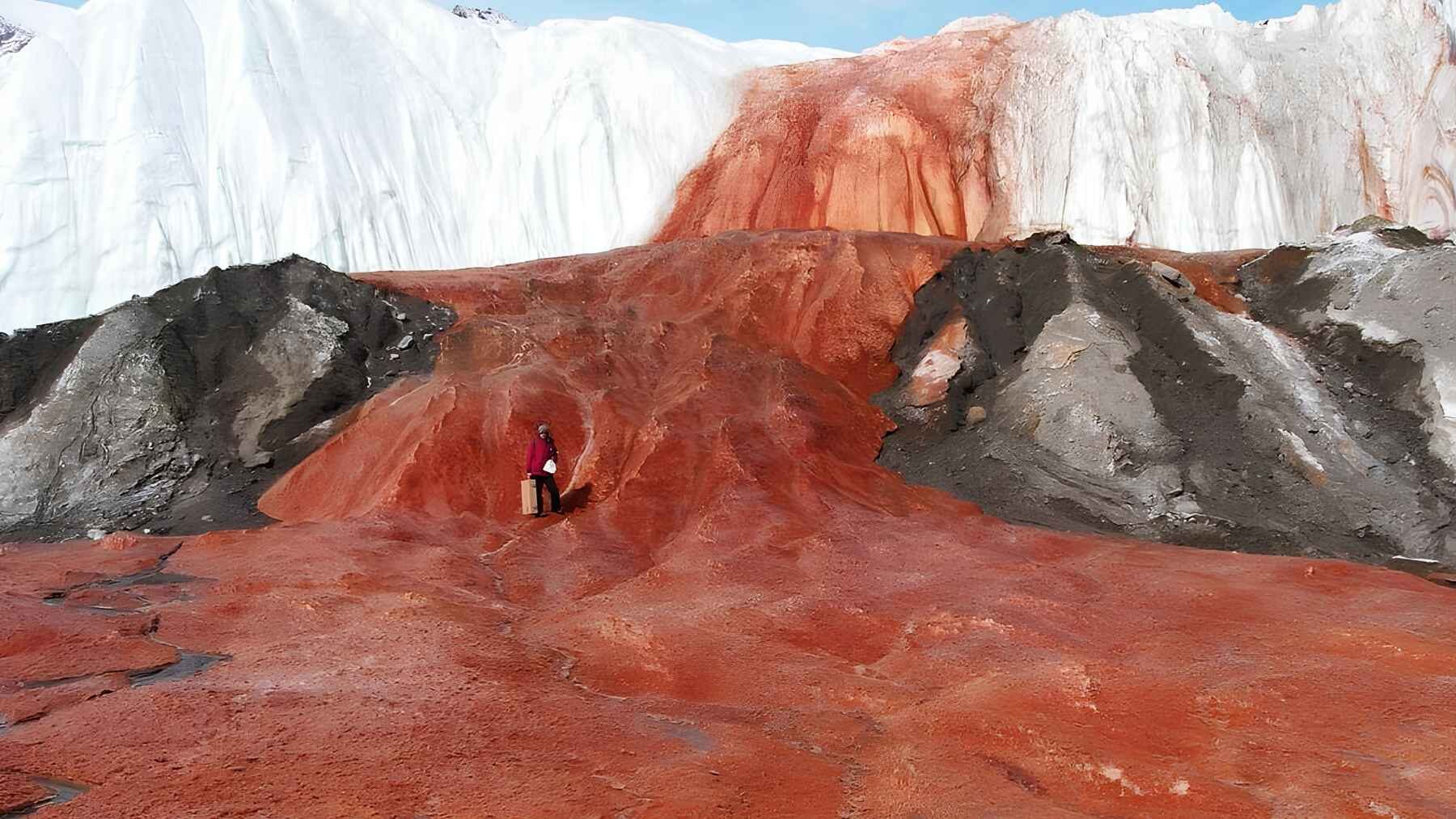
Antarctica’s Blood Falls looks like a wound in the ice. But there’s nothing bloody about it.
Its deep red color comes from iron-rich saltwater flowing from Taylor Glacier. When that iron meets the air, it oxidizes and turns rusty red. Simple enough.
But what is living there?
Scientists have now found something far more surprising in the red mud and sediment around the outflow. An active community of microscopic organisms with strong marine roots. In other words, this nearly lifeless-looking corner of Antarctica is very much alive.
The new evidence suggests that this isolated part of the McMurdo Dry Valleys still carries a biological record of an earlier connection to the sea. The researchers are not saying that an untouched ancient ocean ecosystem survives beneath the glacier. Not quite. Instead, they found marine-derived lineages that appear to have persisted and adapted long after the area became isolated from the ocean.
Why Blood Falls runs red
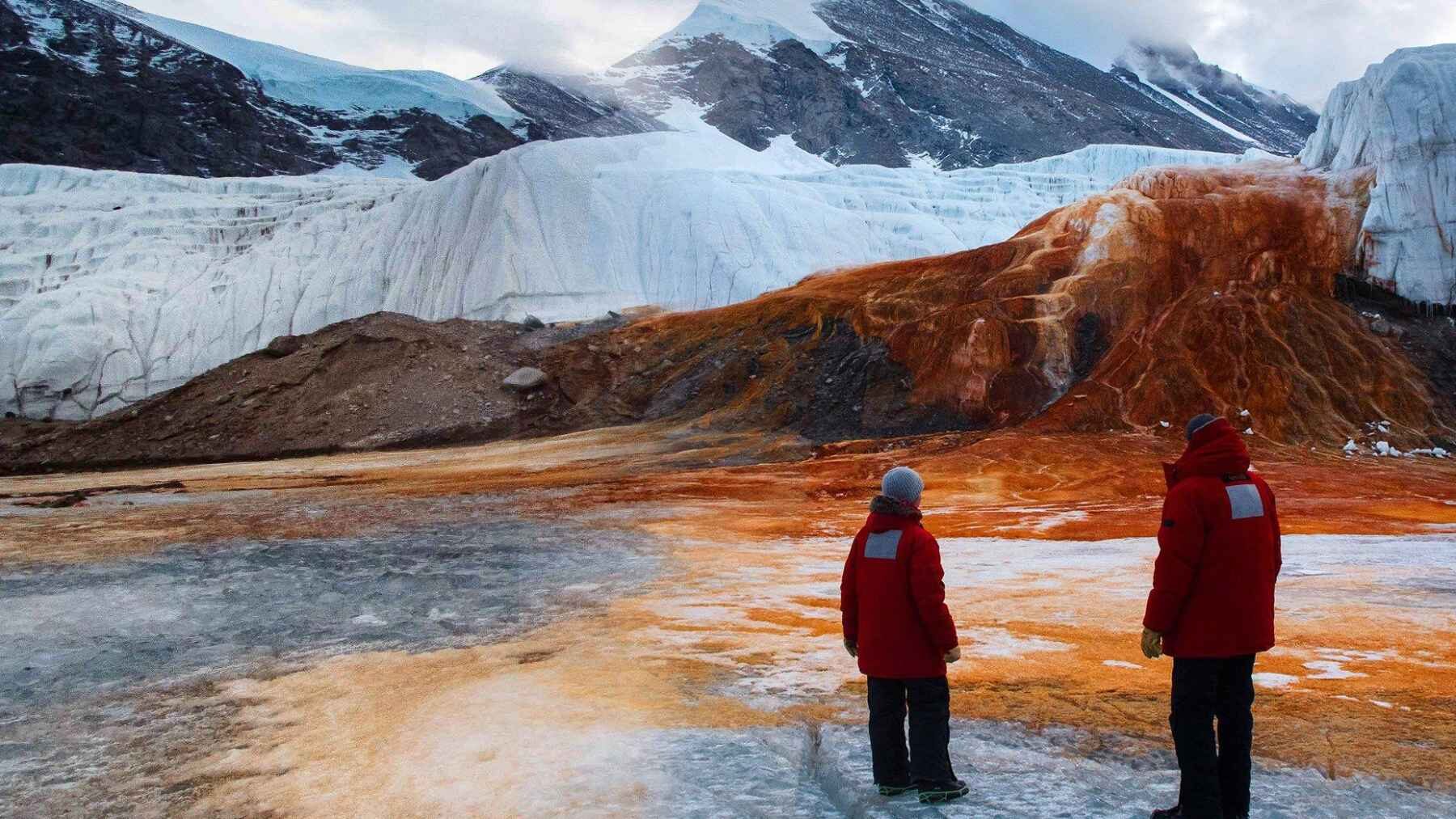
Blood Falls is fed by hypersaline brine. Basically, it is extremely salty water.
It is so salty that it can remain liquid under conditions that would freeze normal freshwater. The brine periodically moves through cracks in and beneath Taylor Glacier before spilling toward Lake Bonney.
And the red color? That comes from iron.
When dissolved iron in the water reaches oxygen at the surface, it oxidizes. Think of an old bicycle left out in the rain. The same basic chemistry creates that rusty appearance.
Earlier chemical studies had already pointed to an ancient seawater origin for the hidden brine. Researchers had also found bacteria closely related to marine organisms there. That made scientists wonder if other forms of marine life had survived too.
A marine signal in the mud
Angela Zoumplis led the research with senior author Andrew E. Allen through the Scripps Institution of Oceanography at the University of California San Diego and the J. Craig Venter Institute.
The team analyzed 167 samples from the Taylor Glacier terminus, nearby lakes and streams, material collected from the wind, and marine reference sites in McMurdo Sound.
That is a lot of mud, ice, and water.
Scientists used genetic sequencing to identify the organisms. They also examined RNA to see whether those organisms were actually active rather than simply leaving old genetic traces behind.
The difference between locations was striking. Marine taxa made up about 80% of the diatom community in red mud and red sediment. Nearby ice and surrounding sediment, meanwhile, were mostly dominated by freshwater or land-associated groups.
These microbes were not just leftovers
Finding marine DNA is interesting. But there is a catch.
DNA can stick around after an organism dies. So finding it alone does not prove that something is still alive.
RNA tells a more immediate story because it breaks down much faster. And here, researchers found RNA linked to photosynthesis, energy use, movement, stress responses, and cellular repair.
In short, the microbes were doing things.
The study describes the marine eukaryotic community around the Taylor Glacier terminus as transcriptionally active at the time of sampling. That strongly suggests researchers were looking at active residents, not just biological remains left behind long ago.
Wind does not explain everything
So how did marine organisms end up inland in Antarctica?
That question has been debated for years.
One possibility is that seawater once entered the valleys during warmer periods. Another is much simpler. Wind may have carried marine microorganisms or their remains inland.
The new study tested that idea by comparing Blood Falls samples with material collected from the air and with modern marine communities.
Modern wind transport does not seem to explain the pattern on its own. Marine signatures were rare in the wind collectors, while several diatom lineages around Blood Falls showed genetic differences from their relatives in McMurdo Sound.
That matters.
Those differences are consistent with populations becoming geographically isolated and then persisting separately over time. Still, the researchers did not completely rule out rare or ancient wind transport.
So the mystery is narrower. Not completely solved.
Survival in a harsh mixing zone
Living near Blood Falls is not exactly easy.
Iron-rich brine periodically wets the sediment. Then glacial meltwater arrives and changes the salt balance again. The result is a constantly shifting chemical environment.
Imagine being moved back and forth between seawater and freshwater. For a microscopic cell, that can be a serious problem.
Yet these organisms appear equipped to cope. Researchers found increased activity in biological pathways associated with ion transport, protein maintenance, and DNA repair.
Those are useful tools when your home is freezing, salty, iron-rich, and chemically unstable.
The researchers also found strong signs of photosynthetic and respiratory activity. So these organisms were not merely hanging on. At least some appeared metabolically active when conditions allowed it.
Some microbes may simply wait
There is another survival trick.
Dormancy.
Several groups detected near Blood Falls can form cysts, spores, or resting cells. These are essentially survival modes that allow microorganisms to shut down much of their activity during bad conditions.
Think of it as hitting pause.
When water returns or conditions improve, some of these organisms can become active again. Previous research has shown that resting stages in certain diatoms can remain viable for extended periods, especially in cold environments.
That could help explain how marine-derived lineages survive such an extreme place.
But there is an important distinction. The study does not prove that individual organisms have been sitting there unchanged since ancient seawater entered Taylor Valley.
Instead, dormancy may be one of several mechanisms helping these populations persist over long periods.
A biological archive of Antarctica
Why does any of this matter?
Because organisms such as diatoms can tell scientists a surprising amount about the past.
Many diatom groups strongly prefer either marine or freshwater environments. Their communities also respond quickly when environmental conditions change.
That makes them useful biological markers.
Scientists already use living and fossil diatoms to reconstruct past climate conditions. The genetic patterns found near Blood Falls could add another layer to that story, helping researchers understand when seawater reached Taylor Valley and how glaciers later changed the landscape.
There are still limits.
The preserved samples did not allow detailed visual identification of the microorganisms, and the researchers warned against claiming that they had discovered new endemic species based only on the genetic region they studied.
Future research will need better genetic resolution, individual-cell studies, and improved timelines.
For now, though, one thing is clear. Blood Falls is more than a strange red stain on Antarctic ice.
It may also be a living biological echo of the ocean that once reached this frozen valley.
The main study was published in Nature Geoscience on Aug. 3, 2026.