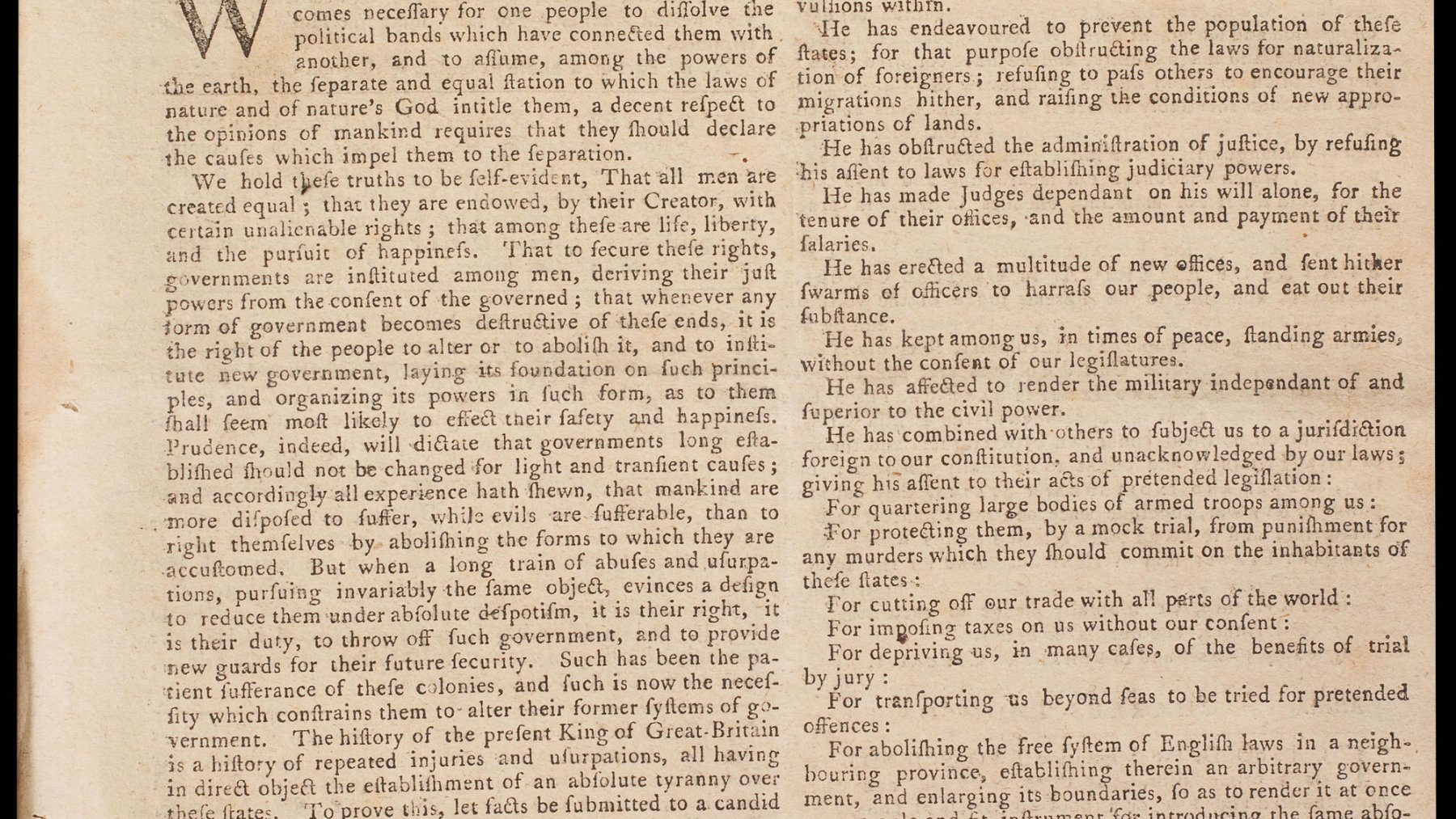
America’s Declaration of Independence reached German-speaking readers just days after Congress adopted it on July 4, 1776. Only two copies of that first German-language broadside edition (a large, single-sheet printing) are known to survive, owned by Gettysburg College in Pennsylvania and the German Historical Museum in Berlin.
The Berlin copy received renewed attention during America’s 250th-anniversary year, when the museum highlighted it in its collection exhibition. Behind the rare paper lies a practical story about reaching people in a language they understood. Keeping the document accessible today brings another challenge, balancing public display with years of protective storage.
The race to spread independence
In 1776, declaring independence and telling people about it were separate jobs. John Dunlap’s Philadelphia print shop produced an estimated few hundred English broadsides after Congress approved the text, giving the announcement a form that could circulate beyond the meeting room.
Think of a community bulletin board rather than a phone alert. Broadsides were intended to be posted publicly or read aloud, but an English-only version could not reach every reader in German-speaking communities. For the printers, language was part of how the news worked.
Printers who already knew the audience
Philadelphia partners Melchior Steiner and Charles Cist were not starting from scratch. Earlier in 1776, their firm had published Thomas Paine’s Common Sense in German under the title “Gesunde Vernunft.” Their work also included printing for Pennsylvania’s assembly and the Continental Congress.
The German Historical Museum dates its broadside to July 6 through July 8, 1776, rather than assigning a single, certain printing day. The German newspaper Pennsylvanischer Staatsbote printed the Declaration on July 9, adding another route for the text to spread.
The design also did some of the work. Instead of Dunlap’s single column, Steiner and Cist used two columns and Gothic lettering adapted to German readers, choices the museum’s analysis links to readability. At roughly 16 by 13 inches, the Berlin sheet carried the argument for independence in a portable format.
Two sheets, two different journeys
Gettysburg’s copy was discovered by a visiting scholar in 1984 among German-language materials in Musselman Library. “It’s not a pretty document, but it has a powerful presence,” philosophy professor Daniel DeNicola said in a college account.
Berlin’s museum acquired its copy in 1993, soon after German reunification. In its July 2026 account, the museum described the purchase as a symbolic commitment to the values of Western democracies. An earlier technical examination documented stains, folds and small repairs, reminders of the paper’s long journey.
These are survivors of the first German broadside edition, not the only German versions of the Declaration. Newspapers also carried the text, so the two sheets represent one particular way the announcement reached its audience.
A wider audience did not mean equal rights
Translating the Declaration helped German-speaking settlers engage with the patriots’ arguments. Gettysburg historian Timothy Shannon notes that winning immigrant support was politically important, including discouraging loyalty to the British Crown.
But reaching more readers did not erase the contradictions in “all men are created equal.” The German Historical Museum’s educational materials emphasize that slavery and the violent displacement of Indigenous peoples stood in direct conflict with the Declaration’s universal language. Translation widened access to the argument, not equal rights in practice.
Why the original needs time in the dark
The Berlin sheet was included in “Objects. History. Stories. Reviewing the Collection,” but the museum’s July 3 update scheduled the original’s display only through early August 2026. The broader exhibition runs through October 31, 2027, so its calendar should not be confused with the original document’s viewing window.
Exhibition project manager Dorlis Blume said the original could be shown for no more than three months at 50 lux, a measure of light level. Afterward, the museum’s plan required a facsimile (a reproduction) and at least three years of dark storage for the original.
Why all that caution? The Conservation Center for Art & Historic Artifacts explains that light damage builds up and is irreversible, potentially fading and weakening paper. Dark storage reduces further exposure, but it does not undo damage already done.
Keeping the paper and the message alive
There is a familiar lesson here for anyone keeping an old family photograph. The Library of Congress recommends displaying a reproduction of valuable paper-based material while storing the original safely, rather than leaving it permanently exposed to light.
Gettysburg has also made its broadside available through its digital collections, allowing readers to examine the text without handling the sheet.
The museum’s official account was published on the German Historical Museum’s DHM Journal on July 3, 2026.