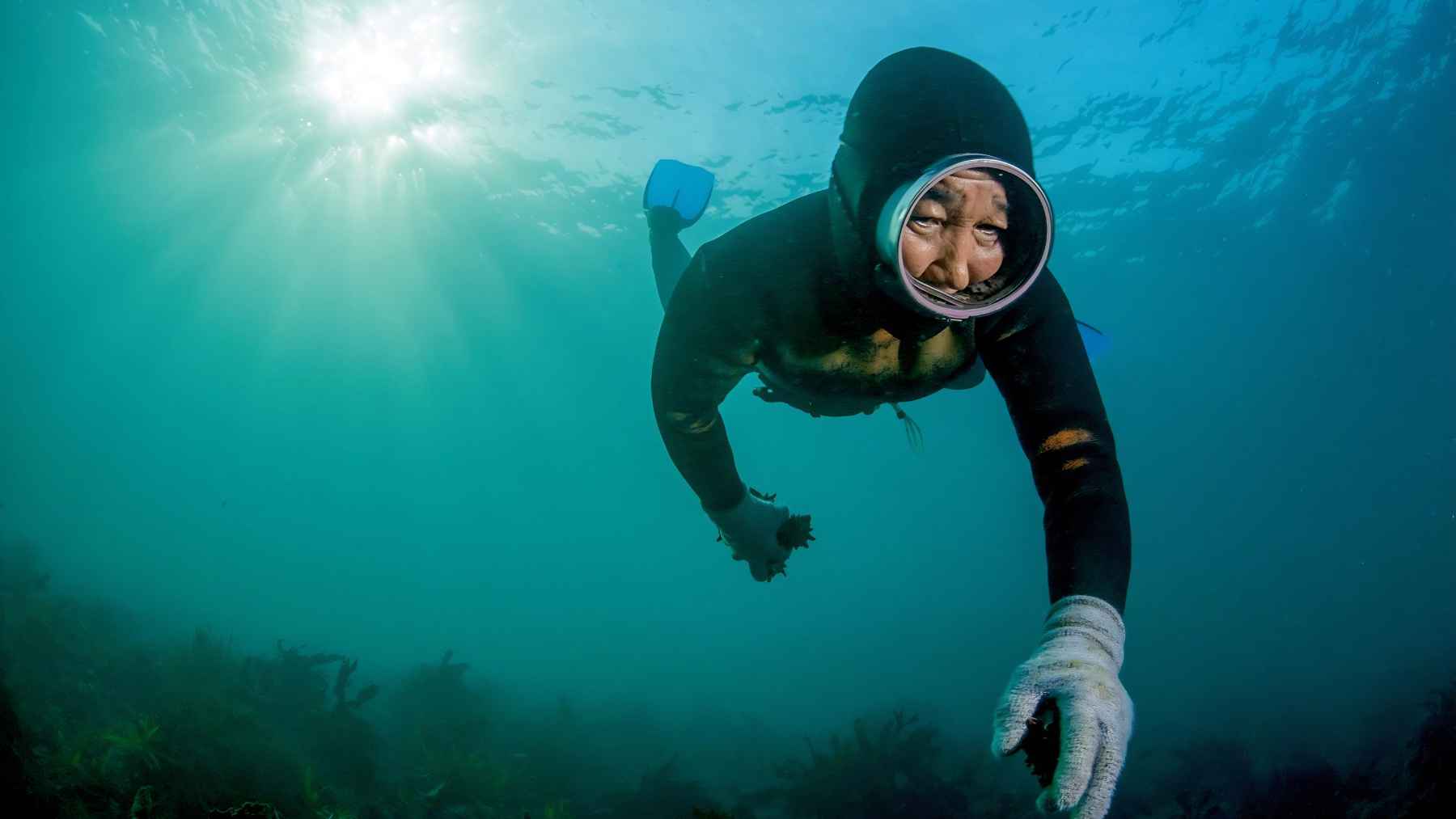
You may not believe this, but off Jeju island in South Korea some women in their 80s and 90s are slipping beneath the waves without air tanks or safety lines. Their work is to descend as deep as 20 meters and look for shellfish between the volcanic rocks. They can keep doing that for hours, and some of them have been doing it for more than 60 years.
These haenyeo (or women of the sea) are preserving far more than a dangerous job. New research done with them suggests that decades of breath-hold diving have trained their hearts to conserve oxygen. It has also shown that the islanders and the next generations may have genetic signatures linking to lower blood pressure during dives. The sad part is that women carrying this culture are aging much faster than new divers can replace them.
What a day in the water really looks like
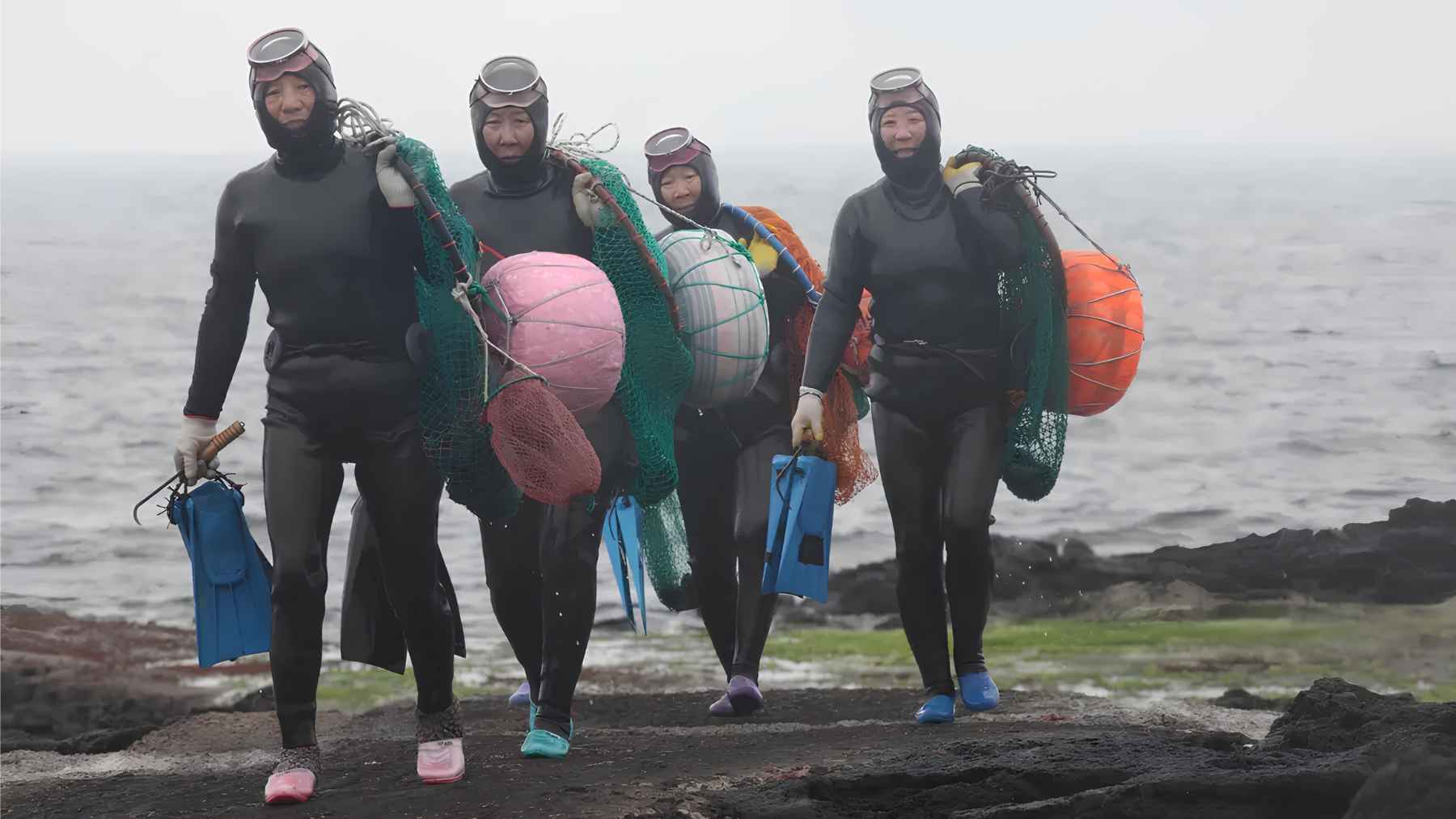
Their equipment is simple. A haenyeo carries a mask, lead weight, a hook tool and a floating “tewak” with a net beneath it. The tewak is a small buoy that is used as a flotation device to help the haenyeo stay afloat in the sea and also serves as a sort of life jacket. In 2016 UNESCO added the culture of Jeju’s haenyeo to its Representative List of the Intangible Cultural Heritage of Humanity.
It might be crazy to you, but those divers can work up to 7 hours a day on 90 days each year. Most of those dives reach around 10 meters, although more experienced women may work at twice that depth. When they resurface they release air with a whistling, just like whales and dolphins. This exhalation method is called “sumbisori”. The workers are divided into 3 ranks, determined by skill. And the senior sangguns guide the others, because nobody dives alone.
Their bodies have learned to stretch one breath
In May 2025, a team led by University of Utah geneticist Melissa Ilardo compared 30 haenyeo to 30 non-diving women from Jeju and 31 women from mainland Korea. The participants averaged 65 years old. Researchers tried to “simulate dives” by asking the participants to hold their breath and place their face in cold water.
The haenyeo’s heart rates fell more sharply than those of other women, helping their bodies use limited oxygen more efficiently. In one specific case described by Ilardo, a diver’s heart rate dropped by more than 40 beats per minute in less than 15 seconds. This response appears to be largely tied to training, showing what years of repeated dives can teach the body.
The genetic clues that were found
The study also found some traces that cannot be attributed to their practice. The haenyeos were more than 4 times as likely to carry both a genetic variant associated with lower blood pressure during diving and a genetic variant linked to a higher cold tolerance than mainland Korean women.
Yet non-diving women from Jeju carried the same markers, making the island’s divers and non-divers nearly indistinguishable genetically. Ilardo proposed that centuries of women diving during pregnancy may have created selective pressure because dangerously high blood pressure can threaten both mother and baby. Still, the study involved only 91 women, so a larger study has to be done if we want more solid conclusions.
Why women became Jeju’s economic backbone
Why did this specific work become female-led? Not even the haenyeos know how to explain it. Theories include historical taxes on male divers and a shortage of men after the Korean war. The result was a partly matriarchal household economy within a society traditionally shaped by male-centered Confuncian norms.
Because of that knowledge was passed from mother to daughter and through village fishing cooperatives, which control local harvesting rights.
The arithmetic is unforgiving
In 2024 Jeju had 2,839 active haenyeo. This is almost 40 percent less than the 4,377 that were counted in 2014. Of those, more than 90 percent were at least 60 years old. It’s also known that in the mid-1960s the island had more than 23,000 divers. That means the number of workers has been reduced by almost 90 percent in 60 years.
Younger residents found safer ways to earn a living without having to dive. Some examples are mandarin teaching, new ways of farming and tourism. The fact that the sea water is getting warmer has also added another layer. The temperature changes reduce the kelp beds that feed the abalone which in turn shrinks suitable diving places. It’s a sad thing to say but a tradition that was built around the ocean might become unsustainable due to how much the ocean is changing.
New recruits are arriving and bringing cameras
The tradition may never end though. Two haenyeo schools now enroll several dozen candidates each year but the licenses are not easy to acquire. A diver must spend at least 60 days per year in the water, earn at least 1.2 million won (their currency) and win the approval from the village cooperative and every haenyeo already working there.
Lee Ah-ran, 32, trained at the Beophwan school after working as a dental hygienist and marketing specialist. After a 3-month internship she joined the Hahwi-ri cooperative where older divers call her “the little one”. She also streams her dives for about 50,000 followers, bringing the tradition onto modern media.
What survives on Jeju’s coast may be a smaller and younger fragment of the original tradition. But that does not erase the culture. It actually shows how much it had to adapt to remain alive.