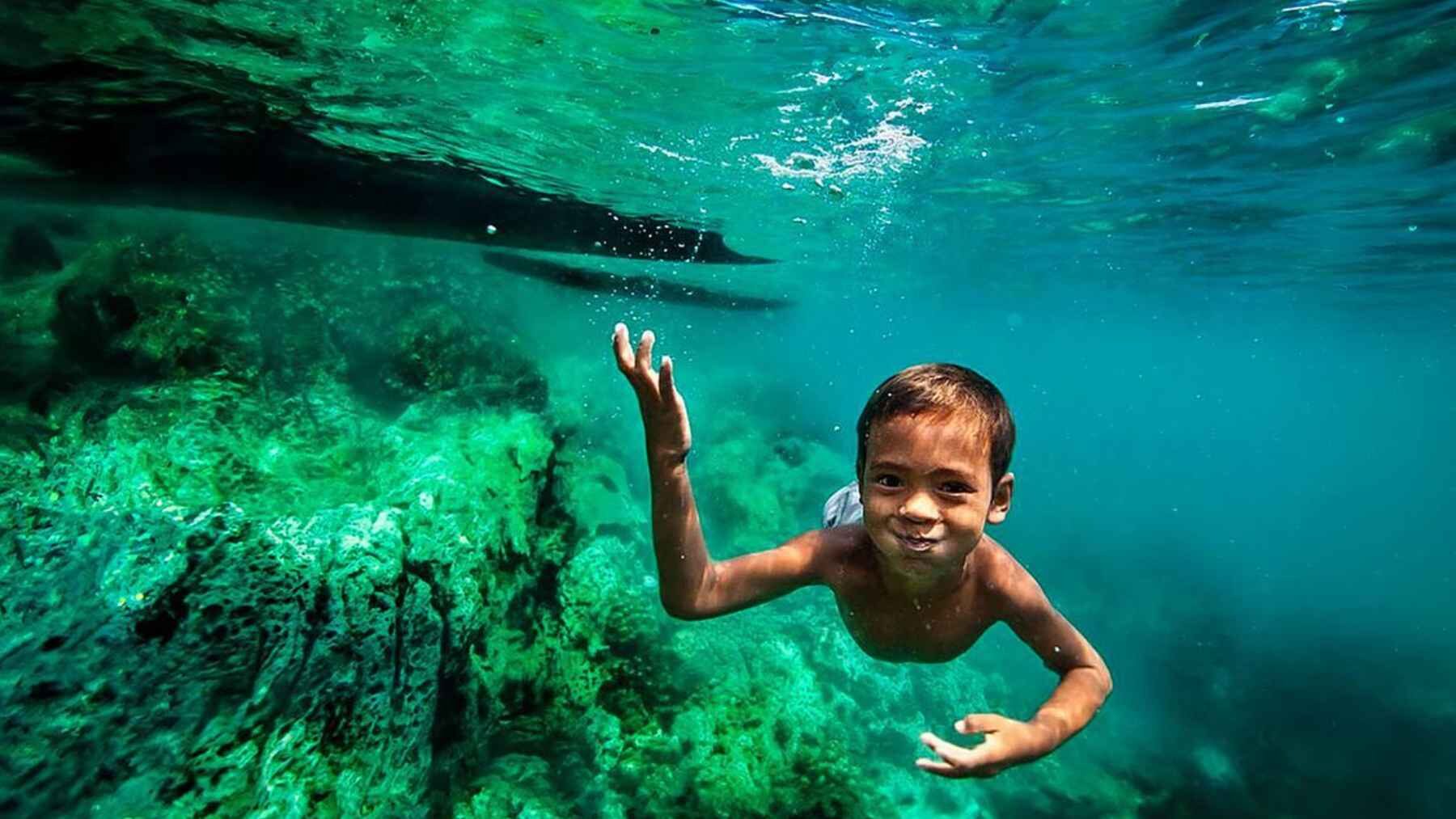
In the northeast Indian Ocean among the islands of Myanmar and Thailand, the Moken children possess a rare ability to see clearly and hunt underwater. If you have ever opened your eyes in a swimming pool without goggles, you understand why gathering shellfish and other food from the seabed would be nearly impossible for an ordinary person.
Recent headlines have presented this as a fresh scientific discovery and compared the children with dolphins, but the evidence behind the story comes from peer-reviewed work published in 2003 and 2006. Its most important lesson is less flashy but more revealing, as the children appear to train ordinary human eyes to perform an extraordinary task.
Why water turns vision blurry
In air, the curved cornea supplies roughly two-thirds of the eye’s refractive power, while the lens fine-tunes the focus onto the retina. Once the eye is submerged, the optical difference between water and the cornea becomes much smaller, so much of that focusing effect disappears.
That is why goggles make such a dramatic difference. The pocket of air in front of the eye restores the boundary the cornea needs, while an unprotected eye is left trying to compensate for severe defocus.
More than twice the detail
In the original field experiment, researchers tested six Moken children and compared them with 28 European children in the same age range. Using underwater cards marked with increasingly fine black-and-white lines, the team recorded an average acuity of 6.06 cycles per degree for the Moken group and 2.95 for the European group.
This means the Moken children resolved more than twice as much underwater detail in that task. Because the first group included only six children, the result is best read as strong evidence of a striking ability, not as a precise estimate for every Moken child.
A pupil becomes a pinhole
The researchers found that the Moken children constricted their pupils to an average diameter of 1.96 mm, compared with 2.50 mm among the European children. A smaller opening works a little like a pinhole camera, cutting down the blur and expanding the range that appears acceptably focused.
Their lenses also changed shape through accommodation, reaching about 15 to 16 diopters, a measure of focusing power that the researchers described as the known limit of human performance. Neither adjustment fully replaces the lost power of the cornea, but together they make fine underwater patterns far easier to resolve.
European children learned it, too
A 2006 follow-up trained four European children through 11 underwater sessions over about one month, and all four improved as distinct bursts of pupil constriction appeared. The study also recorded gains after a four-month period without underwater activities.
When tested outdoors in bright sunlight eight months after the final session, the children reached the same underwater acuity measured in the Moken group. That does not rule out every possible inherited influence, but it strongly suggests that unique Moken eye anatomy is not required and that repeated practice can teach young eyes to combine strong accommodation with unusually tight pupil control.
The dolphin comparison breaks down
Calling the skill “dolphin-like” makes an irresistible headline, but the biology is not the same. Cetaceans have evolved specialized features that include powerful spherical lenses, distinctive corneal designs, reflective tissue behind the retina, and molecular changes suited to underwater light.
Moken children are doing something subtler. They push normal human mechanisms toward unusual limits, producing a somewhat similar outcome through learned control rather than through the suite of anatomical adaptations found in marine mammals.
What the studies really proved
The experiments measured spatial resolution with patterned targets. They did not show that Moken children match dolphins across color perception, motion detection, distance judgment, low-light vision, or every other part of seeing underwater.
They also did not establish that every child can acquire the skill, that it lasts for life, or that genes play no role at all. What they did establish is compelling enough, since underwater visual acuity can be shaped by experience far more than researchers once assumed.
A skill tied to a changing culture
UNESCO describes Moken free-diving, fishing, and gathering as part of a broader body of indigenous knowledge built through close attention to currents, reefs, animals, and changing seascapes. The organization has also documented how observations and oral knowledge helped Moken communities recognize danger and respond during the 2004 Indian Ocean tsunami.
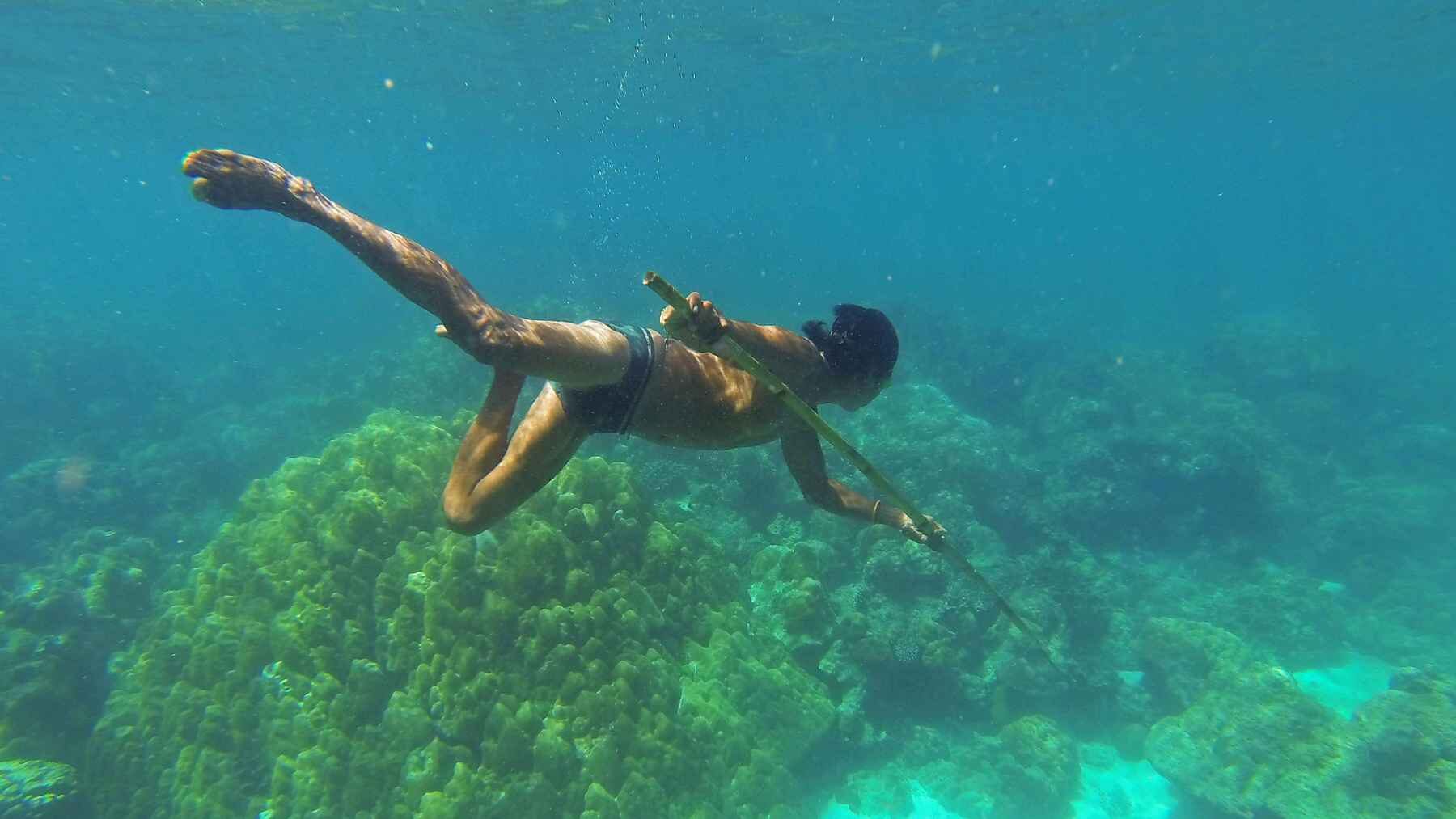
That cultural setting is under pressure. UNESCO reports that traditional kabang houseboats have largely disappeared, fishing and foraging areas have narrowed, and younger generations are becoming less familiar with some sea-based knowledge, although those changes do not by themselves prove that underwater acuity has declined.
The real discovery
At the end of the day, Moken children do not break the rules of human vision. They show how far those rules can be stretched when practice begins early and underwater detail is part of everyday life.
The follow-up study was published in Vision Research.