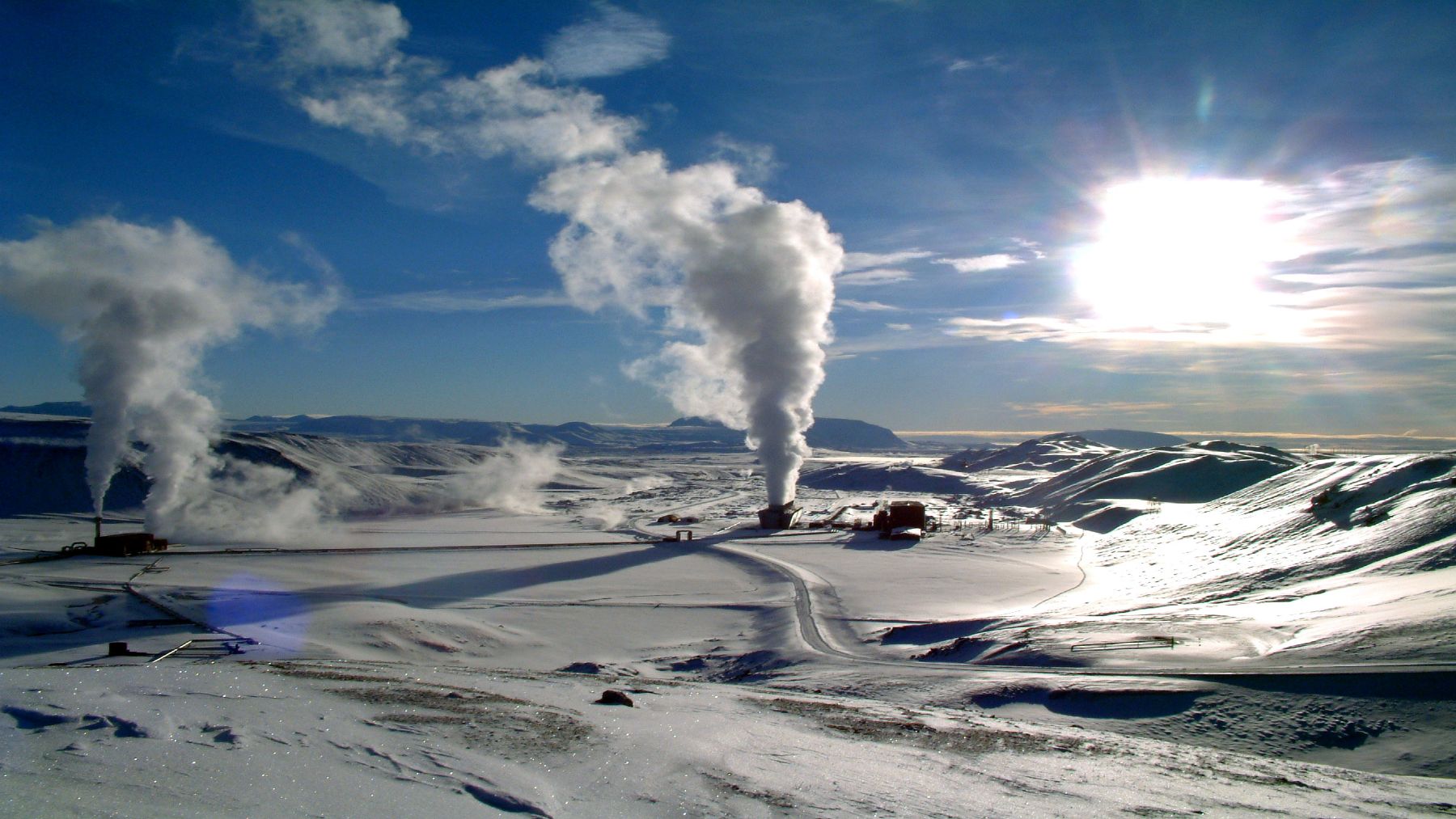
Half a century ago, Iceland pioneered itself when it began exploring geothermal power sources, particularly at the Krafla Geothermal Power Plant. It is a turning point in the Iceland energy industry and a pioneer for sustainable global energy development.
Today, the United States looks for a similar geothermal potential at Yellowstone National Park. This article gives insight into the history of Iceland’s Krafla Geothermal Station, how it was constructed, and its efficiency in the concept and resemblances to what America is currently pursuing.
A fascinating history of the Krafla Geothermal Station in Iceland
The first power plant was Krafla Geothermal Station, situated east of Lake Mývatn, which started generation in 1978. This was after about four years of explorations in 1974 through well-drilling exercises that showed Iceland had a bounty of geothermal power hidden beneath its snowy surface.
Working with steam from high-temperature artesian wells, Krafla, which initially supplied 7MW of energy to the national grid, has increased its electrical output to 60MW.
Some of the advancements in drilling at Krafla, such as directional drilling, have made the process faster and more friendly to the environment, thus making Krafla a benchmark in geothermal development around the globe.
When Iceland embarked on geothermal energy, several measures that may be described as trendy were adopted; Krafla high-temperature boreholes were constructed to enable efficient power generation with as low an impact on the ecology as possible.
This has placed Krafla at the vanguard of geothermal technology and has shaped other comparable projects worldwide, including in Yellowstone. Through reinjection of run-off water, which has been in practice since 2022, the geothermal system shall be sustainable by providing an unending source of energy that, in a way, will not exhaust resources.
Exploring the geothermal energy potential of Yellowstone National Park
As America feels the pinch to reduce its reliance on foreign petroleum and seeks cleaner energy sources, Yellowstone National Park is the right place to expand geothermal development.
It also has essential thermal features, such as the park’s hot springs, geysers, and apparent underlying volcanic characteristics. The same is true in Iceland’s case. Some concerns are connected with environmental issues, tourism, and the technological problems of using this energy.
However, the possibility of utilizing sustainable energy is enormous. Geothermal energy has tremendous potential for becoming an efficient energy source because it emits very low CO2 and becomes the source of renewable energy that makes this country independent of foreign energy sources.
Key lessons for America from Iceland’s geothermal energy journey
The lessons that could be learned from the Krafla Geothermal Station could only have been obtained by Americans from trial and error. For this reason, The International Geothermal Review underlined the critical importance of integrating science and the social dimension with engineering and politics in exploring productive frameworks for geothermal energy.
This kind of cooperation can be helpful in the determination of successful strategies applied in Iceland to optimize them when implementing them in geologically and environmentally substantially different Yellowstone.
Community sensitization will also be vital in developing a support base for geothermal projects, considering that communities have to be acquainted with the issues of change to renewable energy sources. This way or that, any collaborative and informed approach to geothermal development can prove optimal for the US.
The promising future of geothermal energy for sustainable solutions
Looking at the future, the stories of Krafla and Yellowstone describe the search for sustainable energy sources anywhere in the world. The case of Iceland is a brilliant example, which documents the process of actual transition from the use of geothermal energy on the shores of Iceland to a model example, and the experience shows that, if needed, with innovation, cooperation, and determination, much can be achieved.
America’s pursuit of geothermal energy in Yellowstone is not purely to realize newer and better power sources here; it is more about the struggle for a cleaner future.
Thus, having used the victories of British heavy industry to highlight the necessity of learning from the past to address the present and form a more sustainable energy future, let us look at how the opposite has played out. What is yet to come for geothermal energy? This book has shown that Iceland and the United States have more prospects.