Imagine observing a galactic collision 8 billion light-years away and, amidst all the cosmic chaos, discovering something that challenges virtually everything we thought we knew about the universe’s formation. Now, imagine that this “something” is a black hole, but not just any black hole. This is because it isn’t at the center of a galaxy, nor its brilliant core, as the script of the known universe dictates. It’s actually in the middle of nowhere. In the limbo between two merged galaxies. This is exactly the scene a group of astronomers found when combing through data from the James Webb Space Telescope.
A cosmic paradox: How did black hole giants emerge in a baby universe?
The James Webb Telescope went into operation in 2022, and since then, it has been delivering a flurry of discoveries. However, amid so many spectacular images of distant galaxies and stars in formation, a question began to bother scientists: how to explain the existence of supermassive black holes so soon after the Big Bang?
All this questioning because, according to traditional models, black holes grow over time from “light seeds,” which are small black holes generated by the death of massive stars. And then, with luck, successive mergers create larger black holes. However, there’s a problem with this timeline: it’s too slow to account for the giants Webb has observed in a still-infant universe. And the alternative lies in a process called direct collapse, where a dense cloud of gas, instead of forming stars, collapses and generates a giant black hole almost instantaneously. The concept has been around for years, but has never actually been observed. That is, until now.
Did we just witness a black hole being born from a galactic crash?
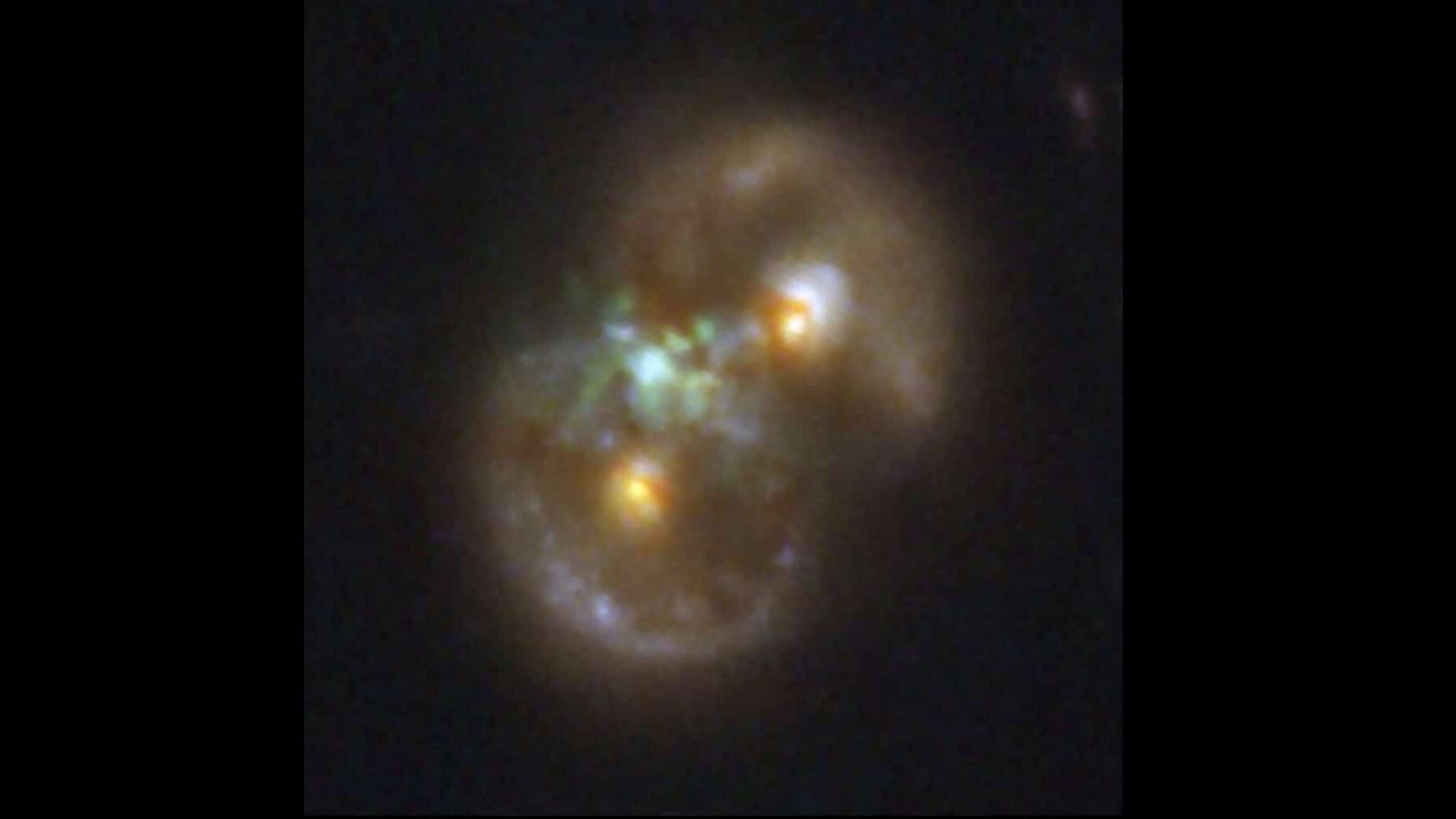
While combing through images from the COSMOS-Web survey, two researchers, Pieter van Dokkum and Gabriel Brammer, discovered a peculiar object. They found two circular, symmetrical structures with compact red cores at the center. Until then, everything indicated they were dealing with the result of a head-on collision between two disk galaxies. The name came almost naturally: Infinity Galaxy.
The structure resembled the symbol ∞, but what was at the center of this image was what kept scientists awake at night: an active black hole (like this black hole in America that continues to grow), surrounded by ionized gas, but outside the galactic nuclei. In other words, it wasn’t the remnant of a galaxy, nor a “fugitive” wandering the universe. It was born there, or at least formed there after the collision, from the compression of gas generated by the collision between galaxies. To prove this, the scientists compared the velocity of the surrounding gas with that of the black hole, and they found an almost perfect match.
Infinity Galaxy challenges what we thought we knew about black hole formation
It’s important to emphasize that this wind is a crucial clue to solving the mystery of “early” black holes found in the early universe. Perhaps the answer lies right here: direct collapse wasn’t an event exclusive to the first moments of the cosmos. The discovery of the Infinity Galaxy shows that, even billions of years after the Big Bang, the universe can still conjure up the extreme conditions to create supermassive black holes practically from scratch. It just needs the right combination:
- Compressed gas.
- No star formation.
- And the exact moment of collapse.
Not stopping there, there’s another curious detail: the two nuclei of the merging galaxies also have active black holes. In other words, we’re looking at a system with three giant black holes, one of which is possibly newborn. This is a true natural laboratory for studying one of the most extreme phenomena in physics. Perhaps they will also help us understand why black holes never run out of fuel.