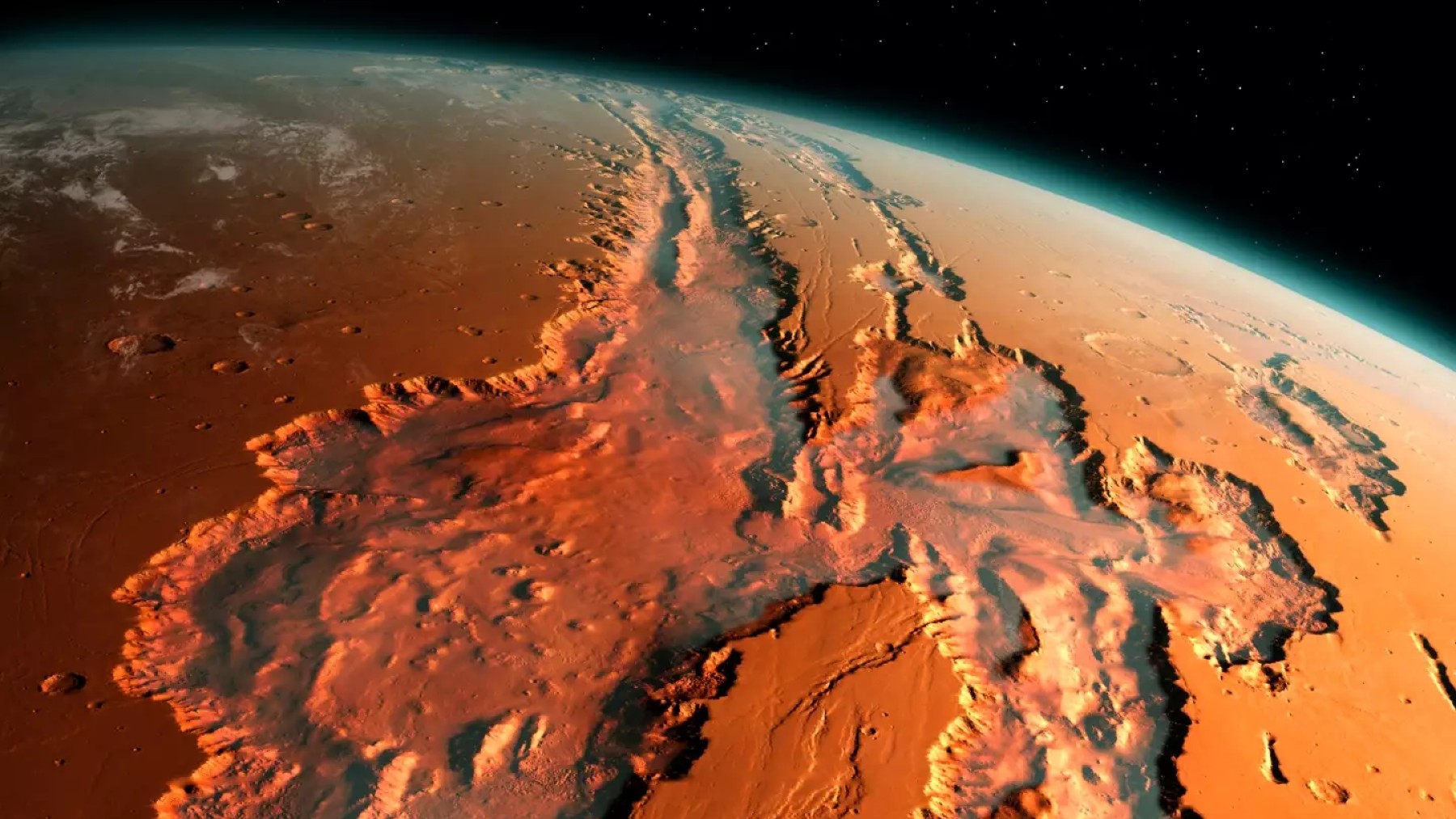
The surface of Mars, when compared with its past, might have habitable conditions, but present-day Mars is a dry desert terrain. New results obtained from the NASA MAVEN mission are explaining the enigma of the change in the image of Mars, which relates to solar wind and the unusual magnetic and electric distributions that the wind creates. The importance of this finding is not only in reconstructing the history of Mars, but also in understanding the cosmological processes which shape the atmospheres of planets.
Mapping Mars: The electric circuit of the planet explored by MAVEN
Earth’s core is made up of molten iron which generates a magnetic field that surrounds the whole planet. Such a process is not present in the case of Mars. It is the solar wind particles that induce electric currents in the Martian atmosphere which creates a magnetic field surrounding the planet.
These currents aren’t only hypothetical; they have been found in the measurements obtained by the sensitive magnetometer of the MAVEN spacecraft, enabling scientists to build a three-dimensional magnetic field map of Mars and track the pathways of these currents.
As noted by Robin Ramstad, a researcher at the University of Colorado, these currents are like the electric circuit found in the atmosphere of Mars, where intense currents sit about 75 to 125 miles from the surface of the planet. This understanding of the induced magnetosphere plays an important role in understanding how atmospheric particles are accelerated and eventually escape to space, causing change on Mars.
How does the solar wind restructure the surface and atmosphere of Mars?
The solar wind, which consists of ionized particles emitted by the sun, operates quite differently on Mars because of the non-existence of an internal magnetic layer. Electrons and ions from the solar winds when they strike the upper layer of the atmosphere of mars, will create electric currents which in turn change that planets’ magnetic fields.
Such currents boost charged particles present in the atmosphere, and hence they expel them out of the planets’ gravitational pull. Over hundreds of millions of years, this slow process has been the main cause of Mars’ atmosphere’s thawing and causing the progressive changes of this planet from its wet and possibly habitable past to wine deserts of today.
MAVEN’s findings enhance the knowledge of escape processes within the solar system in showing that energy losses of this type are of much bigger magnitude than previously thought.
Is it possible to save the planet with an artificial magnetic field? Theoretical solutions and risks probably
Hypothetically, one of the ways to keep or rather bring back the atmosphere on Mars would be to create an artificial magnetic field around the planet. Measurements show that covering the equator of mars with a band of superconductor will form a field like that of earth and thus could save mars from the solar winds.
This method has, however very high impracticalities owing to enormous power requirements and hazards. The power supply necessary to produce such a magnetic field would be enormous and more so, a cut in supply to the superconducting band would result in dangerous levels of energy being expelled in the form of X-rays.
Such a failure mode is extreme enough that it would probably render most of the solar system lifeless, hence this technique for atmospheric conservation is expensive and impractical.
The results obtained from MAVEN’s investigations show that Mars’ atmospheric and magnetic fields are significantly influenced by various solar forces. By tracing the electric currents responsible for atmospheric escape, scientists elucidate how Mars has evolved from a warmer and more hydrated world. This research contributes not only to the knowledge of Mars, but also to the planning of other missions and studies of planetary atmospheres within and outside the solar system.