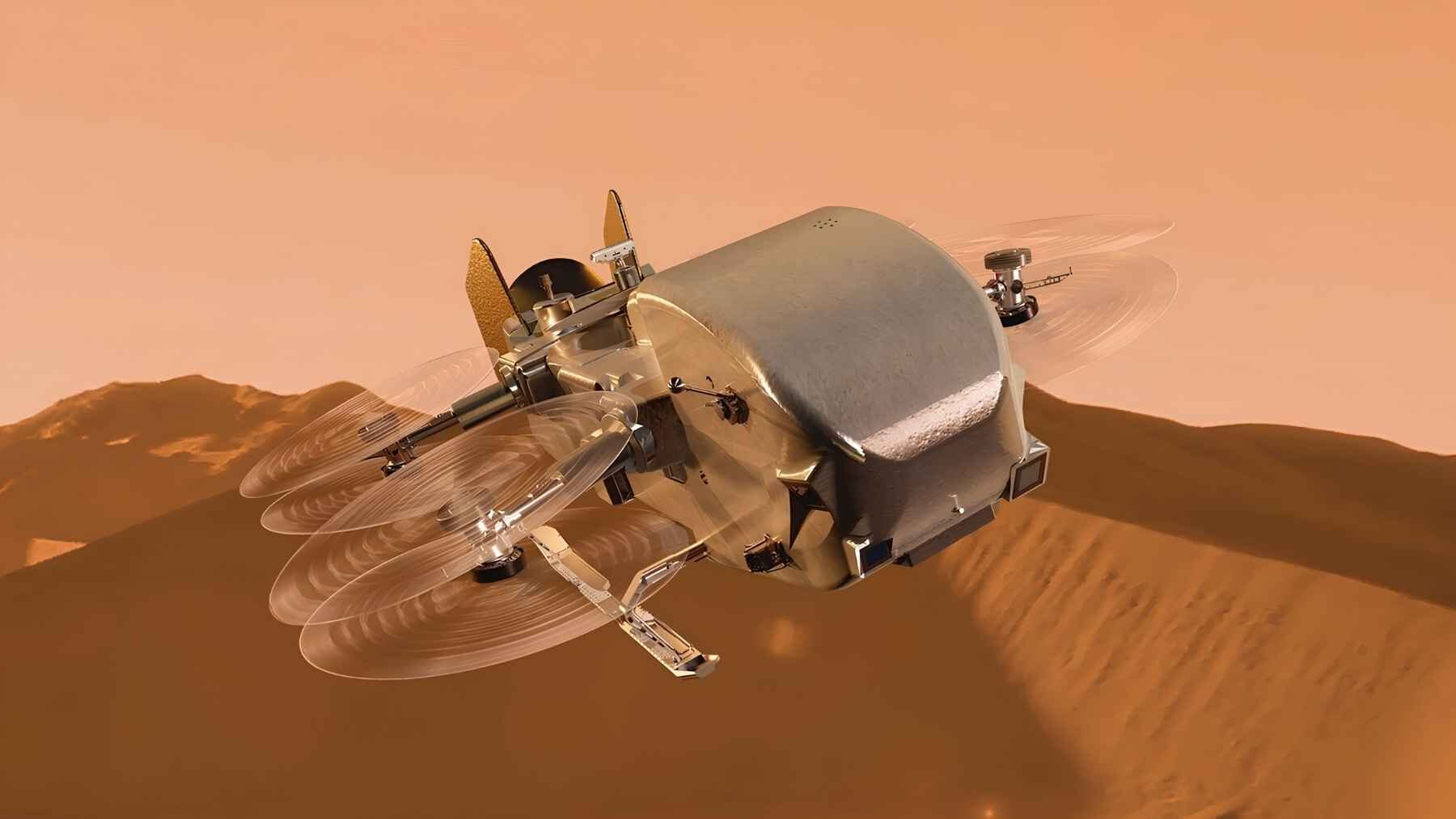
What was once just a project on computer screens has now become reality. NASA’s engineers at the Johns Hopkins Applied Physics Laboratory are now working on the Dragonfly, a probe that is going to set sail to Titan, Saturn’s largest moon. The Dragonfly’s almost 13-foot fuselage is being filled up with wires, electronic devices, engineering instruments and thermal systems, all things that are going to be needed to turn that truck-sized octocopter into a real working spacecraft that has a long journey ahead.
When we talk about space-related technology we always talk about things that we don’t see in our day-to-day routines. The Dragonfly is a very unusual machine, perfectly fit to journey towards a very unusual destination. Titan’s surface atmosphere is about 4.5 times denser than ours, while its gravity is much weaker, with roughly one-seventh of the strength of the one we have here on Earth! The fact that the gravity is so much weaker allows an ideal hover-power requirement about 40 times lower than what we would need here on our planet.
Dragonfly is taking shape
The integration team, which is the team that connects the separate parts of the Dragonfly, had good news on June 29 with the ahead of schedule arrival of the fuselage. Because of that on July 1 they were able to start the mechanical, the thermal and the electrical integration. Now the engineers are adding all the remaining spare parts: bulkheads, wiring harnesses, cables, connectors, avionics, and all the scientific instruments needed as more testings are being done and finished.
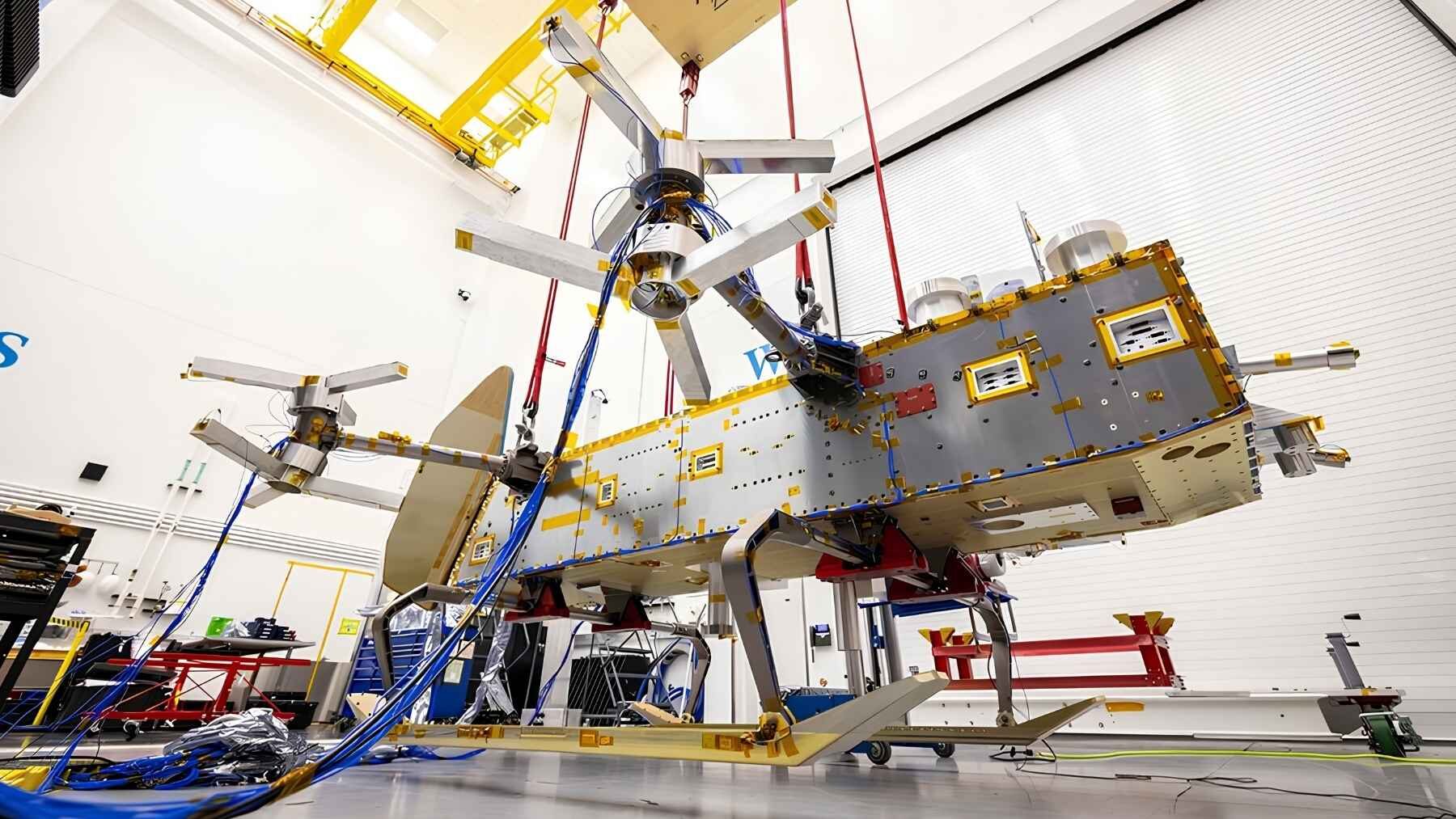
In one of the tests that are being done before the handoff, for example, the team suspended the frame on bungee cords to calculate the impact of the vibrations that would travel through the rotor structure. On another one the integration engineers also pressurized the whole structure in order to find and prevent leaks that could allow Titan’s dense, frigid atmosphere to reach sensitive equipment previously knowing that the Dragonfly will have to operate in temperatures of near minus 290 degrees Fahrenheit. The communication department of NASA said the test results were “extremely good”, painting a promising picture.
Titan makes rotor flight easier
Here such a heavy octopter would need to push enough air downward to hold up its whole weight, which logically makes sense. But Titan’s atmosphere isn’t like ours. There the air is denser, which means that the octocopter rotors have more mass to work with. Add to that the fact that it has a weaker gravity and the force needed to keep the machine to stay aloft is reduced exponentially. There the Dragonfly is going to be helped twice as much, benefiting from the advantages of both sides of the equation.
Still, the previously mentioned 40 times estimate is just an ideal theoretical scenario. NASA has built a special place to test the rotor system in wind tunnels that can mimic key parts of Titan’s unusual atmosphere, but the Dragonfly’s eight rotors and its four coaxial pairs, will have to face real flight interferences, blade drags, motor losses, turns, climbs, winds and control corrections while on Titan’s surface.
Nuclear power does not spin the rotors
The Dragonfly is powered by a monstrous engine called Multi-Mission Radioisotope Thermoelectric Generator, that will turn heat from a naturally decaying plutonium-238 and transform it into a steady supply of electricity. It may sound like a fission reactor but it isn’t, and it will not mechanically drive the blades, so even though it can technically be called nuclear-powered that would be a bit misleading.
Instead, the generator will work differently by recharging the batteries that provide short bursts: high-powered short bursts needed for flight and some specific demanding scientific work. Make an exercise, think of the generator not as an nuclear engine, but a patient charger that will keep the electronics and instruments warm while the Dragonfly travels through Titan’s bitter cold and hazy weak sunlight.
A flying laboratory on an ocean world
The mission is going to be a long 3.3-year surface mission, in which the Dragonfly is planned to travel several miles during each flight while moving through Titan’s wonders. From organically rich equatorial dunes towards Selk Crater. The crater is a point of interest because the impact site might preserve places where liquid water once could have mixed with surface organics, turning it into a promising laboratory for studying habitability and the chemistry that can come before biology!
NASA currently targets the Dragonfly launch to no earlier than July 2028 and its arrival is programmed to happen in late 2034 after a six-year journey. The schedule is open to change, but the clean-room work marks a clear shift from plans to real spacecraft hardware.
The official update was published on NASA.