
Astronomers have spotted an enormous molecular hydrogen cloud surprisingly close to the solar system, and it was hiding in plain sight. The structure, nicknamed Eos, sits about 300 light-years away and is so wide on the sky that it would dominate the night if our eyes could see it.
What’s new is the method that revealed it. Instead of relying on the usual chemical stand-ins, researchers tracked a faint far-ultraviolet glow from molecular hydrogen itself, uncovering a “CO-dark” cloud that older surveys would mostly miss. If one giant cloud can slip through the cracks, how complete are our maps of the Milky Way’s star-forming fuel?
Meet Eos
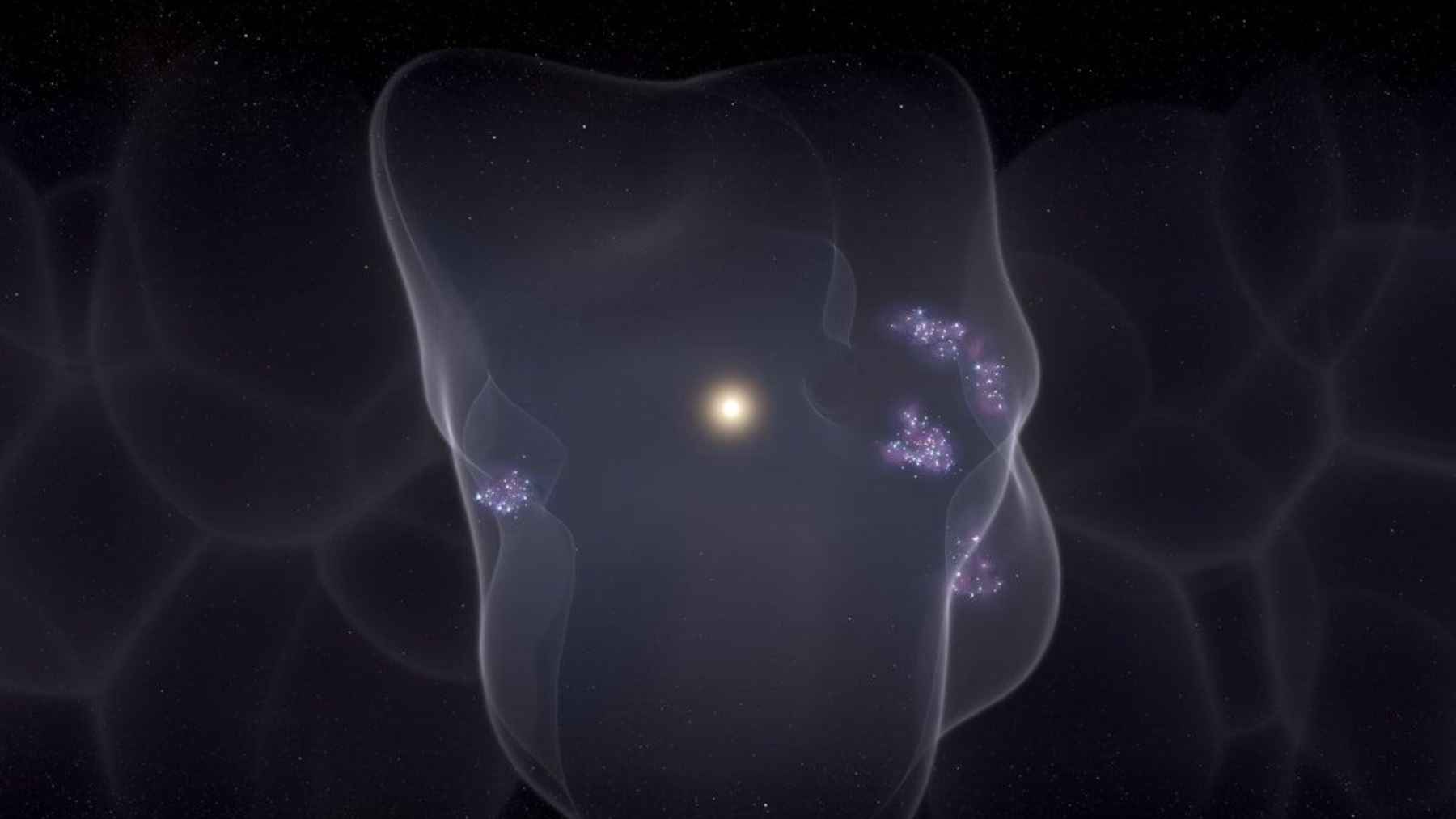
Eos is close in astronomical terms, roughly 300 light-years from Earth (about 1.8 quadrillion miles). The team places it near the surface of the Local Bubble, a cavity in the interstellar medium that the solar system currently occupies. Researchers also note it poses no risk to Earth, it is simply part of the thin material between stars.
Its size is what grabs attention. Scientists estimate Eos spans about 40 full moons across the sky, which works out to roughly 20 degrees, about two fists held at arm’s length. The cloud’s mass is estimated at about 3,400 times the mass of the Sun, a huge reservoir for a structure that went undetected for so long.
The cloud that CO could not find
Most molecular clouds are discovered with a useful shortcut. Astronomers look for carbon monoxide because it is easier to detect at radio and infrared wavelengths and often traces where molecular hydrogen is concentrated. Molecular hydrogen itself is tricky because it is faint in the cold interiors of many clouds, so CO has become the workhorse.
Eos breaks that assumption. In the Nature Astronomy analysis, CO maps pick up only a small CO-bright pocket, equivalent to roughly 20 to 40 solar masses of molecular hydrogen, while the cloud’s total molecular mass is estimated around 3.4 × 10^3 solar masses. In practical terms, the usual tracer highlights well under 1 percent of what is actually there.
A far-ultraviolet “blacklight”
So how do you spot a cloud that barely shows CO at all? The team used far-ultraviolet fluorescence, a process where molecular hydrogen absorbs far-ultraviolet photons and re-emits a faint glow that can be detected in sensitive surveys. It mostly lights up at cloud boundaries and interfaces, which is exactly where a cloud meets the harsher radiation field of its surroundings.
The key data came from the Far-Ultraviolet Imaging Spectrograph (FIMS), also known as SPEAR, flown on South Korea’s STSAT-1 satellite. The instrument operated from late 2003 to mid 2005, but the dataset only became publicly available in 2023, which helped make this discovery possible. Lead author Blakesley Burkhart described the archive as “kind of like just waiting to be explored.”
Burkhart also underscored why Eos is a milestone. “This is the first-ever molecular cloud discovered by looking for far ultraviolet emission of molecular hydrogen directly,” she said, adding that “this cloud is literally glowing in the dark.” It’s a small shift in approach, but it opens a bigger door for finding more “invisible” material nearby.
Why its neighborhood matters
Eos is not just a blob of gas, it is part of a very specific local setting. The Nature Astronomy paper says the distance estimate draws on multiple lines of evidence, including three-dimensional dust maps and how the cloud absorbs the soft X-ray background, placing it consistent with the Local Bubble’s surface.
Its edge is also outlined along the high-latitude side of the North Polar Spur, a prominent X-ray and radio feature linked to energetic events in our galactic neighborhood.
That environment may also explain why Eos is temporary. By the authors’ models, ultraviolet light that makes the hydrogen fluoresce will also gradually break apart molecular hydrogen, and they predict the cloud will photoevaporate in about 5.7 million years. That’s fast by cosmic standards, and it turns Eos into a time-limited laboratory for studying how clouds form, erode, and sometimes kick off star formation.
What Eos hints about hidden star-forming fuel
For years, interstellar theory has suggested that galaxies could host substantial amounts of molecular gas that are “dark” to common tracers like CO. Eos is a nearby, measurable example of that idea, and it suggests our census of star-forming material may be incomplete even close to home. That matters because molecular gas estimates feed directly into how we calculate star formation efficiency across the Milky Way.
Co-first author Thavisha Dharmawardena put the broader implication in simple terms. “The use of the far ultraviolet fluorescence emission technique could rewrite our understanding of the interstellar medium,” she said, because it can uncover hidden clouds across the galaxy and potentially much farther. It’s a claim worth testing, and Eos gives astronomers a strong reason to try.
A discovery that feels close
You won’t see Eos through binoculars, or even through most amateur telescopes, because its signal is in far-ultraviolet light that Earth’s atmosphere blocks.
Still, it changes how we think about the space around us, not as empty darkness, but as a dynamic environment where gas is constantly being assembled and pulled apart. The interstellar medium is messy, and that mess is where new worlds eventually come from.
There’s also something quietly humbling about it. A cloud large enough to span 40 full moons can sit just 300 light-years away and stay largely hidden until someone looks with a new “filter.”
The study was published on Nature Astronomy.