Scientists have created an organic crystal that converts lower-energy visible light into higher-energy ultraviolet light at an intensity comparable to sunlight. The solid material reached a 1.9% conversion yield, a notable result for a process that has usually worked best in liquids or under much stronger light.
Why does that matter? Ultraviolet light drives reactions used in hydrogen production, pollution control, chemical manufacturing, and resin curing, but only a small slice of sunlight provides the useful UV energy many catalysts need. A material that reshapes the solar spectrum could help future systems use more of the light already falling on them, although this experiment is still far from a commercial device.
A sunlight-level result
Naoyuki Harada, Hayato Shoyama, and Nutnicha Boonmong contributed equally to the research, which grew from a program Nobuo Kimizuka began in 2012. The work was based at Kyushu University, with computational collaborators at the Institute for Molecular Science.
The best-performing crystal produced roughly two ultraviolet photons for every 100 visible photons it absorbed. Its activation threshold was slightly below the sunlight intensity available in the narrow blue band used for the test, and the paper reports the yield as the highest yet for a solid visible-to-UV system operating at such low intensity.
How the crystal upgrades light
How can two weaker packets of light create one stronger packet? The process is called photon upconversion, and it gathers energy from multiple visible-light photons before releasing a single photon with enough energy to fall in the ultraviolet range.
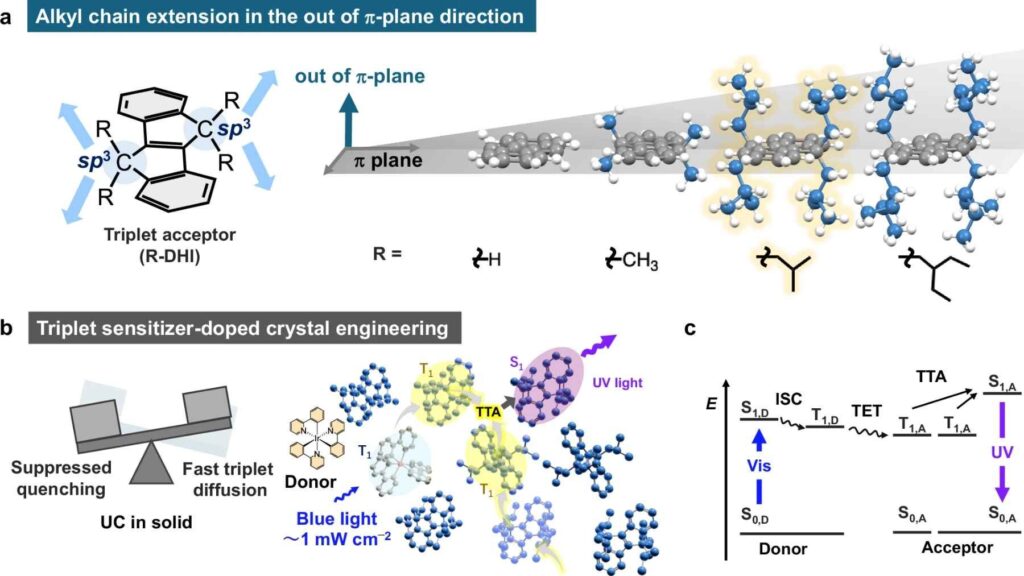
Corresponding author Yoichi Sasaki put it simply, saying, “What we do here is ‘add together’ the energy from two visible light photons to make one ultraviolet photon.” In the mechanism used here, a donor molecule absorbs light, passes the stored energy to nearby acceptor molecules, and two excited states eventually combine to trigger UV emission.
The problem with solid materials
That energy handoff is easier in a liquid, where molecules can move around and encounter one another. In a crystal, the molecules are largely fixed, so the energy itself must travel through the packed structure before it fades away as heat or other losses.
The molecules also need just the right amount of contact. Think of people in a crowded hallway. Pack them too tightly and movement stalls, but spread them too far apart and they cannot pass a message efficiently.
Molecular spacing made the difference
Instead of inventing an entirely new light-emitting core, the researchers modified a molecule called dihydroindenoindene. They attached alkyl chains, which are small hydrocarbon arms, above and below the molecule’s central plane to create controlled gaps between neighboring units.
The best version, called iBu-DHI, kept the molecules close enough for rapid energy transfer without letting their electron clouds overlap too strongly. Its solid-state fluorescence yield reached about 69 to 83%, while its longer-lived excited states gave the energy more time to find a partner before disappearing.
The manufacturing method mattered too. A slowly dried, drop-cast film needed even less light to switch on than a faster spin-coated film, suggesting that orderly crystal growth may be just as important as the chemical recipe.
Why green hydrogen is part of the story
Green hydrogen is hydrogen made with little or no fossil-fuel emissions, often by splitting water with renewable energy. Many photocatalysts that can help split water respond mainly to ultraviolet light, so a coating that converts visible sunlight into UV could feed them energy they would otherwise miss.
The new study did not produce hydrogen itself, which is an important distinction. Still, a related 2025 water-splitting experiment used photon upconversion to drive a UV-active catalyst, doubling hydrogen output under one blue-light setting and tripling it under another compared with controls.
Uses beyond hydrogen
Ultraviolet light is also used to break down airborne pollutants and organic contaminants in water. A light-converting layer could let purification systems tap visible sunlight before turning to a specialized UV lamp, potentially reducing electricity use and the electric bill that comes with continuous operation.
The same basic chemistry appears in resin curing for some 3D printers, dental fillings, and gel nail products. Chemical manufacturers also use UV to start selected reactions, so the crystal’s broader value may lie in delivering high-energy light exactly where a process needs it.
A more practical kind of material
A finished solid film does not depend on a liquid working medium that can leak or evaporate, although the test films were made from a solvent during coating. The dense crystal also continued producing upconverted light in air, a useful sign because oxygen usually shuts down these excited states.
There is another nuance. The headline 1.9% result used an iridium-based donor, but the team also observed the effect with metal-free sensitizers. Those versions may eventually reduce reliance on a costly metal, though the paper says deeper performance studies are still to come.
What still stands in the way
This is a proof of principle, not a ready-made solar hydrogen panel. A 1.9% yield is scientifically meaningful for this low-light solid system, yet commercial equipment would need higher output, predictable manufacturing, and long service life under changing outdoor conditions.
Crystal growth is a major hurdle because small changes in grain size, boundaries, and molecular mixing can alter performance. A 2023 solid-film study reported more than 100 hours of stability in air with a different design, showing both that durability is possible and that the field still needs careful comparisons.
For now, the main advance is a design rule. By treating molecular spacing like crowd control, scientists may be able to build a wider family of solids that move light energy efficiently instead of losing it.
The full study was published in the journal Nature Communications.