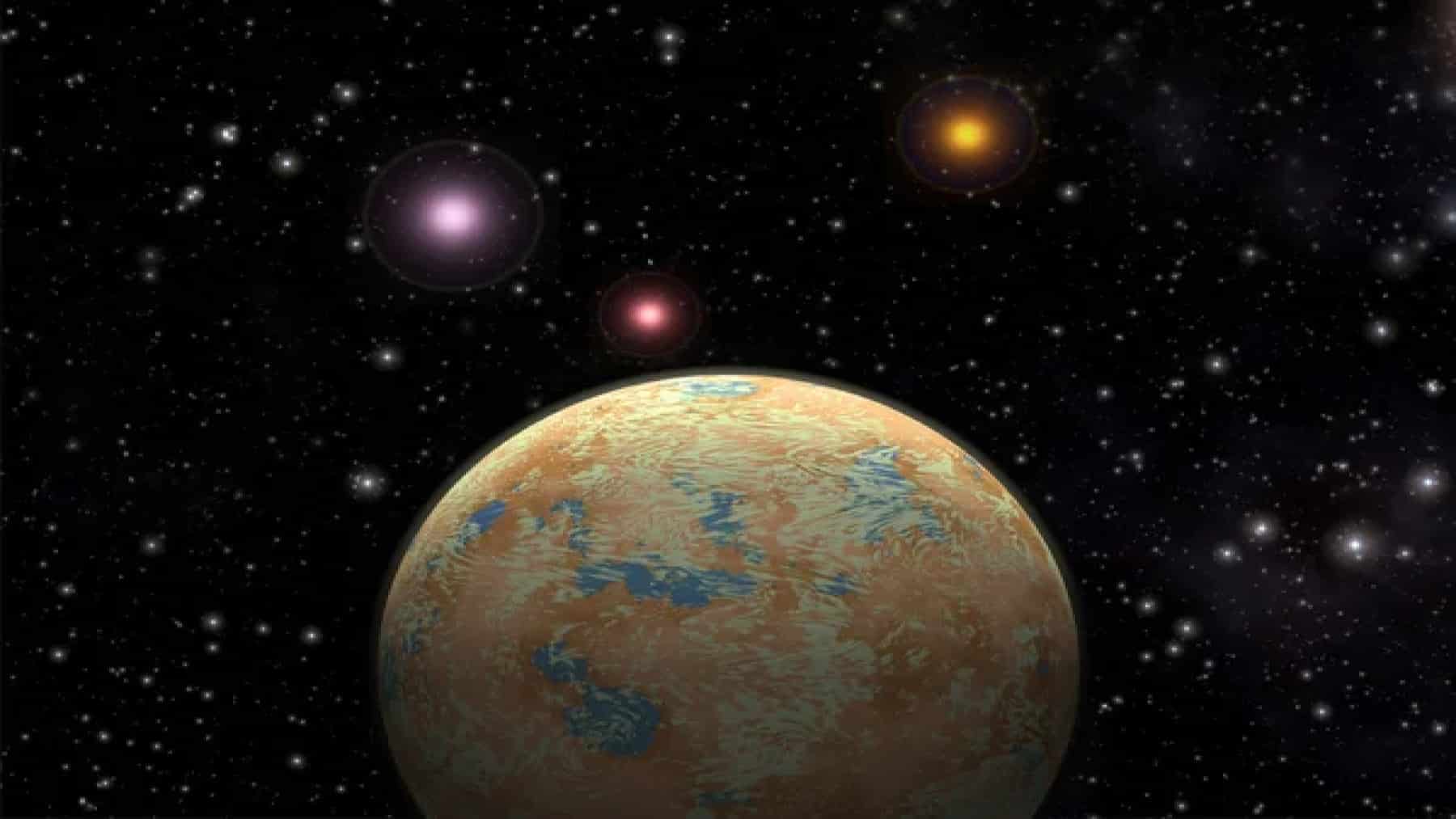
A new type of exoplanet has been discovered: Enaiposha, also known as GJ 1214 b. Long heralded as a mini-Neptune, new observations have indicated that it is a member of a category never seen before and is now officially being called a “Super-Venus.” Enaiposha orbits a red dwarf star 47 light years away from our own Earth, upending previous theories of how planets are formed and structured and giving scientists a tempting window into the otherworldly diversity of planets beyond our Solar System.
Enaiposha: A new exoplanet is revealed
Enaiposha, discovered in 2009, has piqued scientists’ curiosity because of its size and the properties of its atmosphere. The exoplanet has a radius around 2.7 times and a mass about 8.2 times greater than Earth. This places it between Earth and Neptune in a size range that typically divides exoplanets into two different classes: super-Earths and mini-Neptunes. Super-Earths are rocky planets larger than Earth with thin, hydrogen-rich atmospheres. Meanwhile, mini-Neptunes are planets with thick hydrogen and helium atmospheres and likely hide ocean oceans under their gas.
Since most exoplanets of this mass are mini-Neptunes, Enaiposha’s unique atmospheric composition is fascinating. Unlike most mini-Neptunes, Enaiposha seems to have an atmosphere dominated by carbon dioxide, like Venus’s, except on a much larger scale.
The James Webb Space Telescope (JWST) observations had shown faint traces of CO2 and dense aerosols in its upper atmosphere. The presence of vaporized metals and minimal hydrogen indicates an entirely different evolutionary pathway than was previously recognized.
Enaiposha’s carbon and metal-laden atmosphere
The ambiance of Enaiposha presents unique challenges to researchers. Its thick, aerosol-dense haze blocks direct sight of its surface or the layers below its upper atmosphere. However, as it sped along its blisteringly short, 1.6-day orbit around its burning-hot host star, the light from the star passing through GJ 1214 b’s atmosphere revealed key details.
The starlight, modified by interactions with carbon dioxide, provided researchers with crucial insights about Enaiposha’s composition. The results suggest a world draped in a metal-rich atmosphere at lower elevations while carbon dioxide reigns in higher strata.
These features are not seen in any previously identified exoplanet (just like this exoplanet, which is unlike anything seen before) of this size and indicate Enaiposha may have been formed differently from standard models of planetary development.
Everett Schlawin of the University of Arizona and Kazumasa Ohno of the National Astronomical Observatory of Japan who led the research, stressed the need for ongoing observation to confirm these results, as the weak CO2 signal required sophisticated statistical analysis. Models of planetary development offered further support for the hypothesis, suggesting a planet entirely different from the mini-Neptunes that dominate that size range.
James Webb Space Telescope and future detection of ‘Super-Venus’
Enaiposha’s discovery as a possible ‘Super-Venus’ redefines how researchers analyze exoplanets in this categorical archetype. Due to its closeness to its host star, Enaiposha is too hot to support life, however it’s features may help explain how similar exoplanets evolve atmospherically.
The atmosphere, which is extremely hot and rich in carbon dioxide, provides interesting comparisons to Venus, a planet found close to Earth. By examining Enaiposha, astronomers could gain better insight into the conditions that formed Venus’s unwelcoming atmosphere and, in turn, understand more about the range of planetary atmospheres found throughout the galaxy.
This finding also highlights the need for highly refined tools, such as JWST, to unlock the secrets of distant worlds. As researchers continue to improve their observational methods, the possibility to spot more so-called ‘Super-Venus’ exoplanets paves the way for determining if Enaiposha is an outlier or the first in a legion of such planets.
This re-classification of Enaiposha as a ‘Super-Venus’ is a real breakthrough for exo-planetary science. Its carbon dioxide and aerosol-laden atmosphere developed challenged theories, and its extreme lack of hydrogen expands our understanding of the diversity of planets (just like this strange object in our Solar System). While additional observations are needed to confirm its distinctive qualities, Enaiposha helps illustrate how little we truly know about the universe.