The cosmos never ceases to amaze, and the atmospheric origin of the exoplanet GJ 1214 b is revealed thanks to NASA’s James Webb Space Telescope (JWST). These results challenge previous conceptions and change our perception of this mysterious class of planets.
Decoding Exoplanet GJ 1214 b: Sub-Neptune secrets uncovered
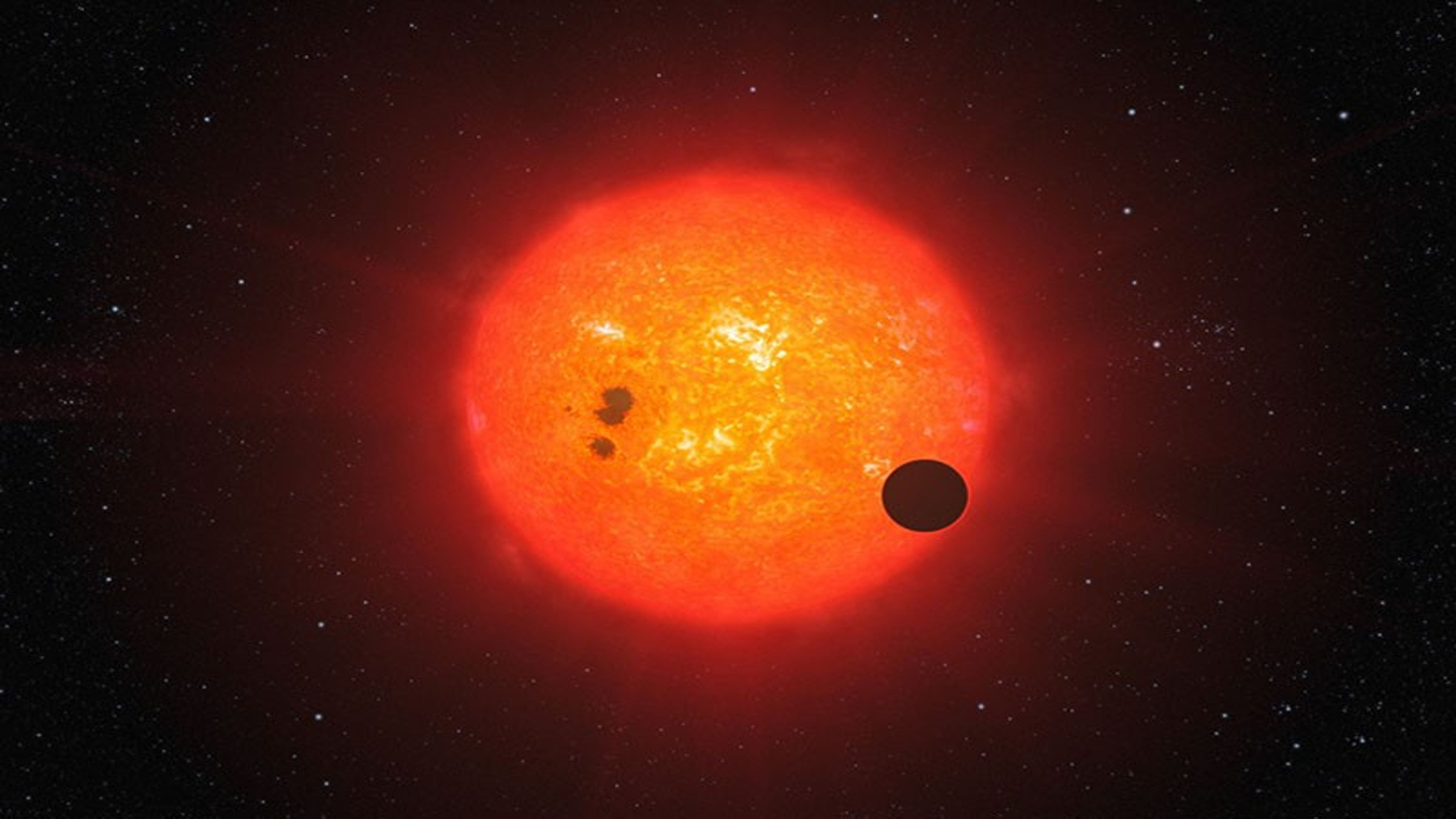
The exoplanet GJ 1214 b was a puzzle for more than a decade because its dense, reflective cloud covering made previous observations ambiguous. Detected at 48 light years away in the direction of the constellation Ophiuchus, the planet, in terms of size, is located between Earth and Neptune.
That is why it is a “sub-Neptune”, a class of exoplanet that does not occur in our Solar System. To reveal its secrets, researchers used the Mid-Infrared Instrument (MIRI) on the JWST and followed the orbit of GJ 1214 b around its host star.
This approach allowed them to create a detailed heat map, capturing the planet’s day and night phases in infrared radiation. The heat map revealed surprising results. The atmosphere of the planet does reflect a considerable amount of light from its host star thereby maintaining a slightly lower temperature than what would be reached by a thermodynamic equilibrium.
There is a significant difference in the temperature both during the day and night. The atmospheric composition, composed mostly of heavier species, for example, water and methane, strongly suggests that it is hydrous genesis. This finding is a turning point in sub-Neptune’s science, which can give us insights into their formation and evolution (just like the strange object which was spotted moving at 1 million miles per hour).
JWST’s role in the decryption of Sub-Neptune’s: A comprehensive study into GJ 1214 b
Sub-Neptune’s are the most prevalent class of planetary bodies in the galaxy, but they are still a mystery. These planets, larger than Earth, but smaller than Neptune, may stand for a wide variety of planets, ranging from mini-Neptune’s with dense gaseous envelopes to super-Earths with solid cores.
The information obtained from GJ 1214 b’s data is crucial to this class of planets. Atmospheric hydrogen is absent at significant levels on the planet, not a prediction of homologous hydrogen, rich envelopes that prevailed in the past.
On the other hand, the presence of water and methane provide evidence of a more compact, over-saturated atmosphere. It speaks to long-running controversies in the literature over whether sub-Neptune’s are icy or gaseous planets.
Speculations exist that GJ 1214 b could be a “water world,” a planet circled by vast oceans or a dense and heavily water-saturated atmosphere. The capability of JWST for light detection of thermal emission and albedo measurements (the ratio of reflected light) has established a new baseline for exo-planetary studies.
Observations by GJ 1214 b are the first step in spectral over a sub-Neptune’s phase curve analysis that discloses, in addition to the thermal structure, atmospheric composition. This finding highlights the role of sophisticated technologies for solving cosmic riddles.
Exoplanet models reveal a CO2 comparison of atmospheric composition comparable to Venus
A remarkable result is the comparison of the atmospheric composition of GJ 1214 b with Venus, comparable amounts of carbon dioxide. This begs the question of whether the Earth looks more like a “super-Venus” instead of a water planet.
Venus, which has a thick CO2 atmosphere, can be used as an analogue for studying the greenhouse effect and evolutionary trajectories of exoplanets. Kazumasa Ohno at the National Astronomical Observatory of Japan built large models, to run a range of scenarios, for the purpose of simulating a range of atmospheric conditions.
Every scenario suggested a carbon-rich global atmosphere, highlighting the richness and variability of sub-Neptune planets. Everett Schlawin, at University of Arizona, likened the task to the hunt for a single adulterated sentence in Tolstoy’s “War and Peace”, noting the painstaking process in which to decode weak signals from distant realities.
The latest results of the GJ 1214 b test challenge our understanding of planetary formation as well as composition, providing a view of a variety of exoplanets in our galactic neighborhood. In revealing a more hydrated, gaseous atmosphere with distinctive thermal characteristics, this study closes the gaps of understanding of sub-Neptune’s. As scientists uncover more of these mysterious realms (such as these strange twin oceans), they reveal new avenues of investigation into the unexplored corners of our cosmos.