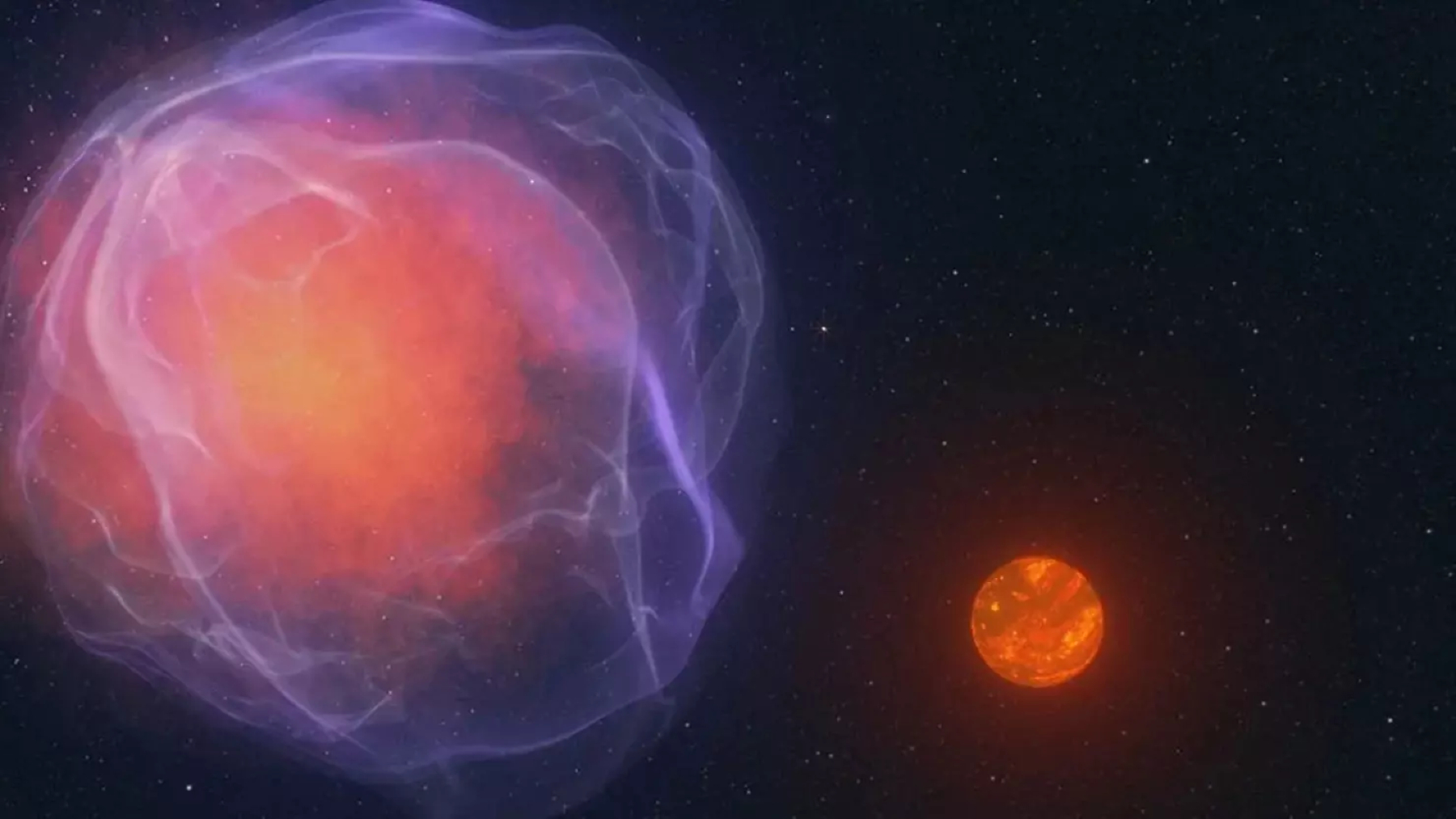
One of the most stunning examples of a mysterious object in our known universe is CWISE J1249. It streaks through space at a speed of 1.6 million km/h or is 400 light-years away from the Earth. This exceedingly strange object weighs 30,000 times that of Earth and has 8% of the mass of the sun. A question many have asked is about the trajectory of such a truly intergalactic object.
The Nightwatch: Placing a working ‘infrared’ chip for the collection of photometry of bright stars
The genesis of CWISE J1249 story starts in a Nasa citizen science initiative called Backyard Worlds: Planet 9. It asks the public to interpret small portions of images from the Wide-field Infrared Explorer (WISE) and NEOWISE missions.
A trio of volunteer contributors, Martin Kabatnik, Thomas P. Bickle, and Dan Caselden, made the faint find of something seemingly very fast-moving. Published in The Astrophysical Journal Letters, it provides again the striking evidence that science, done by citizens in collaboration, can be famous.
“I am just overwhelmed,” said Kabatnik. “I first saw how quickly this event was happening and somehow convinced myself that it had been announced before.” The ground-based telescopes later also confirmed the object and then its unique composition and high speed-it moves with extraordinary rapidity-acquired greater elegance. It also brings out the role that citizens play in opening mysteries in the universe (just like this one which 85% of the universe has never seen).
Is CWISE J1249 a low-mass star or possibly a Brown Dwarf: A puzzling revelation?
The characteristics of CWISEJ 1249 significantly distinguish it from the conventional objects of the astronomical community. Either it is a low-mass star or a brown dwarf. A brown dwarf is a celestial body that exceeds the mass of the planet but does not possess enough mass for continuous nuclear fusion.
With over 4,000 brown dwarfs discovered by the Backyard Worlds project, this does not coincide with the observed extraordinary velocity of J1249. Another fascinating issue is that of its composition. Hawaii’s W. M. Keck Observatory has found that it is very much less than iron and all other metals as compared with stars and brown dwarfs.
This suggests that it may belong to the first generation of stars of our galaxy, which would make it an ancient relic from the early cosmos. Theories on how J1249 got this rapid speed: How is it that CWISE J1249 can achieve such fast speed? For the moment, two theories have been put forward by scientists:
- The White Dwarf: This might have been previously in a binary system with a white dwarf, but the white dwarf became end of gaining material and exploded into supernova. It instantly shot the J1249 into unimaginable speed.
- Absorption by Black Holes: Another possibility is that the object was born in densely packed globular star clusters. An unplanned interaction between black holes may cause a gravitational slingshot effect that would fling J1249 from the cluster pasture and then into the expanse of space.
“When a star is captured in a black hole binary, this complex dance of three-body dynamics can eject this star right out of the globular cluster,” explained Kyle Kremer, an astrophysics professor at UC San Diego.
Scientific craze in investigating the mystery of CWISE J1249
There is a fever among the scientific community to discover more about CWISE J1249. From learning about its elemental content and its journey, searches should determine whether it assembled in a binary system or in a star cluster.
Moreover, by merely utilizing voluntary efforts between amateurs, professionals, or students, cosmic enigmas could be solved. The travel of J1249, the restless wanderer, poses more problems than what it can possibly solve; a tantalizing glimpse of the magnitude and turbulent forces shaping the lucky galaxy.
There is yet to be understood, in the sureties that come from bygone roots and unusual speed, why the celestial enigma invites questions about the extensive world of mysteries. Perhaps one lesson to take from this is that rather all-encompassing research published by well-loved persons from across the globe augmented is the fact of the matter that such discovery is never possible (just like this which is growing in the Sahara).