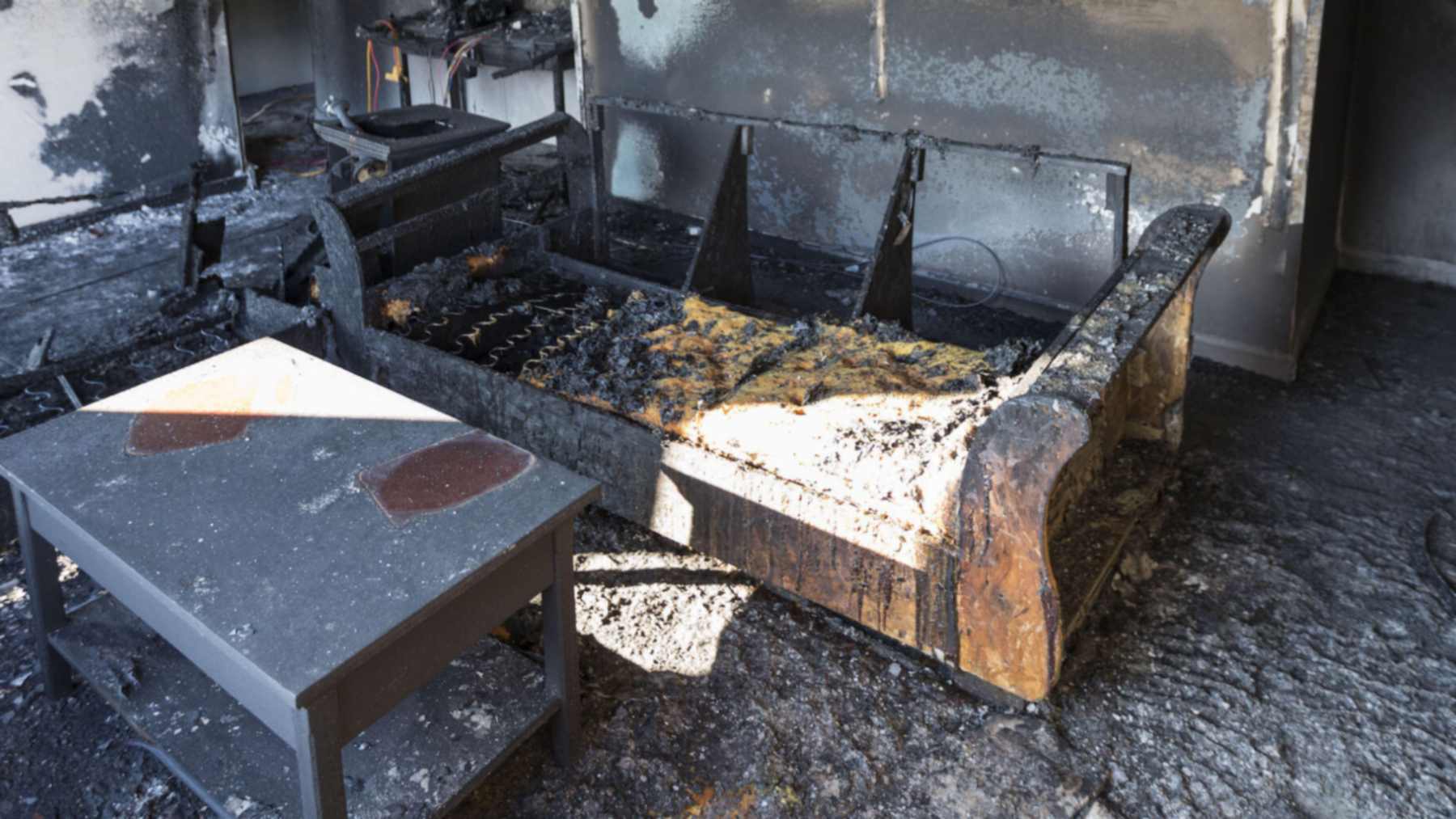
Steve Kerber’s advice for bedtime fits in one line. “Sleep with the bedroom door closed,” says Kerber, vice president and executive director of the Fire Safety Research Institute, part of UL Research Institutes. “If there is a fire, there is no time to act.”
His researchers began testing how doors and windows change a house fire in 2008. Thermal cameras watched bedrooms on the first and second floors as the fire spread. Rooms with the door shut stayed below 100°F on average, the institute says, while rooms with the door open went past 1,000°F.
“You could see a markable difference that a person could be alive in a room with a closed door much longer,” Kerber said.
Online, the same habit is getting a different kind of attention. On Sept. 17, Argentina’s La Nación ran a piece credited to Colombia’s El Tiempo under the headline “Los expertos en psicología coinciden: quienes duermen con la puerta cerrada son personas seguras,” which means psychology experts agree that people who sleep with the door closed are secure people. It names none of those experts and cites no study.
What the psychology study measured
One study that does look at bedrooms is a 2010 paper in Evolutionary Psychology by Matthias Spörrle and Jennifer Stich of the University of Munich. They gave 138 volunteers, aged 14 to 73, floor plans of a bedroom and asked them to place the furniture.
Of the participants, 83% put the bed where they could see the door, and 70% put it as far from the door as the room allowed. The authors read that as an evolved preference for a safe place to sleep.
The volunteers imagined the rooms rather than furnishing real ones, the authors note, and the plans were two-dimensional. Nobody was asked whether they close their door at night. Confidence, independence and emotional security were not measured.
Smoke, oxygen and children’s rooms
The gases differed too. Carbon monoxide reached about 10,000 parts per million in the open-door bedroom and about 100 in the closed one, according to the institute.
“We started to see that the furnishings, open layout, and construction allow the fire to spread and become more toxic much faster,” Kerber said. Opening a window to let smoke out can make things worse, he added. “You’re letting the smoke out, but you’re letting the air in, and that’s where the problem occurs.”
He has a specific warning for parents. “If you close their door before you go to bed, if you’ve already put that safety barrier in place, then you know your children have longer to survive,” he said.
The National Fire Protection Association’s Fire Prevention Week runs Oct. 4 to 10, and this year’s campaign is about charging lithium-ion batteries safely.
The other thing a closed door changes
A closed door also traps the air people breathe out. Pawel Wargocki, a professor at the Technical University of Denmark, has spent years measuring what that does to sleep. His team tracked more than 100 households while they slept with windows and doors open or closed.
“It has previously only been sparsely documented that bedroom air quality can affect your sleep. Our study has now clearly proven that it can,” Wargocki said. An open window improved sleep and next-day test scores. Opening only the door had no measurable effect.
“When you sleep with the door open, air from elsewhere in the home mixes with the air in the bedroom, which dilutes air pollution in the bedroom, but it isn’t necessarily clean air that comes from the other rooms in the home,” he explained.
A 2025 paper by Wargocki and colleagues in Science and Technology for the Built Environment concluded that carbon dioxide from sleeping occupants “should, as a minimum, remain below 1,000 ppm, and preferably below 800 ppm,” and that bedroom outdoor air supply should be at least doubled compared with current standards. The authors use carbon dioxide as a marker of ventilation and say further research is needed.
Quiet, cool, dark and safe
“Keep your bedroom quiet, cool, and dark,” advises the National Heart, Lung, and Blood Institute. A closed door helps with the first and the last, and fits easily into a predictable bedtime routine.
For air, Wargocki’s advice depends on where you live. “An open window is recommended when air pollution is low and if there is no ventilation system in the home. Otherwise, the best solution is mechanical ventilation,” he said. In Shanghai, his team found that an open window let in harmful particles from outdoor air pollution during the night.
Kerber sums up the fire advice this way. “If Stop, Drop & Roll is for when your clothes are on fire, ‘Close Your Door’ is for when your house is on fire and you cannot get out,” he said.
Photo: UL Research Institutes’ Fire Safety Research Institute