Warm, salty water from the Atlantic has been pushing farther into the Arctic through the Barents Sea for decades, a process scientists call atlantification. A new study argues the missing clue is not simply stronger winds, but a change in the pace of the atmosphere itself.
Researchers report that when low-pressure systems over the Nordic Seas shift their typical rhythm, the ocean responds in a surprisingly sensitive way. Over time, that shift can help more Atlantic water enter the Barents Sea, with knock-on effects for sea ice and marine life.
Atlantification in plain words
Atlantification is what happens when parts of the Arctic start behaving more like the Atlantic Ocean. In practical terms, warmer and saltier water moves north, making it harder for sea ice to form and easier for existing ice to melt.
Read More: {{post_title link:post}}
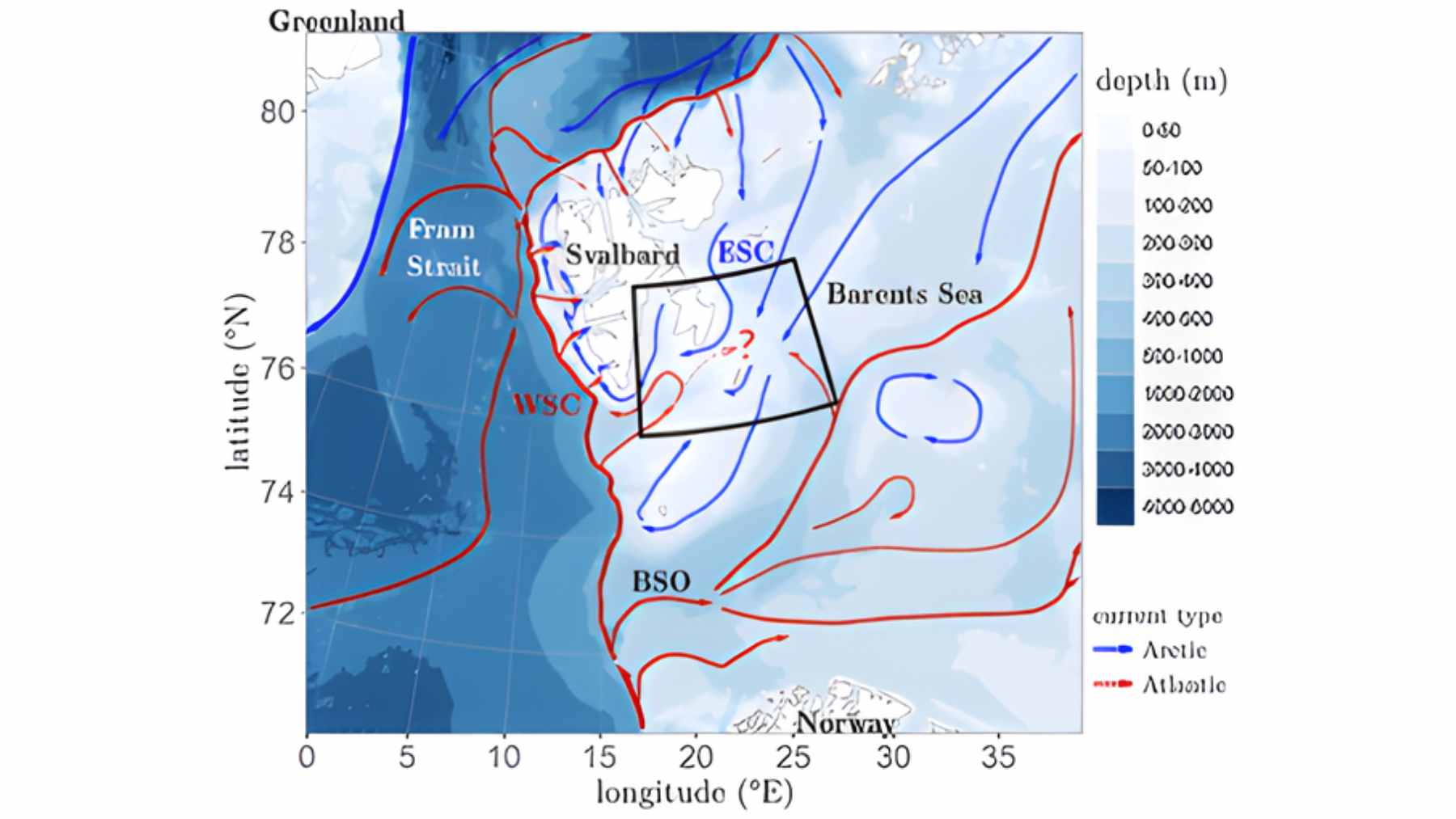
The Barents Sea is a hotspot because it sits on a main route into the Arctic, between mainland Norway and Bear Island. If that gateway lets in more heat, it is a bit like leaving a refrigerator door cracked open for longer than usual.
A long-running mystery at a narrow gateway
Oceanographers have tracked a steady rise in Atlantic water moving through the Barents Sea Opening over roughly the last 40 years. Yet many earlier explanations, including changes in average wind patterns, struggled to explain why the trend stayed positive.
The new work, led by Robinson Hordoir with Vahidreza Jahanmard, Pål Erik Isachsen, Ulrike Löptien, Heiner Dietze, Anne Britt Sandø, and Vidar S Lien, lays out a different mechanism in a new peer-reviewed study.
The collaboration includes the Institute of Marine Research in Bergen, plus partners at Tallinn University of Technology, the University of Oslo, the Norwegian Meteorological Institute, the University of Kiel, and King’s College London.
The weather’s cadence shows up in ocean data
Instead of focusing only on whether winds got stronger, the researchers asked a different question. Did the atmosphere’s short-term variability, the regular march of storm systems that bring those gray, windy days, change in a way the ocean can “hear”?
Using the ERA5 reanalysis, a widely used weather reconstruction built from observations and models, they measured how pressure patterns over the Nordic Seas shifted from 1980 to 2021.
They report a characteristic timescale of about six days that lengthened by as much as 12 hours, which points to slower swings in day-to-day weather.
Deep learning helps test cause and effect
To test whether that timing shift could drive the ocean trend, the team combined a regional ocean model with deep learning, a type of artificial intelligence that can spot patterns in huge datasets.
In one experiment, they swapped the faster-changing parts of the atmospheric signal between earlier decades and recent decades, and the predicted Barents Sea flow shifted with it.
In a January 12, 2026, news release, the lead researcher put it plainly, saying, “It’s about frequencies.” That is the heart of the argument. He also noted that it is “not about wind strength” but about how often low-pressure systems pass over the Nordic Seas.
Seafloor waves that can leave a lasting current
So what does storm timing have to do with ocean currents? The study points to topographic Rossby waves, which are slow waves that travel along underwater slopes and get guided by the shape of the seafloor.
Read More: {{post_title link:post}}
These waves can move energy long distances, but the authors argue the most important part is what is left behind. Under some conditions, the back-and-forth motion can create a small leftover current that nudges the mean circulation in a particular direction.
What the numbers look like in everyday units
In ocean science, transport is often reported in Sverdrups, where one Sverdrup equals about 35 million cubic feet of water per second. In their regional simulations, the depth-averaged flow toward the Arctic through a key section increased by about 0.014 Sverdrups each year from 1980 to 2021, which is roughly 500,000 cubic feet per second of added flow per year.
The paper also finds the trend is dominated by the northern part of the opening, where an outflow from the Barents Sea toward the Nordic Seas weakened over time. If less water is escaping that way, more Atlantic inflow can remain in the Barents Sea and keep moving toward the Arctic interior.
Why this matters for sea ice and ecosystems
This mechanism fits with other research showing that details of circulation can shape winter sea ice. A 2025 paper on Atlantic water recirculation and winter sea-ice extent highlights how changes in a “return flow” can influence how much warm water reaches the ice edge.
Read More: {{post_title link:post}}
For the broader picture, a 2021 review on the physical and ecological impacts of Arctic atlantification describes how shifts in heat and salt can ripple through ecosystems, from plankton to fish. It matters, because sea ice helps set the stage for everything from habitat to the weather patterns that reach farther south.
What scientists still want to nail down
The authors also flag limits to what they have shown so far. Their key trend is in the depth-averaged part of the flow, but real currents also depend on layering of water with different temperatures and salinities.
They made their supporting code and data public through a Zenodo archive, which should help other groups test the idea in different models. Another open question is how this storm timing link interacts with cyclones, an area explored in a 2023 study on cyclones and Barents Sea transports.
The main study has been published in Nature Climate Change.